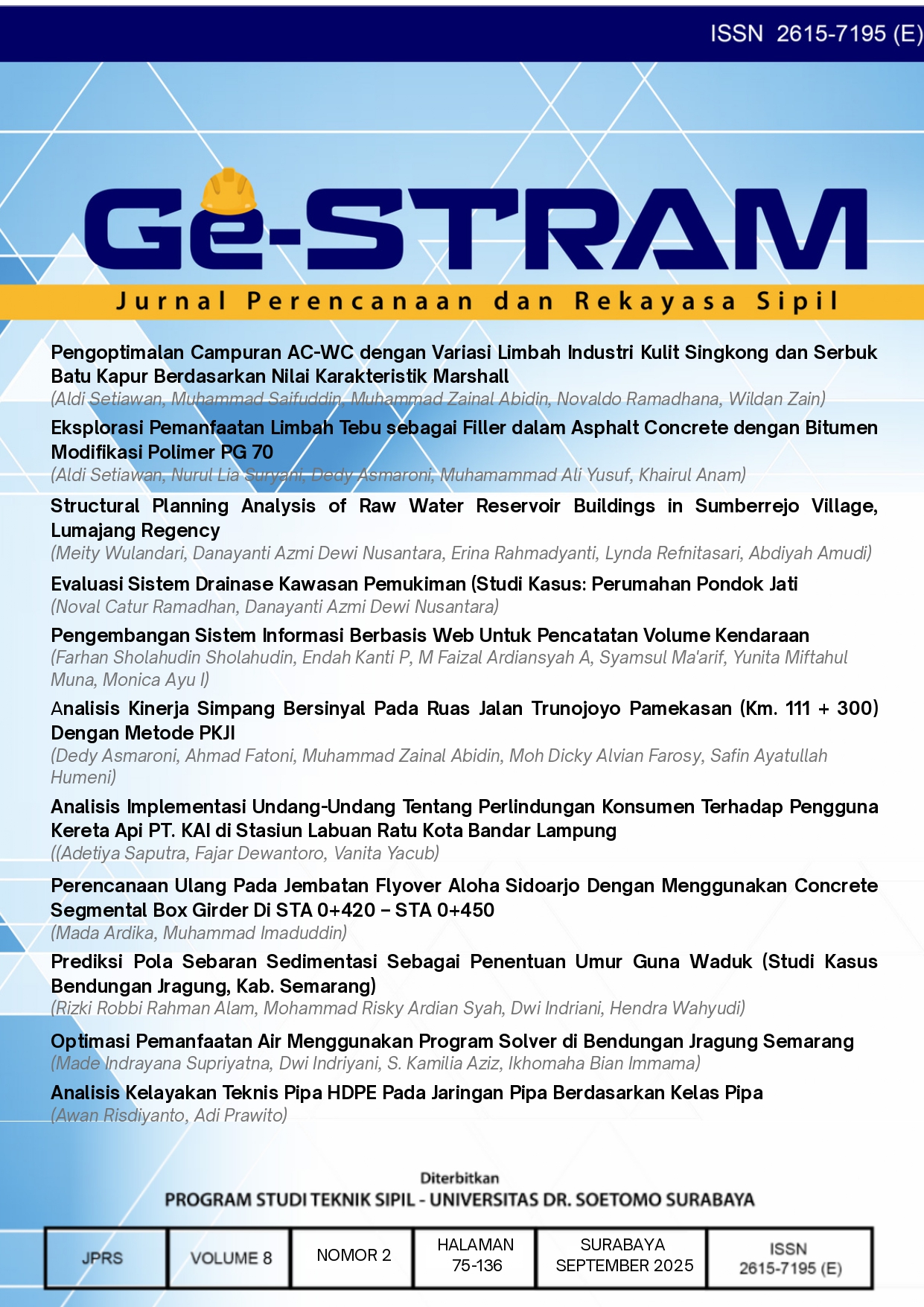
Pengoptimalan Campuran AC-WC dengan Variasi Limbah Industri Kulit Singkong dan Serbuk Batu Kapur Berdasarkan Nilai Karakteristik Marshall
DOI:
https://doi.org/10.25139/jprs.v8i2.10050Keywords:
cassava, limestone, fillerAbstract
The materials used in hot mix asphalt are natural materials that are non-renewable, one of which is filler. Therefore, innovation is needed to utilize waste and local materials that are more economical. This study utilizes cassava peel waste and limestone powder as fillers, as well as local crushed stone as aggregates, considering the potential of local materials and their lower economic value. So far, these wastes have been underutilized and have an environmental impact. The research aims to determine the effect of using cassava peel and limestone powder as fillers on the Marshall characteristics, using the Marshall Test method to measure the Marshall characteristic values, including stability, flow, VIM, VMA, VFB, and Marshall Quotient (MQ). The fillers used in this study were 1%, 2%, 3%, 4%, and 5% of the total mixture weight, with each filler composition consisting of 10% cassava peel and 90% limestone powder, based on the total filler weight, along with the use of local aggregates. From the testing results of AC-WC using local materials with variations in the mixture of both types of fillers (limestone and cassava peel), there were two mixtures that met the General Specifications of Bina Marga 2018 Revision 2 for Marshall characteristics: the 3% filler mixture with 5.8% asphalt variation, and the 4% filler mixture with 5.4% asphalt variation.
References
Kementrian Pekerjaan Umum dan Perumahan Rakyat Direktorat Jenderal Bina Marga. (2018). “Spesifikasi Umum 2018 Untuk Pekerjaan Konstruksi Jalan dan Jembatan (Revisi 2), Direktorat Jenderal Bina Marga, Jakarta.
Mukhlis, Lusyana, Enita S, Denisa RS, Alyza S. 2023. “Marshall Characteristics Of Asphalt Concrete - Wearing Course (AC – WC) With Substitution Of Silica Sand As Fine Aggregateâ€. Fondasi : Jurnal Teknik Sipil, Vol 12, No 2, Oktober 2023, Hal 250-259, Jurusan Teknik Sipil Fakultas Teknik Universitas Sultan Agung Tirtayasa, Cilegon.
Rohmatul Maghfiroh, Ervina Ahyudanari. (2023). “ Peningkatan Performasi Aspal Penetrasi 60/70 dengan Penambahan Serbuk Limbah UPVCâ€. Jurnal Aplikasi Teknik Sipil, Vol 21, No 1, Februari 2023, Hal 107-112, Institut Teknologi Sepuluh Nopember Surabaya.
Taurina Jemmy Irwanto, Agus Irmawan. . 2021. “Pengaruh Pemanfaatan Limbah Kulit Kerang Bambu Sebagai Pengganti Sebagian Semen Terhadap Kuat Tekan Beton dengan Penggunaan Agregat Kasar Maduraâ€. Ge- STRAM J. Perenc. dan Rekayasa Sipil, Vol 4 No 1, Maret 2021, Hal 21-26, Universitas Dr. Soetomo Surabaya.
Taurina Jemmy Irwanto, Aldi Setiawan, and M. Hazin Mukti. 2022. “The Utilisation of Waste Bamboo Shells as A Filler in The ACWC Mixture on Marshall Characteristicsâ€, International Journal of Multidisciplinary: Applied Business and Education Research, Vol 3, No 4, April 2022 Hal . 693-702.
Taurina Jemmy Irwanto, Suryani NL, Renaldi S. (2023). “Perbandingan Karakteristik Marshall Aspal Karet (Natural Rubber Modified Asphalt) Dan Aspal Penetrasi 60/70 Pada Campuran Asphalt Concrete - Wearing Course (AC-WC) Menggunakan Aggregat Lokal Maduraâ€. Ge-STRAM J. Perenc. dan Rekayasa Sipil, Vol 6 No 1, Maret 2023, Hal 33-38, Universitas Dr. Soetomo Surabaya.
Downloads
Published
How to Cite
Issue
Section
License
Authors who publish with this journal agree to the following terms:
- Authors retain copyright and grant the journal right of first publication with the work simultaneously licensed under a Creative Commons Attribution-ShareAlike 4.0 International License that allows others to share the work with an acknowledgement of the work's authorship and initial publication in this journal.
- Authors are able to enter into separate, additional contractual arrangements for the non-exclusive distribution of the journal's published version of the work (e.g., post it to an institutional repository or publish it in a book), with an acknowledgement of its initial publication in this journal.
- Authors are permitted and encouraged to post their work online (e.g., in institutional repositories or on their website) prior to and during the submission process, as it can lead to productive exchanges, as well as earlier and greater citation of published work (See The Effect of Open Access).

This work is licensed under a Creative Commons Attribution-ShareAlike 4.0 International License.