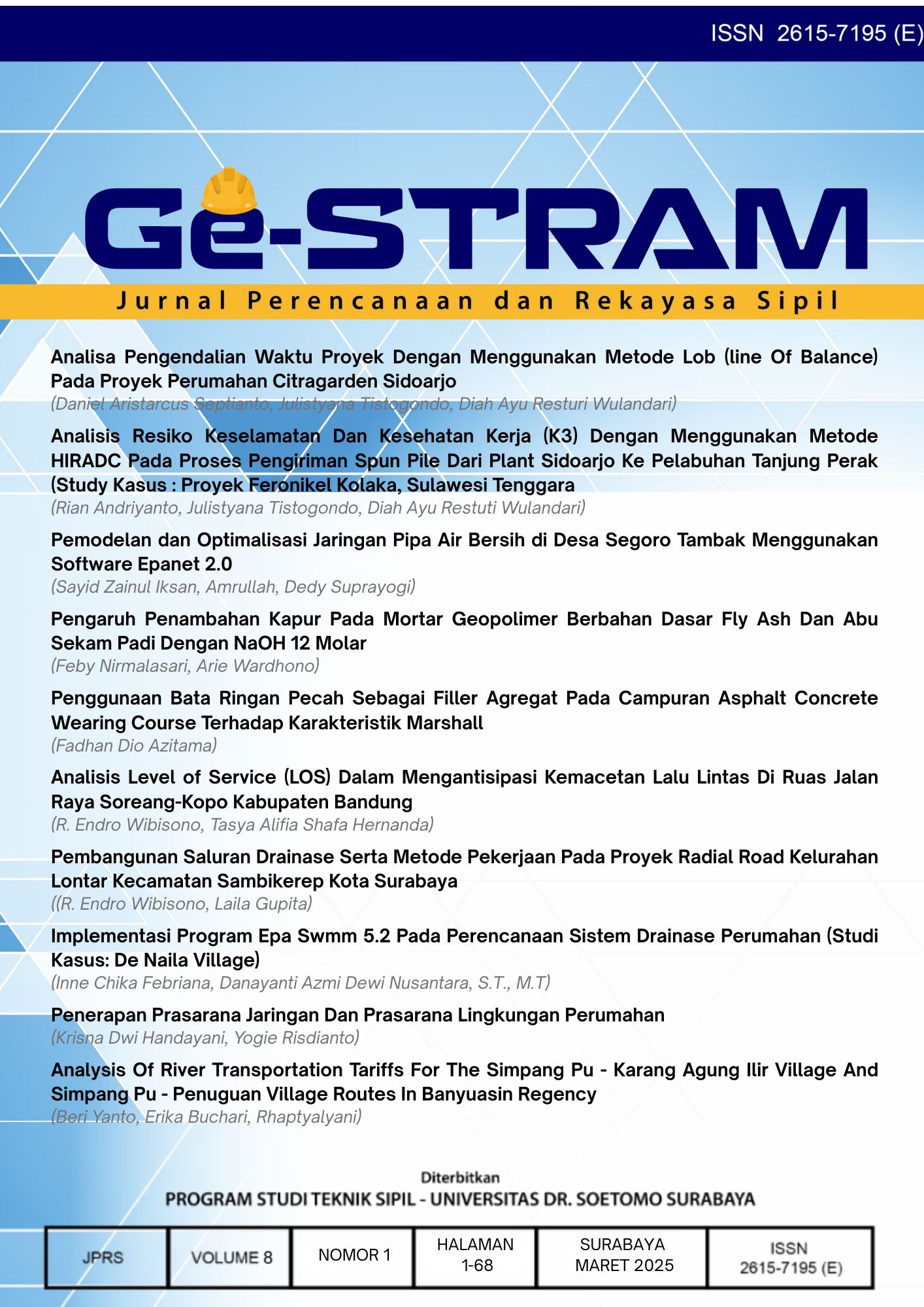
Analisis Resiko Keselamatan Dan Kesehatan Kerja (K3) Dengan Menggunakan Metode HIRADC Pada Proses Pengiriman Spun Pile Dari Plant Sidoarjo Ke Pelabuhan Tanjung Perak (Study Kasus : Proyek Feronikel Kolaka, Sulawesi Tenggara )
DOI:
https://doi.org/10.25139/jprs.v8i1.8860Keywords:
Delivery, Risk, HIRADC MethodAbstract
Work accidents are one of the problems that often occur in companies, where accidents often happen to workers and cause serious physical injuries toworkers. The very rapid development of industry with advances in science and technology has led to an increase in the use of machine tools and chemicals in the production process with the aim of producing a product or service of good quality in order to compete in the market. However, the rapid development of industry and progress in the field of science and technology can cause various problems with the safety and health of workers in companies, such as increasing sources of danger, increasing potential for danger, and work-related diseases in the workplace. The process of sending Spun Pile by sea using a fleet of barges , in carrying out the delivery using several heavy equipment such as cranes which have the potential to cause the risk of work accidents during the delivery period, to identify potential risks of danger that occur using the HIRADC (Hazard Identification Risk Assessment And Determine Control) method. This research aims to reduce the potential for sending Spun Pile from Plant Prambon Sidoarjo to Jetty Wolo - Southeast Sulawesi using an expedition barge fleet
References
2021).
Damayanti, G. E. 2018. Analisis Risiko Kesehatan dan Keselamatan Kerja (K3) Menggunakan Metode Hazard Identification, Risk Assessment and Risk Control (HIRARC) Pada Proses Produksi Pembuatan Gula (Studi Kasus Pada PG. Madukismo). Tugas Akhir. (Tidak Diterbitkan). Universitas Islam Indonesia. Yogyakarta
Darmawi, Herman. 2008. Manajemen Risiko. Jakarta: Bumi Aksara.
Febrianto, D. 2018. Analisis Tingkat Risiko K3 Pekerjaan Struktur Beton Bertulang Pada Proyek Pembangunan Apartemen The Palace. Tugas Akhir. (Tidak Diterbitkan). Universitas Islam Indonesia. Yogyakarta.
Handoko, T. 2020. Analisis Bahaya dan Risiko Pada Pekerjaan Pemasangan Façade/Kaca Gedung Bertingkat Dengan Menggukana HIRADC Pada Project Thamrine Nine Jakarta Tahun 2020. Tugas Akhir. (Tidak Diterbitkan). Universitas Binawan. Jakarta.
Iwan Satibi. 2011. Teknik Penulisan Skripsi, Tesis & Disertasi. Bandung: Ceplas.
Jannah, M. R. 2017. “Analisis Risiko Keselamatan Dan Kesehatan Keja (K3) Melalui Pendekatan HIRADC Dan Metode Job Safety Analysis Pada Studi Kasus Proyek Pembangunan Menara X di Jakarta.†Jurnal Mahasiswa Jurusan TeknikSipil Universitas Brawijaya Vol.1 (No.2): 1138 - 111145.
Adriyatno, J. 2018 Evaluasi Pekerjaan Instalasi Fasad Curtain Wall Unitized System Pada Bangunan Twist Building Dengan Metode Operasi Konstruksi Berulang (Cyclone) (Studi Kasus : Proyek Avian Tower Surabaya). Tugas Akhir. (Tidak Diterbitkan). Universitas Mercu Buana. Jakarta.
Keputusan Menteri Tenaga Kerja Republik Indonesia No. Kep. 463/MEN/1993.Tentang Pola Gerakan Nasional Membudayakan Keselamatan dan Kesehatan.
Downloads
Published
How to Cite
Issue
Section
License
Authors who publish with this journal agree to the following terms:
- Authors retain copyright and grant the journal right of first publication with the work simultaneously licensed under a Creative Commons Attribution-ShareAlike 4.0 International License that allows others to share the work with an acknowledgement of the work's authorship and initial publication in this journal.
- Authors are able to enter into separate, additional contractual arrangements for the non-exclusive distribution of the journal's published version of the work (e.g., post it to an institutional repository or publish it in a book), with an acknowledgement of its initial publication in this journal.
- Authors are permitted and encouraged to post their work online (e.g., in institutional repositories or on their website) prior to and during the submission process, as it can lead to productive exchanges, as well as earlier and greater citation of published work (See The Effect of Open Access).

This work is licensed under a Creative Commons Attribution-ShareAlike 4.0 International License.