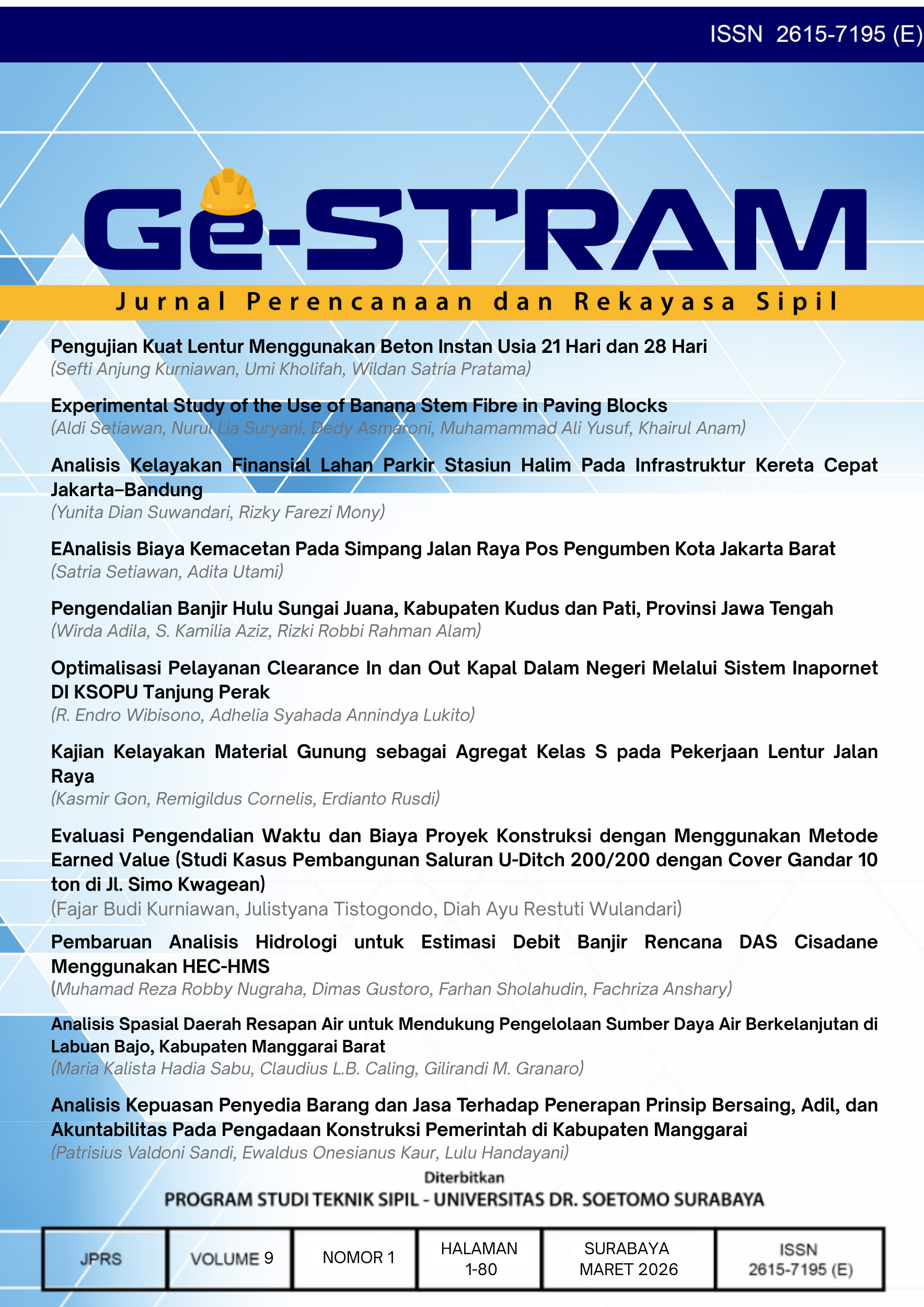
Analisis Biaya Kemacetan Pada Simpang Jalan Raya Pos Pengumben Kota Jakarta Barat
DOI:
https://doi.org/10.25139/jprs.v9i1.9938Keywords:
Congestion, Vehicle Operating Cost, Congetsion Cost, Degree of SaturationAbstract
This study analyzes congestion costs at the intersection of Jl. Raya Pos Pengumben and Jl. Raya Sukabumi Selatan, frequently experiences traffic congestion, particularly during morning and evening rush hours. Traffic congestion at this location results in various negative impacts for road users, including prolonged travel times, increased risk of vehicle accidents, heightened air pollution, economic losses, and additional Vehicle Operational Costs (VOC) costs. The primary objectives of this study are to assess the degree of traffic saturation at the intersection, calculate the existing Vehicle Operational Costs (VOC), and estimate the overall congestion cost. The study methodology follows the 2023 Road Capacity Guidelines (PKJI) and the 1997 LAPI-ITB Method. The findings indicate that peak traffic occurs between 17:30 and 18:30 WIB, with a travel speed of 11.2 km/h on the East approach and a traffic volume of 2,563 vehicle/hour. The degree of saturation at this intersection is measured at 0.517, corresponding to a Level C road service classification. Furthermore, the total congestion costs were analyzed based on Vehicle Operating Costs (BOK) and time valuation. The results show the following congestion costs for different approaches North approach Rp 5,538.92, South approach: Rp 5,614.19, East approach: Rp 5,441.09, and West approach: Rp 5,104.10. These findings provide valuable insights into the economic impact of traffic congestion in the study area and can serve as a basis for future traffic management strategies.
References
Alkas, M. J. (2017). “Analisis Biaya Perjalanan Akibat Tundaan Lalu Lintas pada Perjalanan ke Pusat Perbelanjaan Berbasis Rumah di Kota Samarinda”. Samarinda.
Andrew A Walean, M. K. (2019). “Strategi Dinas Perhubungan dalam Mengatasi Kemacetan di Kota Manado Provinsi Sulawesi”. Manado, Sulawesi Utara: Universitas Sam Ratulangi.
Azhar, R. F. (2022). “Analisis Biaya Kerugian Emisi Gas Buang Kendaraan Bermotor Akibat Volume Lalu Lintas di Ruas Jalan Kota Bandar Lampung”. Bandar Lampung.
Cici N. N. Tahir, L. I. (2022). “Analisis Pengaruh Hambatan Samping Terhadap Kinerja Lalu Lintas pada Jalan Satu Arah”. Manado, Sulawesi Utara: Universitas Sam Ratulangi.
Hayati, F. M. (2013). “Biaya Kemacetan dan Polusi Karbon Monoksida pada Lalu Lintas Akibat Adanya Pembangunan Fly-Over”. Malang: Universitas Brawijaya.
Jinca, A. S. (2012). “Kinerja Transportasi Penyeberangan Trans Maluku dalam Menunjang Aktivitas Sosial Ekonomi Masyarakat”. Makassar: Universitas Hasanuddin.
Karels, D. W. (2018). “Indeks Permukaan Perkerasan Jalan di Kompleks Kampus Undana dengan Pemeriksaan Visual Menggunakan Metode PCI dan RCI”. Kupang: FST Undana.
Kementerian Lingkungan Hidup. (2010). Peraturan Menteri Lingkungan Hidup Nomor 12 Tahun 2010 tentang Pelaksanaan Pengendalian Pencemaran Udara di Daerah. DKI Jakarta: Kementerian Lingkungan Hidup.
Lerinsah Sinaga, T. L. (2019). “Evaluasi Geometrik Jalan Berdasarkan Standar Perencanaan Bina Marga”. Manado, Sulawesi Utara: Universitas Sam Ratulangi.
Marga, D. J. (2021). Pedoman Desain Geometrik Jalan. Jakarta: Kementerian Pekerjaan Umum dan Perumahan Rakyat.
MKJI. (1997). Manual Kapasitas Jalan Indonesia (MKJI) . Jakarta: Departemen Pekerjaan Umum.
PKJI. (2023). Pedoman Kapasitas Jalan Indonesia. Jakarta: Kementerian Pekerjaan Umum dan Perumahan Rakyat.
Praja, M. A. (2021). “Tinjauan Efektivitas Penerapan Simpang Bersinyal di Simpang By Pass Manggus Kota Bukittinggi”. Bukittinggi: Universitas Muhammadiyah Sumatera Barat.
Setiawan, I. K. (2022). “Analisis Perbandingan dengan Pengaturan Tiga Fase Sinyal Lalu Lintas pada Simpang Jalan Gunung Sanghyang-Jl. Kesambi di Kabupaten Badung Sebelum dan Sesudah Covid-19”. Denpasar: Universitas Mahasaraswati Denpasar.
Suherdiyanto, W. M. (2012). “Analisis Faktor Faktor Penyebab Kemacetan Lalu Lintas di Sepanjang Jalan H. Rais A Rahman (Sui Jawi) Kota Pontianak”. Pontianak: Jurnal Edukasi.
Sulistyono. (2022). “Kemacetan Kendaraan Pengguna BBM Fosil dan Dampaknya Terhadap Kerugian Ekonomi dan Lingkungan”. Cepu, Jawa Tengah: PPSDM Migas.
Syawaluddin Effendi Lubis, A. W. (2021). “Analisis Kinerja Ruas Jalan Luar Kota di Kabupaten Jombang”. Jawa Timur: Universitas Hasyim As’ary.
Tamin, O. Z. (2000). Perencanaan & Pemodelan Transportasi. Bandung: Institut Teknologi Bandung (ITB).
Thalib, M. T. (2018). “Analisis Hubungan Volume, Keceptan, dan Kepadatan Arus Lalu LIntas pada Ruas Jalan Prof. Dr. H. B. Jassin dengan Membandingkan Metode Greenshield dan Metode Greenberg”. Gorontalo: Jurnal Peradaban Sains, Rekayasa dan Teknologi Sekolah Tinggi Teknik (STITEK) Bina Taruna Gorontalo Volume 6 No. 1, 61.
Wibisana, H. (2007). “Studi Hubungan Arus Lalu Lintas di Ruas Jalan Rungkut Asri Kota Madya Surabaya dengan Metode Underwood”. Jawa Timur: Universitas Pembangunan Nasional Veteran.
Downloads
Published
How to Cite
Issue
Section
License
Authors who publish with this journal agree to the following terms:
- Authors retain copyright and grant the journal right of first publication with the work simultaneously licensed under a Creative Commons Attribution-ShareAlike 4.0 International License that allows others to share the work with an acknowledgement of the work's authorship and initial publication in this journal.
- Authors are able to enter into separate, additional contractual arrangements for the non-exclusive distribution of the journal's published version of the work (e.g., post it to an institutional repository or publish it in a book), with an acknowledgement of its initial publication in this journal.
- Authors are permitted and encouraged to post their work online (e.g., in institutional repositories or on their website) prior to and during the submission process, as it can lead to productive exchanges, as well as earlier and greater citation of published work (See The Effect of Open Access).

This work is licensed under a Creative Commons Attribution-ShareAlike 4.0 International License.