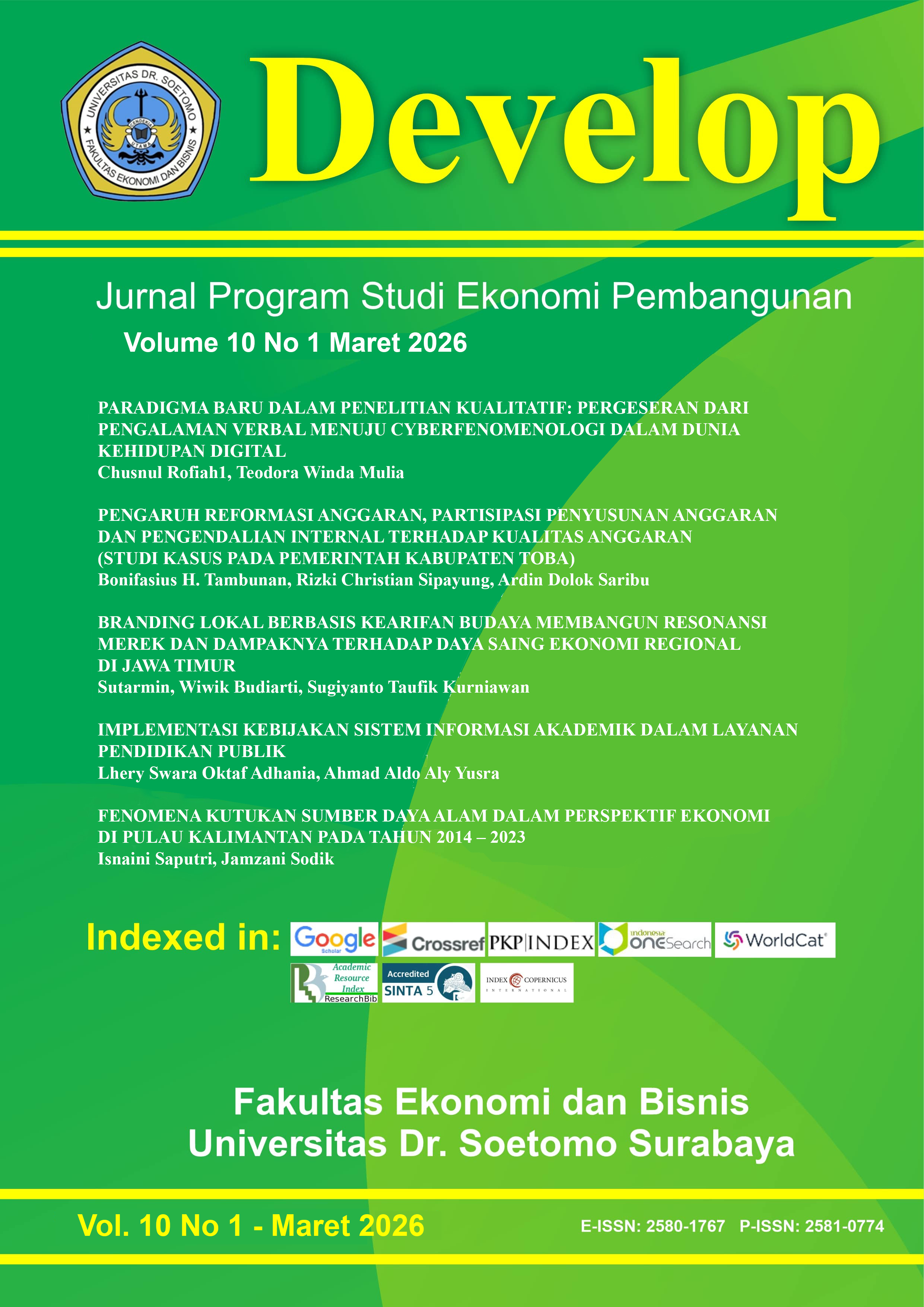
Paradigma Baru dalam Penelitian Kualitatif: Pergeseran dari Pengalaman Verbal menuju Cyberfenomenologi dalam Dunia Kehidupan Digital
DOI:
https://doi.org/10.25139/dev.v10i1.11618Keywords:
inkuiri kualitatif, cyberfenomenologi, dunia-kehidupan digital, paradigma interpretatif, evolusi epistemik, penelitian pascadigitalAbstract
Perkembangan pesat lingkungan yang dimediasi secara digital mendorong peninjauan kritis terhadap fondasi epistemik inkuiri kualitatif. Ketika pengalaman manusia semakin bersifat hibrid, terdistribusi, dan terstruktur oleh teknologi, kerangka interpretatif yang dibangun di atas asumsi kehadiran langsung dan ko-presensi menghadapi keterbatasan analitis yang semakin nyata. Artikel konseptual ini berupaya menjawab tiga pertanyaan utama: (1) bagaimana inkuiri kualitatif berevolusi sebagai respons terhadap perubahan kondisi realitas sosial; (2) ketegangan metodologis apa yang muncul ketika pengalaman hidup semakin dimediasi secara digital; dan (3) bagaimana tradisi fenomenologis dapat diperluas untuk mempertahankan kedalaman interpretatif dalam konteks pascadigital.
Dengan bertumpu pada perdebatan kontemporer mengenai ketelitian kualitatif, pluralitas metodologis, visual turn, serta penelitian yang terbenam dalam lingkungan digital, artikel ini mengembangkan analisis konseptual integratif untuk menelusuri lintasan epistemik metode kualitatif. Analisis menunjukkan bahwa transformasi metodologis bukanlah inovasi yang terpisah, melainkan mencerminkan rekonfigurasi yang lebih luas dalam cara subjektivitas dibentuk dan ditafsirkan. Pendekatan yang ada semakin menghadapi tantangan dalam menangkap dunia-kehidupan yang dimediasi teknologi, di mana kehadiran bersifat hibrid dan makna muncul melalui lingkungan yang terhubung secara jejaring.
Untuk menjembatani kesenjangan interpretatif tersebut, cyberfenomenologi diajukan sebagai perluasan fenomenologis yang mampu berinteraksi dengan pengalaman yang dimediasi secara digital sekaligus mempertahankan komitmen teoretis yang selama ini mendefinisikan keilmuan kualitatif. Alih-alih diposisikan sebagai disrupsi metodologis, cyberfenomenologi ditempatkan dalam gerakan yang lebih luas menuju paradigma interpretatif pascadigital. Artikel ini memberikan tiga kontribusi utama: mengonseptualisasikan evolusi inkuiri kualitatif sebagai transisi epistemik, memperluas analisis fenomenologis ke dalam realitas yang terstruktur teknologi, serta merumuskan implikasi bagi penelitian masa depan terkait kerja lapangan yang terdistribusi, refleksivitas yang diperluas, dan interpretasi multimodal. Secara keseluruhan, temuan konseptual ini menawarkan kerangka untuk memahami mengapa metode kualitatif perlu terus berevolusi seiring dengan transformasi cara manusia mengalami dunia sosial
References
Anito Jr, J. (2025). Reflexive Human–AI Collaboration: Tracing the Evolving Epistemics of Qualitative Inquiry (2021–2025).
Balding, K. J., Geraghty, S., Timler, A., Pezaro, S., & McChlery, S. (2024). Phenomenography: A useful methodology for midwifery research. Journal of Advanced Nursing, 80(6), 2598–2610.
Bancou, L. (2024). Towards a ‘vulnerable co-presence’for hybrid ways of working: Recasting the nexus of co-presence and vulnerability with Merleau-Ponty and Butler. Management Learning, 55(3), 451–473.
Bartoli, C., Mattiacci, A., & Nosi, C. (2024). Digital technologies meet soft laddering: A critical reflective perspective. International Journal of Market Research, 66(6), 694–710.
Berger, V. (2020). Phenomenology of online spaces: interpreting late modern spatialities. Human Studies, 43(4), 603–626.
Bergh, D. D., Boyd, B. K., Byron, K., Gove, S., & Ketchen Jr, D. J. (2022). What constitutes a methodological contribution? In Journal of Management (Vol. 48, Issue 7, pp. 1835–1848). Sage Publications Sage CA: Los Angeles, CA.
Borkovich, D. J. (2022). Digital ethnography: A disruptive qualitative approach to inquiry. Issues in Information Systems, 23(4).
Bryda, G., & Costa, A. P. (2023). Qualitative research in digital era: innovations, methodologies and collaborations. Social Sciences, 12(10), 570.
Campbell, C., & Olteanu, A. (2024). The challenge of postdigital literacy: Extending multimodality and social semiotics for a new age. Postdigital Science and Education, 6(2), 572–594.
Cellard, L. (2022). Algorithms as figures: Towards a post-digital ethnography of algorithmic contexts. New Media & Society, 24(4), 982–1000.
Cheah, C. W. (2025). AI-Augmented Netnography: Ethical and Methodological Frameworks for Responsible Digital Research. International Journal of Qualitative Methods, 24, 16094069251338910.
Chusnul Rofiah, S. E., & MM, Ciq. (2023). METODE PENELITIAN STUDI KASUS Konsep, Paradigma, Desain Penelitian (Dilengkapi dengan Pembahasan dan Contoh Multikasus dan Multisitus). Literasi Nusantara.
Deroncele-Acosta, A., Gross-Tur, R., Bellido-Valdiviezo, O., & López-Mustelier, R. (2024). Qualitative Research From Grounded Theory to Build a Scientific Framework on the Researcher’s Epistemic Competence. International Journal of Qualitative Methods, 23, 16094069241284218.
Fawns, T., Ross, J., Carbonel, H., Noteboom, J., Finnegan-Dehn, S., & Raver, M. (2023). Mapping and tracing the postdigital: Approaches and parameters of postdigital research. Postdigital Science and Education, 5(3), 623–642.
Gautam, V. K. (2023). Qualitative research approaches in social sciences. MKSES Publication.
Gioia, D. A., Corley, K. G., & Hamilton, A. L. (2013). Seeking qualitative rigor in inductive research: Notes on the Gioia methodology. Organizational Research Methods, 16(1), 15–31.
Gkevrou, M., & Stamovlasis, D. (2025). Merger of critical realism and complexity theory: Laying the foundations for a unified ontological and epistemological perspective for the study of social systems. Foundations of Science, 1–21.
Hyde, B., & Rouse, E. (2023). What is it like to experience the other in an online interview? Using phenomenology to explore the online encounter of the other. Qualitative Inquiry, 29(7), 874–881.
Ivanova, K., & Elsawah, S. (2022). Iterative refinement of multi-method OR workshop designs through boundary critique: An analytical framework and case studies in technology utilisation. Systemic Practice and Action Research, 35(3), 345–374.
Jarrahi, M. H., Sawyer, S., & Erickson, I. (2022). Digital assemblages, information infrastructures, and mobile knowledge work. Journal of Information Technology, 37(3), 230–249.
Kelly, G. J. (2023). Qualitative research as culture and practice. Handbook of Research on Science Education, 60–86.
Köhler, T., Smith, A., & Bhakoo, V. (2022). Templates in qualitative research methods: Origins, limitations, and new directions. Organizational Research Methods, 25(2), 183–210.
Lee, N. J. (2022). Phenomenological lifeworld research: A proposed phenomenological research methodology: With an application to the lifeworld of new migrants. University of Southern Queensland.
Lim, W. M. (2025). What is qualitative research? An overview and guidelines. Australasian Marketing Journal, 33(2), 199–229.
Liu, C. (2024). Follow the digital: Methodological thoughts on doing everyday geographies in a digital world. Digital Geography and Society, 6, 100079.
Ma, Y., & Cai, W. (2023). Social media in ethnographic research: critical reflections on using WeChat in researching Chinese outbound tourists. Current Issues in Tourism, 26(20), 3275–3287.
Maldonado-Castellanos, I., & Barrios, L. M. (2023). Ethical issues when using digital platforms to perform interviews in qualitative health research. International Journal of Qualitative Methods, 22, 16094069231165948.
Mavhandu-Mudzusi, A. H., Moyo, I., Mthombeni, A., Ndou, A., Mamabolo, L., Ngwenya, T., Marebane, T., & Netshapapame, T. (2022). WhatsApp as a qualitative data collection method in descriptive phenomenological studies. International Journal of Qualitative Methods, 21, 16094069221111124.
Nazari, M. A. (2025). Instinctual Authenticity: An Interdisciplinary Inquiry Into Mystical Nihilism, Sexistentialism, and Virtual Evolution. California Institute of Integral Studies.
O’Shiel, D. (2022). The phenomenology of virtual technology.
Palmberger, M. (2025). The Digital Diary: A Mobile, Multimodal, and Participatory Method and Part of Digital Ethnography. International Journal of Qualitative Methods, 24, 16094069251329262.
Pértega, E., Holmberg, C., Dahlberg, K., & Dahlberg, H. (2025). Lifeworld-led research: a phenomenological approach to grant experts by experience in vulnerable positions their right to participate in healthcare research. International Journal of Qualitative Studies on Health and Well-Being, 20(1), 2522875.
Rofiah, C. (2023a). Metode Penelitian Fenomenologi Konsep Dasar, Sejarah, Paradigma, dan Desain Penelitian. Malang: Literasi Nusantara Abadi.
Rofiah, C. (2023b). Metode Penelitian Grounded Theory. Litnus, Malang.
Rofiah, C. (2024). Cyberfenomenologi dan Evolusi Identitas Manusia Dalam Dunia Media Sosial: Pendekatan Studi Kualitatif. Develop, 8(2), 136–160.
Sancar, R. (2023). Cyber identity: determining the meaning-making process of university students in terms of the phenomenological perspective. Educational Media International, 60(1), 1–13.
Tracy, S. J. (2010). Qualitative quality: Eight “big-tent” criteria for excellent qualitative research. Qualitative Inquiry, 16(10), 837–851.
Wilcock, A. (2024). Shifting consciousness: Challenges to ontological assumptions in feminist research. Emotion, Space and Society, 50, 101004.
Zelenskiy, A. (2022). The Breach, Digital Disruption, the Event: Psychoanalytic and Philosophic Critique of Embodiment. Trent University (Canada).
Zhang, J., & Zhang, L. (2025). Clock Technology and Time Interpretation: A Narrative and Post-Phenomenological Exploration. Journal of the British Society for Phenomenology, 1–20.
Zhu, D., & Kohls, C. (2025). Operationalizing Affordances in Hybrid Spaces: An Enhanced TACIT Framework for Human-Agent Interaction. International Conference on Human-Computer Interaction, 218–239.
Zörgő, S., Peters, G.-J., Jeney, A., Kovács, S. D., & Crutzen, R. (2025). A Multimodal Analysis of Online Information Foraging in Health-Related Topics Based on Stimulus-Engagement Alignment: Observational Feasibility Study. Journal of Medical Internet Research, 27, e64901.
Downloads
Published
How to Cite
Issue
Section
License
CC BY 4.0 Creative Commons Attribution 4.0 International. This license requires that reusers give credit to the creator. It allows reusers to distribute, remix, adapt, and build upon the material in any medium or format, even for commercial purposes.
BY: Credit must be given to you, the creator.