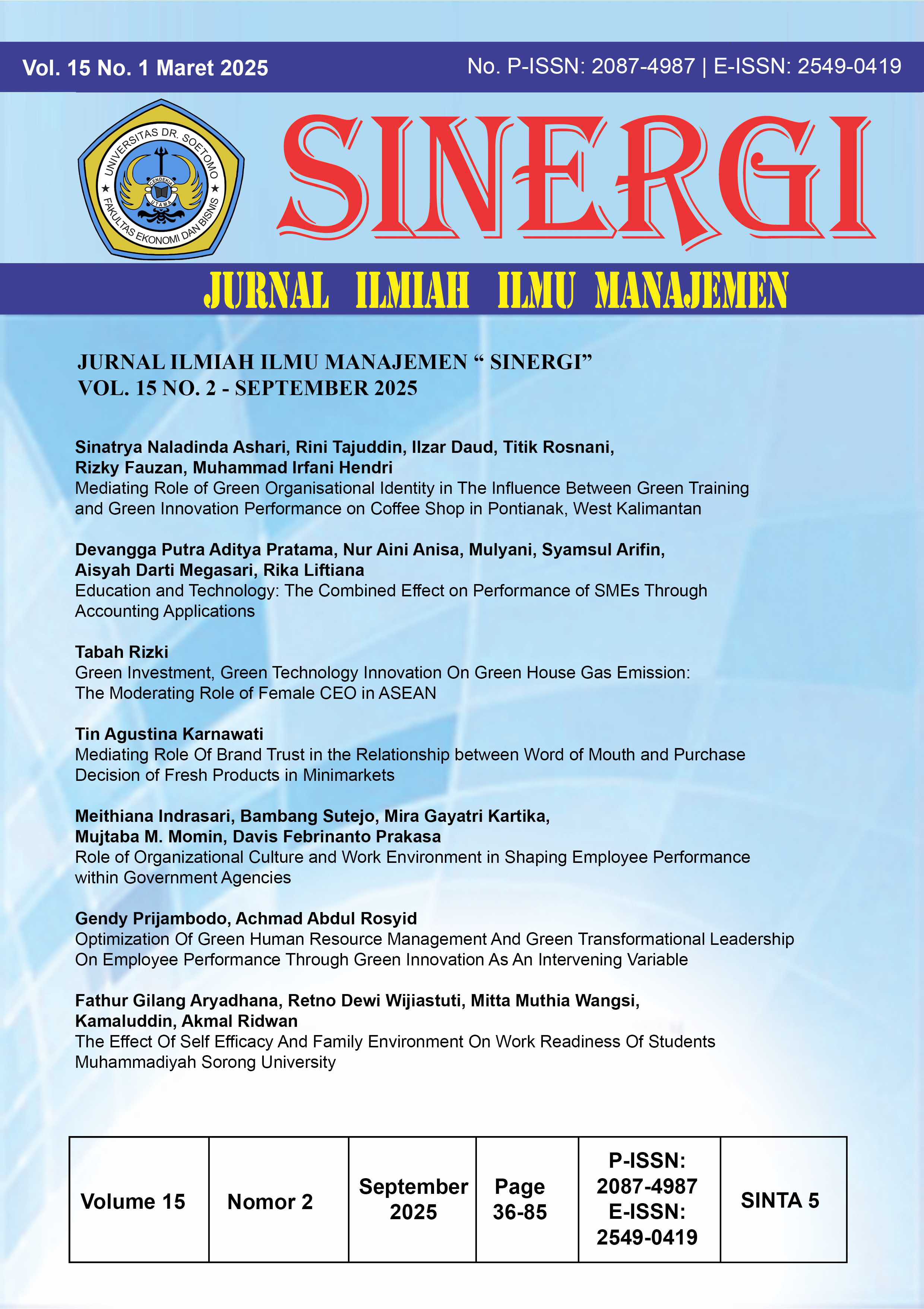
Role of Organizational Culture and Work Environment in Shaping Employee Performance within Government Agencies
DOI:
https://doi.org/10.25139/sng.v15i2.10792Keywords:
Organizational culture, Work environment, Employee performance, Public sector, Human resource managementAbstract
Abstract. Purpose – This study explores how organizational culture and work environment shape employee performance within government institutions, using the Regional Financial and Asset Management Agency (BPKAD) of Maybrat Regency as a case study. Design/methodology/approach – Adopting a quantitative explanatory design, the research examines how cultural values and workplace conditions contribute individually and collectively to performance outcomes in a public sector context. The data were collected through an online survey and analyzed using WarpPLS software version 7.0. Findings – The analysis highlights that improvements in the physical, psychological, and managerial aspects of the work environment play a critical role in enhancing employee effectiveness, particularly in remote regions with limited resources. Research limitations – This study is limited by its narrow geographical scope, focusing solely on civil servants within the Regional Financial and Asset Management Agency (BPKAD) of Maybrat Regency, which may restrict the generalizability of the findings to other public institutions with differing administrative complexities or cultural dynamics. Future research should broaden the institutional scope and consider integrating mediating factors such as leadership style or job satisfaction to deepen theoretical understanding and practical relevance. Practical implications – These findings underscore the need for public institutions to prioritize environmental improvements alongside cultural development. Originality/value – This study examines these two constructs separately or in an urban context, focusing on a remote and underdeveloped area Maybrat Regency where organisational performance is influenced by unique social and administrative challenges
References
Al-Saqri, Z. T. A. H., & Vida, V. (2023). Motivation Among Employees in Multinational Corporations. Applied Studies in Agribusiness and Commerce, 17(1). https://doi.org/10.19041/apstract/2023/1/9
Brandenburg, C., Raatz, M., & Ward, E. C. (2022). What Is Known About Clinician Researcher Careers in Allied Health? A Scoping Review of the Last Decade. Journal of Health Organization and Management, 36(6), 693–711. https://doi.org/10.1108/jhom-12-2021-0441
Budiprasetia, A., & Lo, S. J. (2021). Mediation Acts From Employee Engagement Which Affects the Employee Competencies and Innovative Work Behaviour on Employee Performance at Pt Tetra Pak Indonesia. Dinasti International Journal of Management Science, 2(4), 680–688. https://doi.org/10.31933/dijms.v2i4.818
Catania, G., Zanini, M., Hayter, M., Timmins, F., Dasso, N., Ottonello, G., Aleo, G., Sasso, L., & Bagnasco, A. (2020). Lessons From Italian Front‐line Nurses’ Experiences During the COVID‐19 Pandemic: A Qualitative Descriptive Study. Journal of Nursing Management, 29(3), 404–411. https://doi.org/10.1111/jonm.13194
Effendi, S. R. F. (2024). The Effect of Job Division, Promotion, Project, Salary, Length of Work With Employee Turnover Using Logistic Regression Analysis. Jurnal Indonesia Sosial Teknologi, 5(3), 1204–1210. https://doi.org/10.59141/jist.v5i3.972
Fajriyati, Adam, M., & Musnadi, S. (2020). Determinant of Organizational Performance Mediated by Job Satisfaction: Study in Department of Public Works and Spatial Planning of Aceh Province. International Journal of Business Management and Economic Review, 03(01), 158–168. https://doi.org/10.35409/ijbmer.2020.3147
Garavan, T. N., McCarthy, A., Lai, Y., Clarke, N., Carbery, R., Gubbins, C., Sheehan, M., & Saunders, M. N. K. (2021). Putting The<i>system</I>back Into Training and Firm Performance Research: A Review and Research Agenda. Human Resource Management Journal, 31(4), 870–903. https://doi.org/10.1111/1748-8583.12337
Ghosh, B., & -, A. S. P. (2024). Chronotype Preferences, Work Motivation, and Gender Differences Among Private Sector Employees in Bengaluru. International Journal of Science and Research Archive, 11(2), 1702–1712. https://doi.org/10.30574/ijsra.2024.11.2.0654
Griffin, D., Li, K., & Xu, T. (2020). Board Gender Diversity and Corporate Innovation: International Evidence. Journal of Financial and Quantitative Analysis, 56(1), 123–154. https://doi.org/10.1017/s002210901900098x
Hadi, S., Satato, Y. R., & Kurniasari, D. (2023). The Influence of Work Environment and Facilities on Employee Performance at the Central Industrial Smokehouse Indah Wonosari Bonang Demak. Ictmt, 1(1), 624–630. https://doi.org/10.56910/ictmt.v1i1.136
Hair, J. F., Hult, G. T. M., Ringle, C. M., Sarstedt, M., Danks, N. P., & Ray, S. (2021). Evaluation of Formative Measurement Models. https://doi.org/10.1007/978-3-030-80519-7_5
Hardiyanto, W., Triatmanto, B., & Manan, A. (2019). The Effects of Working Motivation, Individual Characteristics and Working Environment on Employees Job Satisfaction. The International Journal of Social Sciences and Humanities Invention, 6(1), 5256–5260. https://doi.org/10.18535/ijsshi/v6i1.09
Henseler, J., Ringle, C. M., & Sarstedt, M. (2015). A new criterion for assessing discriminant validity in variance-based structural equation modeling. Journal of the Academy of Marketing Science, 43(1), 115–135. https://doi.org/10.1007/s11747-014-0403-8
Ismail, H., Iqbal, A., & Nasr, L. (2019). Employee Engagement and Job Performance in Lebanon: The Mediating Role of Creativity. International Journal of Productivity and Performance Management, 68(3), 506–523. https://doi.org/10.1108/ijppm-02-2018-0052
Márquez-Miramontes, B. L., & Cobos-Floriano, S. (2023). Remote Work Efficacy: A Quantitative Analysis of Administrative Staff Performance in Ciudad Juárez’s Industrial Sector Amidst the COVID-19 Pandemic. Modelling Measurement and Control D, 44(1–4), 26–31. https://doi.org/10.18280/mmc_d.441-405
Nguyễn, T. P. L., Doan, X. H., Trần, M. D., Le, T. T., & Nguyen, Q. T. (2019). Knowledge Sharing and Individual Performance: The Case of Vietnam. Uncertain Supply Chain Management, 483–494. https://doi.org/10.5267/j.uscm.2018.11.007
Norful, A. A., He, Y., Rosenfeld, A., Abraham, C. M., & Chang, B. (2022). Revisiting Provider Communication to Support Team Cohesiveness: Implications for Practice, Provider Burnout, and Technology Application in Primary Care Settings. International Journal of Clinical Practice, 2022, 1–8. https://doi.org/10.1155/2022/9236681
Prabawanti, D. N. S., & L, R. I. (2019). Work Environment and Work Stress Affecting Nurse Performance (Study Hospitals in Indonesia). Iarjset, 6(1), 59–65. https://doi.org/10.17148/iarjset.2019.6110
Qhisbullah, A., Mohyi, A., & Hilmi, L. D. (2023). The Effect of Workload and Job Satisfaction on Outsourced Employee Performance. Jamanika (Jurnal Manajemen Bisnis Dan Kewirausahaan), 3(01), 23–30. https://doi.org/10.22219/jamanika.v3i01.25448
Ramosaj, Dr. Sc. B., & Berisha, MSc. G. (2014). Systems Theory and Systems Approach to Leadership. ILIRIA International Review, 4(1), 59. https://doi.org/10.21113/iir.v4i1.53
Rauf, R., Pajala, S., & Asirie, R. A. (2024). Analysis of Organizational Culture and Job Satisfaction on Employee Performance. Jurnal Economic Resource, 7(1), 57–64. https://doi.org/10.57178/jer.v7i1.835
Russell, T. L., Sparks, T. E., Campbell, J. P., Handy, K., Ramsberger, P., & Grand, J. A. (2017). Situating Ethical Behavior in the Nomological Network of Job Performance. Journal of Business and Psychology, 32(3), 253–271. https://doi.org/10.1007/s10869-016-9454-9
Salvioni, D. M., & Almici, A. (2020). Circular Economy and Stakeholder Engagement Strategy. Symphonya Emerging Issues in Management, 1, 26. https://doi.org/10.4468/2020.1.03salvioni.almici
Samur, M., & İntepeler, Ş. S. (2019). Nurses’ View of Their Work Environment, Health and Safety: A Qualitative Study. Journal of Nursing Management, 27(7), 1400–1408. https://doi.org/10.1111/jonm.12821
Sugiharjo, R. J., Nugraha, R. S., Purbasari, Rr. N., Parashakti, R. D., PAIJAN, P., & Oktaviar, C. (2022). The Effect of Leadership Style and Work Environment on Employee Performance. JRDM. https://doi.org/10.7176/jrdm/82-04
Trušiņa, I., Jermolajeva, E., & Gopejenko, V. (2023). Nonlinear Natural Scientific Thinking and Ecological Consciousness for Sustainability. Journal of Teacher Education for Sustainability, 25(2), 165–186. https://doi.org/10.2478/jtes-2023-0022
Weiping, Z., & Yao, H. (2020). Service Supply Chain Incentive Strategy: From the Perspective of Win-Win. International Journal of Services Technology and Management, 26(1), 1. https://doi.org/10.1504/ijstm.2020.105400
Wijayanti, N. W., & Tirtoprojo, S. (2023). Organizational Culture and Work Environment on Employee Performance With Management Knowledge as Mediation. International Journal of Economics Business and Management Research, 07(01), 157–171. https://doi.org/10.51505/ijebmr.2023.7113
You, J. J., & Williams, C. (2023). Organizational Resilience and Interorganizational Relationships: An Exploration of Chinese Business Service Firms. European Management Review, 20(3), 591–609. https://doi.org/10.1111/emre.12558