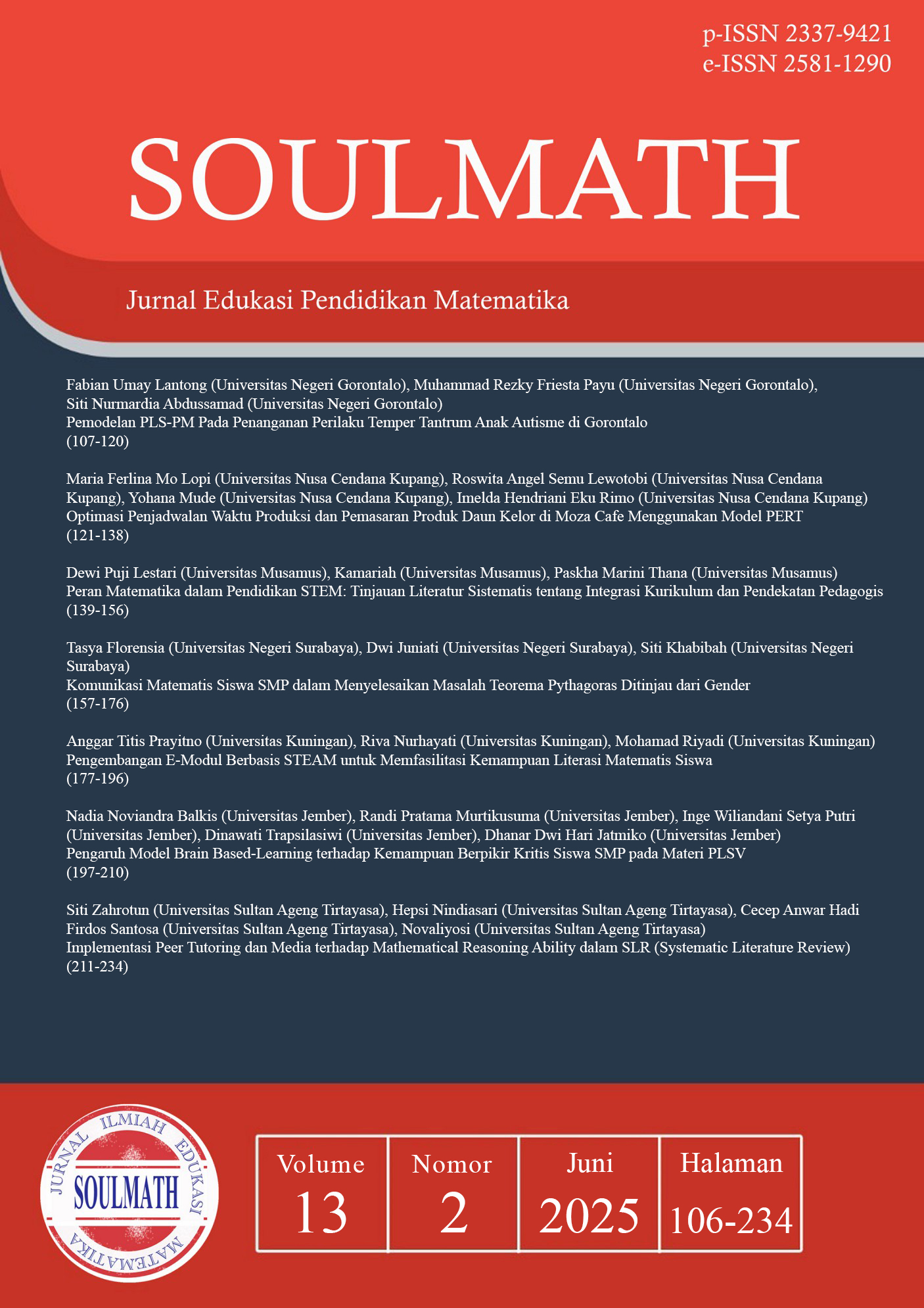
Implementasi Peer Tutoring dan Media terhadap Mathematical Reasoning Ability dalam SLR (Systematic Literature Review)
DOI:
https://doi.org/10.25139/smj.v13i2.10943Abstract
Several primary studies have been conducted on the application of peer-to-peer learning models and the use of various media that influence mathematical reasoning abilities. Recognition, assessment, and withdrawal are necessary to draw general conclusions for researchers and mathematicians for the benefit and input in developing the field of mathematics education. The purpose of this study was to review articles related to the application of peer learning and media to mathematical reasoning abilities. The next step was carried out by grouping the parts that were interpreted and analyzed. The method used was SLR with the collection of articles over 5 years, from 2020 to 2025. Articles were screened based on Sinta 1, 2, and 3 accreditation and were indexed by Scopus. There were 25 articles with each criterion of the relationship between variables to be studied. A total of 7 articles discussed the application of peer learning to mathematical reasoning abilities implicitly and 18 articles addressed the use of media to mathematical reasoning abilities. The general findings indicate that the implementation of peer tutoring and media both improve mathematical reasoning competency. This provides insights for researchers to pursue further research, and educators can apply it to learning activities.
References
E. F. Fahyuni, Buku Ajar Inovasi Konselor Sebaya di Sekolah (Dalam Perspektif Pendidikan Islam), 1st ed. Sidoarjo: UMSIDA Press, 2018.
M. Rif’at, S. Sudiansyah, Heriyanto, and B. Press, “Penalaran Matematika,” Riau, Apr. 2025. [Online]. Available: https://www.researchgate.net/publication/390845444
J. Berman, Learning to Peer Tutor Answer to 25 Questions Novice Tutors Ask. Vanier College Press, 2017.
R. C. AS, R. Masykur, and S. Andriani, “Efektifitas Pembelajaran Peer Led Guided Inquiry Untuk Peningkatan Kemampuan Komunikasi Matematis Ditinjau dari Number Smart,” AKSIOMA: Jurnal Program Studi Pendidikan Matematika, vol. 9, no. 3, p. 681, Sep. 2020, doi: 10.24127/ajpm.v9i3.2719.
R. Sitorus and M. Irawan, “Hubungan Antara Kecerdasan Emosional dengan Perkembangan Sosial Siswa Kelas XI IA MAN 2 Model Medan Helvetia,” Indo-MathEdu Intellectuals Journal, vol. 4, no. 2, pp. 1249–1257, Oct. 2023, doi: 10.54373/imeij.v4i2.351.
Z. Amrina et al., “Analisis Technological Pedagogical Content Knowledge Terhadap Kemampuan Menyusun Perangkat Pembelajaran Matematika Daring Calon Guru SD,” Jurnal Cendekia : Jurnal Pendidikan Matematika, vol. 06, no. 1, pp. 1069–1079, 2022.
C. A. H. F. Santosa, I. Rafianti, and D. Yulistiany, “K R E A N O Worked-Example Method on Mathematical Problem-Solving Ability in term of Students’ Initial Ability,” K R E A N O J u r n a l M a t e m a t i k a K r e a t i f – I n o v a t i f, vol. 13, no. 2, 2022, [Online]. Available: http://journal.unnes.ac.id/nju/index.php/kreano
P. N. Widya, L. Ariyanto, and Y. H. Murtianto, “Pengembangan Bahan Ajar Matematika Berbasis Contextual Teaching and Learning Berbantuan Pop Up Book untuk Meningkatkan Kemampuan Penalaran Matematis Siswa Kelas VII,” vol. 2, no. 2, pp. 95–101, 2020, doi: 10.26877/imajiner.v2i2.5769.
E. Van de Weijer-Bergsma and S. H. G. Van der Ven, “Why and for whom does personalizing math problems enhance performance? Testing the mediation of enjoyment and cognitive load at different ability levels,” Learn Individ Differ, vol. 87, Apr. 2021, doi: 10.1016/j.lindif.2021.101982.
Andriyani., H. F. S. Cecep. Anwar, and Widiasih., “Pengaruh Model Pembelajaran Berbasis Masalah Berdiferensiasi dan Kemandirian Belajar terhadap Hasil Belajar Matematika di Sekolah Dasar,” 2025. [Online]. Available: https://jurnaldidaktika.org
H. Y. Hasibuan, N. Anriani, C. A. H. F. Santosa, and S. Syamsuri, “Penggunaan Model Cipp dalam Melakukan Evaluasi Program Pendidikan Inklusif Pembelajaran Matematika SMP,” AKSIOMA: Jurnal Program Studi Pendidikan Matematika, vol. 12, no. 1, p. 1050, Mar. 2023, doi: 10.24127/ajpm.v12i1.6658.
Nurjanah, J. A. Dahlan, and Y. Wibisono, “The Effect of Hands-On and Computer-Based Learning Activities on Conceptual Understanding and Mathematical Reasoning,” International Journal of Instruction, vol. 14, no. 1, pp. 143–160, Jan. 2020, doi: 10.29333/IJI.2021.1419A.
R. Marasabessy and A. Hasanah, “Penalaran Matematika: Apa Aspek Sentralnya?,” Jurnal Cendekia : Jurnal Pendidikan Matematika, vol. 05, no. 01, pp. 562–577, 2021.
J. Olsson and C. Granberg, “Teacher-student interaction supporting students’ creative mathematical reasoning during problem solving using Scratch,” Math Think Learn, vol. 26, no. 3, pp. 278–305, 2024, doi: 10.1080/10986065.2022.2105567.
H. A. Wau, D. Harefa, and R. Sarumaha, “AFORE: Jurnal Pendidikan Matematika,” AFORE : Jurnal Pendidikan Matematika, vol. 1, no. 1, 2022, [Online]. Available: https://jurnal.uniraya.ac.id/index.php/Afore
K. Khauro’, A. Setiyawan, and T. Citrawati, “Pengaruh Metode Ceramah Terhadap Hasil Belajar Dalam Pelajaran Matematika Kelas I SDN Telang 1,” 2020.
C. A. H. F. Santosa and M. Filiz, “Investigating the limit of peer collaboration: Insight from worked-example in multivariable calculus,” Infinity Journal, vol. 14, no. 2, pp. 461–482, May 2025, doi: 10.22460/infinity.v14i2.p461-482.
M. A. Maulyda, “Paradigma Pembelajaran Matematika Berbasis NCTM,” 2020. [Online]. Available: https://www.researchgate.net/publication/338819078
M. Kaplar, S. Radović, K. Veljković, K. Simić-Muller, and M. Marić, “The Influence of Interactive Learning Materials on Solving Tasks That Require Different Types of Mathematical Reasoning,” Int J Sci Math Educ, vol. 20, no. 2, pp. 411–433, Feb. 2022, doi: 10.1007/s10763-021-10151-8.
I. P. Lestari, R. F. K. Dewi, and N. Ulia, “Pengembangan You-Mathbook untuk Meningkatkan Pemahaman Konsep Perkalian pada Siswa SD Islam Darul Huda Kota Semarang,” Profesi Pendidikan Dasar, vol. 1, no. 1, pp. 105–120, Jul. 2020, doi: 10.23917/ppd.v1i1.10969.
S. Shoffa et al., Buku Media Pembelajaran, 1st ed. CV. Afasa Pustaka, 2023. [Online]. Available: https://www.researchgate.net/publication/377116610
Yuliana, E. K. Aribowo, and A. F. Setianingtyas, “Persepsi Mahasiswa terhadap Profil Dosen Menggunakan Analisis Konjoin,” Indonesian Journal of Educational Science (IJES), vol. 03, no. 02, 2021, [Online]. Available: www.bit.ly/dosen-idaman
Y. Yuliana, T. Triyono, P. Haryono, and H. Retnawati, “Pemodelan Persamaan Struktural : Motivasi Prestasi Belajar Matematika Siswa terhadap Aspek-Aspek Berpengaruh pada Pembelajaran Daring,” AKSIOMA: Jurnal Program Studi Pendidikan Matematika, vol. 11, no. 2, p. 1194, Jun. 2022, doi: 10.24127/ajpm.v11i2.5004.
L. A. Fitriana, N. Wijayati, and Y. Utanto, “The Effectiveness of Android-Based Learning Media on Science Lesson Content to Increase Motivation and Digital Literacy of Grade V Elementary School Students,” 2022. [Online]. Available: https://journal.unnes.ac.id/sju/index.php/jpe
D. Harefa and T. L. Hestu, “Media Pembelajaran Audio Video Terhadap Kemampuan Pemecahan Masalah Matematika Siswa,” AKSARA: Jurnal Ilmu Pendidikan Nonformal, vol. 07, no. 02, 2021, doi: 10.37905/aksara.7.2.329-338.2021.
Wahyudi, M. D. Yahya, C. B. Susilo, M. D. Suwarma, and O. Veza, “Hubungan Penggunaan Multimedia dalam Pembelajaran terhadap Peningkatan Hasil Belajar Peserta Didik,” Journal on Education, vol. 06, no. 01, pp. 25–34, 2023.
D. Moher et al., “Preferred reporting items for systematic reviews and meta-analyses: The PRISMA statement,” Jul. 01, 2009, Public Library of Science. doi: 10.1371/journal.pmed.1000097.
R. Fitriani and R. C. I. Prahmana, “Penelitian Implementasi Pembelajaran Matematika bagi Anak Berkebutuhan Khusus di Indonesia,” AKSIOMA: Jurnal Program Studi Pendidikan Matematika, vol. 10, no. 3, p. 1293, Oct. 2021, doi: 10.24127/ajpm.v10i3.3968.
L. Moliner and F. Alegre, “Effects of peer tutoring on middle school students’ mathematics self-concepts,” PLoS One, vol. 15, no. 4, Apr. 2020, doi: 10.1371/journal.pone.0231410.
Ramadoni and K. T. Chien, “Integrating Peer Tutoring Video with Flipped Classroom in Online Statistics Course to Improve Learning Outcomes,” Infinity Journal, vol. 12, no. 1, pp. 13–26, Feb. 2023, doi: 10.22460/infinity.v12i1.p13-26.
T. Azizah, A. Fauzan, and Y. Harisman, “‘Flipped Classroom Type Peer Instruction-Based Learning’ Based On A Website to Improve Student’s Problem Solving,” Infinity Journal, vol. 11, no. 2, pp. 325–348, Sep. 2022, doi: 10.22460/infinity.v11i2.p325-348.
L. H. Sukma, R. Ramadoni, and M. Suryani, “The Implementation Effect of Peer Teaching Flipped Classroom on Student’s Understanding of Mathematical Concepts in Learning Mathematics,” Alifmatika: Jurnal Pendidikan dan Pembelajaran Matematika, vol. 4, no. 2, pp. 150–165, Dec. 2022, doi: 10.35316/alifmatika.2022.v4i2.150-165.
A. A. Celedonio and R. S. P. Elicay, “Reciprocal Peer Tutoring Strategy on Students’ Anxiety, Self-Efficacy, and Mathematics Performance,” International Journal on Emerging Mathematics Education (IJEME), vol. 8, no. 2, pp. 73–90, 2024, doi: 10.12928/ijeme.v8i2.
A. Indah, S. Susanto, A. Suwito, S. Sunardi, and D. S. Pambudi, “Efektivitas Model Problem Based Learning Metode Tutor Sebaya Berbantuan Card Problem terhadap Hasil Belajar Matematika,” AKSIOMA: Jurnal Program Studi Pendidikan Matematika, vol. 12, no. 1, p. 1119, Mar. 2023, doi: 10.24127/ajpm.v12i1.6728.
C. I. Butar-Butar and T. Listiani, “Application of Peer Method Tutoring in Cultivating Sense of Belonging Junior High School Students to Online Learning,” Mathline : Jurnal Matematika dan Pendidikan Matematika, vol. 8, no. 4, pp. 1461–1474, Nov. 2023, doi: 10.31943/mathline.v8i4.508.
E. Wulandari and E. Ayda, “Analisis Perangkat Pembelajaran Matematika Berbasis Open-Ended yang Berorientasi Higher Order Thinking Skills Ditinjau dari Aspek Validitas,” 2021.
A. Jariyah, R. I. I. Putri, and Zulkardi, “Development of Learning Video Reflection Using Palembang Songket Context to Determine Students’ Mathematical Reasoning,” Jurnal Pendidikan Matematika, vol. 18, no. 2, pp. 273–294, May 2024, doi: 10.22342/jpm.v18i2.pp273-294.
R. Risnanosanti, A. A. Prasetyo, and M. Syofiana, “Hypothetical Learning Trajectory Penalaran Matematis pada Materi Statistika SMP,” Indiktika : Jurnal Inovasi Pendidikan Matematika, vol. 5, no. 2, pp. 201–210, Jul. 2023, doi: 10.31851/indiktika.v5i2.11743.
N. Widiati, Syaifuddin, and N. I. Kusumawati, “Model Pembelajaran Berbasis Masalah dan Kemampuan Penalaran Matematika Siswa pada Materi Barisan dan Deret Aritmetika,” INDIKTIKA (Jurnal Inovasi Pendidikan Matematika), vol. 2, no. 2, pp. 198–206, 2020.
K. V. Alif Hazira, E. Pujiastuti, and S. -, “Kualitas Pembelajaran Model Discovery Learning Berbantuan Applet Geogebra Terhadap Kemampuan Penalaran Matematis Siswa dalam Menyelesaikan Soal HOTS,” Teorema: Teori dan Riset Matematika, vol. 9, no. 1, p. 107, Mar. 2024, doi: 10.25157/teorema.v9i1.12842.
R. N. Afifah, H. Patmawati, and S. V. Dewi, “Analisis Kemampuan Penalaran Matematis Siswa dalam Mengerjakan Soal Berbasis AKM ditinjau dari Resiliensi Matematis,” Indiktika : Jurnal Inovasi Pendidikan Matematika, vol. 7, no. 1, pp. 116–130, Dec. 2024, doi: 10.31851/indiktika.v7i1.15380.
F. Y. Sari, N. Supriadi, and R. W. Y. Putra, “Mosharafa: Jurnal Pendidikan Matematika Model Pembelajaran CUPs Berbantuan Media Handout: Dampak terhadap Kemampuan Pemahaman Konsep Matematis ditinjau dari Gaya Kognitif,” vol. 11, no. 1, 2022, [Online]. Available: http://journal.institutpendidikan.ac.id/index.php/mosharafa
D. Lestari, M. Nurlita, and V. M. Muhlis, “Pengaruh Pembelajaran Matematika Dengan Menggunakan Media Video Pembelajaran Terhadap Kemampuan Penalaran Matematika Siswa The Effect of Mathematics Learning Using Learning Video Media on the Mathematical Reasoning Ability of Students,” 2022.
N. H. Annisa and M. Budi, “Efektivitas Media Pembelajaran Geogebra untuk Meningkatkan Kemampuan Pemecahan Masalah Matematis Siswa pada Materi Transformasi Geometri,” JIPMat, vol. 9, no. 2, pp. 234–245, Oct. 2024, doi: 10.26877/jipmat.v9i2.481.
N. Nurhayati, Y. S. Kusumah, and D. Juandi, “Development of Collaborative Problem Solving-Based Learning Tools to Improve Mathematical Adaptive Reasoning Skills,” AKSIOMA: Jurnal Program Studi Pendidikan Matematika, vol. 13, no. 3, p. 964, Sep. 2024, doi: 10.24127/ajpm.v13i3.10728.
H. E. L. Tobing, S. Somakim, and E. Susanti, “Development of E-Module Based on HOTS Questions on Distance Material for High School Students,” Jurnal Pendidikan Matematika, vol. 16, no. 1, pp. 1–14, Dec. 2021, doi: 10.22342/jpm.16.1.14694.1-14.
S. Sumardi and I. Amalia, “Analisis Kemampuan Penalaran Matematis dalam Menyelesaikan Soal Literaso Matematika Ditinjau dari Gaya Kognitif Siswa,” AKSIOMA: Jurnal Program Studi Pendidikan Matematika, vol. 11, no. 3, p. 2296, Sep. 2022, doi: 10.24127/ajpm.v11i3.5286.
E. Susanti, T. Wulandari, Hapizah, Indaryanti, Isrok’atun, and R. H. Simarmata, “Digital-Worksheets Based Creative Problem Solving to Support Students Mathematical Thinking for Audio-Visual Students,” Mathematics Education Journal, vol. 19, no. 1, pp. 23–46, 2025, doi: 10.22342/jpm.v19i1.pp23-46.
R. Kurniawan, L. B. Silalahi, C. Limbong, and H. Tambunan, “Analisis Literasi , Komunikasi Dan Penalaran Matematika Terhadap Hasil Belajar Siswa Selama Pembelajaran E-Learning Pada Materi Matriks Kelas XI SMA di Sumatera Utara,” Jurnal Pendidikan Matematika (JUDIKA EDUCATION), vol. 4, no. 1, pp. 56–70, Jun. 2021, doi: 10.31539/judika.v4i1.2312.
G. M. A. Siregar, Wahyudin, Tatang Herman, and Sufyani Prabawanto, “Leveraging Computer Assisted to Enhance the Effectiveness of Direct Instruction in Supporting Students’ Mathematical Reasoning,” Mosharafa: Jurnal Pendidikan Matematika, vol. 13, no. 1, pp. 1–16, Jan. 2024, doi: 10.31980/mosharafa.v13i1.1686.
A. Booth, D. Papaioannou, and A. Sutton, Systematic Approaches to a Successful Literature Review, 2nd ed. SAGE, 2016. [Online]. Available: https://www.researchgate.net/publication/235930866
Downloads
Published
How to Cite
Issue
Section
License

Jurnal Ilmiah Soulmath by http://ejournal.unitomo.ac.id/index.php/mipa is licensed under a Creative Commons Attribution 4.0 International License.Â