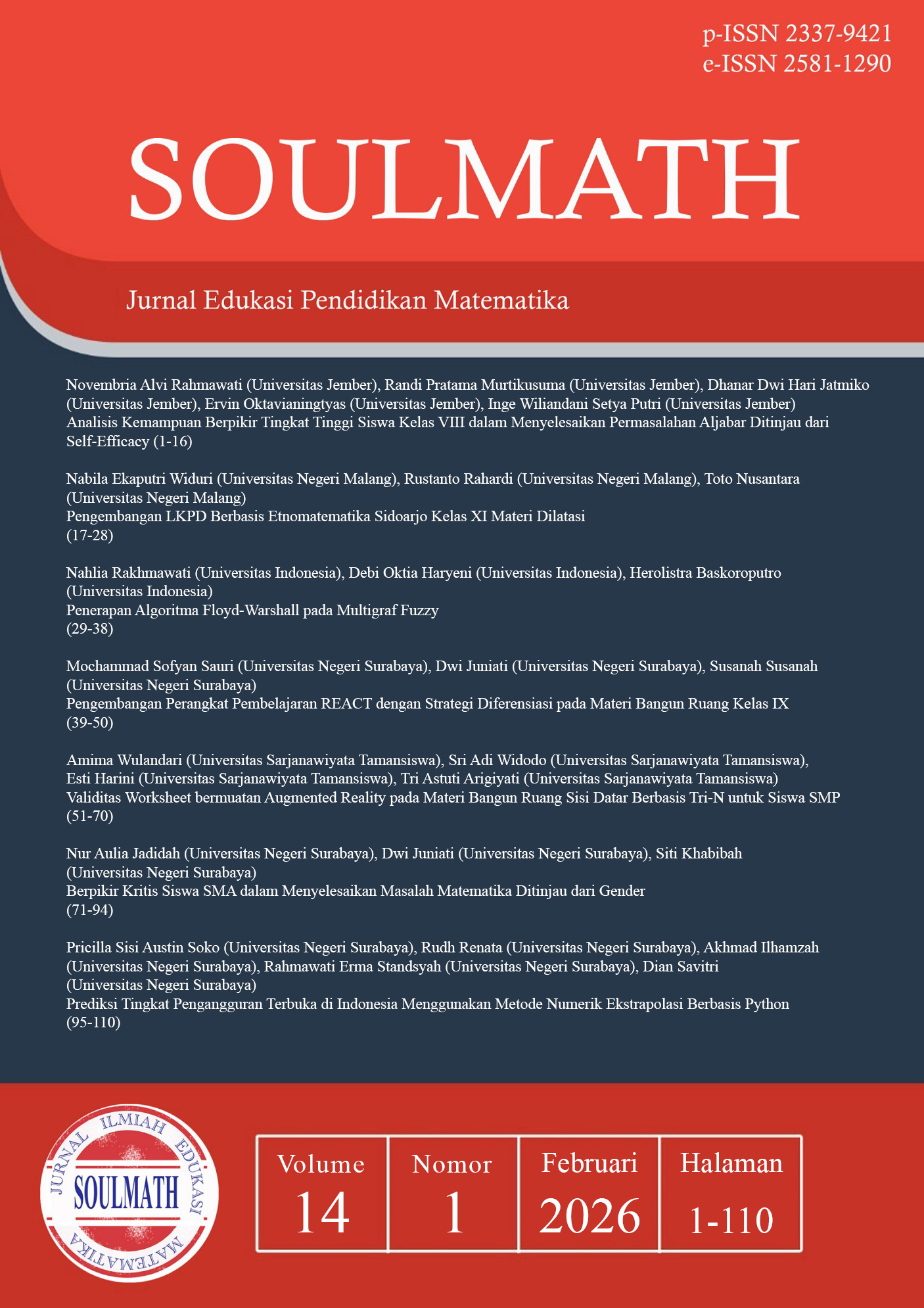
Pengembangan LKPD Berbasis Etnomatematika Sidoarjo Kelas XI Materi Dilatasi
DOI:
https://doi.org/10.25139/smj.v14i1.11236Abstract
Mathematics plays an essential role in daily life, requires effective learning, participatory and supported by media that helps visualize abstract concepts. The Merdeka Curriculum encourages differentiated learning and provides teachers with the freedom to develop engaging learning media, including student worksheets. Integrating ethnomathematics such as the local culture of Sidoarjo into the student worksheets can make learning more meaningful. Students still experience difficulties in geometry, particularly in dilation, making the development of an ethnomathematics-based student worksheets highly relevant. This study is a Research and Development using the Dick and Carey development model, which consists of ten stages, from identifying learning objectives to conducting summative evaluations. The research subjects were 34 grade XI-1 students from MAN Sidoarjo. The study focuses on the process and results of developing an ethnomathematics-based student worksheets for grade XI that is valid, practical, and effective. Data collection techniques include interviews, observations, questionnaires, tests, and documentation, using instruments such as the Learning Objective Flow, teaching modules, student worksheets, quiz questions, teacher and student questionnaires, observation sheets, and validation sheets.The results show that the ethnomathematics-based student worksheets on dilation for grade XI is feasible for use. Validity scores reached 100% for the learning objective flow, teaching module, student questionnaire, and teacher questionnaire; the student worksheets 96%, the quiz 95%, and the observation sheet 100%. Practicality scores for student responses 92%, teacher responses at 100%, and observation sheets at 100%. The effectiveness of the student worksheets is demonstrated by learning mastery, with 97% of students successfully completing the quiz.
Keywords: LKPD; Ethnomathematics; Sidoarjo; Dilation.
Downloads
References
I. Isnaningrum, Filsafat MIPA. Jakarta: Unindra Press, 2018
E. S. Indrayany and F. Lestari, “Penerapan pembelajaran blended learning untuk meningkatkan keaktifan belajar mandiri siswa kelas VII SMP pada materi perbandingan,” DIKSI: Jurnal Kajian Pendidikan dan Sosial, vol. 2, no. 2, pp. 68–76, 2021, doi: 10.53299/diksi.v2i2.115
S. K. Fazira and A. Qohar, “Development of pop-up book mathematics learning media on polyhedron topics,” Journal of Physics: Conference Series, vol. 1957, no. 1, 2021, doi: 10.1088/1742-6596/1957/1/012005
K. F. Jhahro, D. Trapsilasiwi, and T. Bara Setiawan, “Pemahaman konsep siswa pada pemecahan masalah soal geometri pokok bahasan segiempat ditinjau dari gaya kognitif reflektif-impulsif siswa,” KADIKMA: Jurnal Matematika dan Pendidikan Matematika, vol. 9, no. 1, pp. 116–122, 2018
A. Qohar, S. Susiswo, S. H. Nasution, and S. Wahyuningsih, “Development of Android-based mathematics learning game on the topic of congruence and similarity,” International Journal of Interactive Mobile Technologies, vol. 15, no. 9, pp. 52–69, 2021, doi: 10.3991/ijim.v15i09.20723
Zetriuslita, Nofriyandi, and E. Istikomah, “The effect of GeoGebra-assisted direct instruction on students’ self-efficacy and self-regulation,” Infinity Journal, vol. 9, no. 1, pp. 41–48, 2020, doi: 10.22460/infinity.v9i1.p41-48
W. Herwina, “Optimalisasi kebutuhan murid dan hasil belajar dengan pembelajaran berdiferensiasi,” Perspektif Ilmu Pendidikan, vol. 35, no. 2, pp. 175–182, 2021, doi: 10.21009/pip.352.10
T. Silvia, “Pengembangan lembar kerja peserta didik (LKPD) berbasis etnomatematika pada materi garis dan sudut,” Hipotenusa: Journal of Mathematical Society, vol. 1, no. 2, pp. 38–45, 2019, doi: 10.18326/hipotenusa.v1i2.38-45
Zaenuri and N. Dwidayati, “Exploring ethnomathematics: mathematics as a cultural product,” PRISMA, Prosiding Seminar Nasional Matematika, vol. 1, no. 1, pp. 471–476, 2018
H. A. Hasibuan and R. U. Hasanah, “Etnomatematika: eksplorasi transformasi geometri ornamen interior Balairung Istana Maimun sebagai sumber belajar matematika,” Jurnal Cendekia: Jurnal Pendidikan Matematika, vol. 6, no. 2, pp. 1614–1622, 2022, doi: 10.31004/cendekia.v6i2.1371
M. Kholil, M. Rooselyna, and S. A’yunin, “Analisis keyakinan matematis dan pengetahuan pedagogik calon guru matematika,” Jurnal Ilmiah SoulMath, vol. 10, no. 1, 2022
L. Maulida and A. Hidayat, “Pengembangan perangkat pembelajaran geometri transformasi berbasis konteks budaya lokal,” Jurnal Ilmiah SoulMath, vol. 9, no. 2, 2021
F. I. Maulani and L. S. Zanthy, “Analisis kesulitan siswa dalam menyelesaikan soal materi transformasi geometri,” Gammath: Jurnal Ilmiah Program Studi Pendidikan Matematika, vol. 5, no. 1, pp. 16–25, 2020, doi: 10.32528/gammath.v5i1.3189
W. Dick, L. Carey, and J. Carey, The Systematic Design of Instruction. 2015
S. Arikunto, Prosedur Penelitian Suatu Pendekatan Praktik. Jakarta: Rineka Cipta, 2016
E. P. Widoyoko, Teknik Penyusunan Instrumen Penelitian. Yogyakarta: Pustaka Pelajar, 2016
Ozerem, A, “Misconceptions in geometry and suggested solutions for seventh grade students,” Procedia – Social and Behavioral Sciences, 55, 720–729, 2012
Yılmaz, Z., & Sahin, S, “Difficulties encountered by students in learning transformation geometry,” International Journal of Science and Mathematics Education, 12(2), 397–420, 2014
Rosa, M., & Orey, D. C, “Ethnomathematics: the cultural aspects of mathematics,” Revista Latinoamericana de Etnomatematica, 4(2), 32–54, 2011
Sirate, F. S, “Menggagas integrasi multikultural pembelajaran matematika,” Jurnal Pendidikan Matematika, 1(1), 1–11, 2015
D’Ambrosio, U, “Ethnomathematics: Link between traditions and modernity,” Rotterdam: Sense Publishers, 2001
Prabawanto, S, Etnomatematika dalam pembelajaran matematika sekolah. Bandung: UPI Press, 2019
Downloads
Published
How to Cite
Issue
Section
License

Jurnal Ilmiah Soulmath by http://ejournal.unitomo.ac.id/index.php/mipa is licensed under a Creative Commons Attribution 4.0 International License.Â