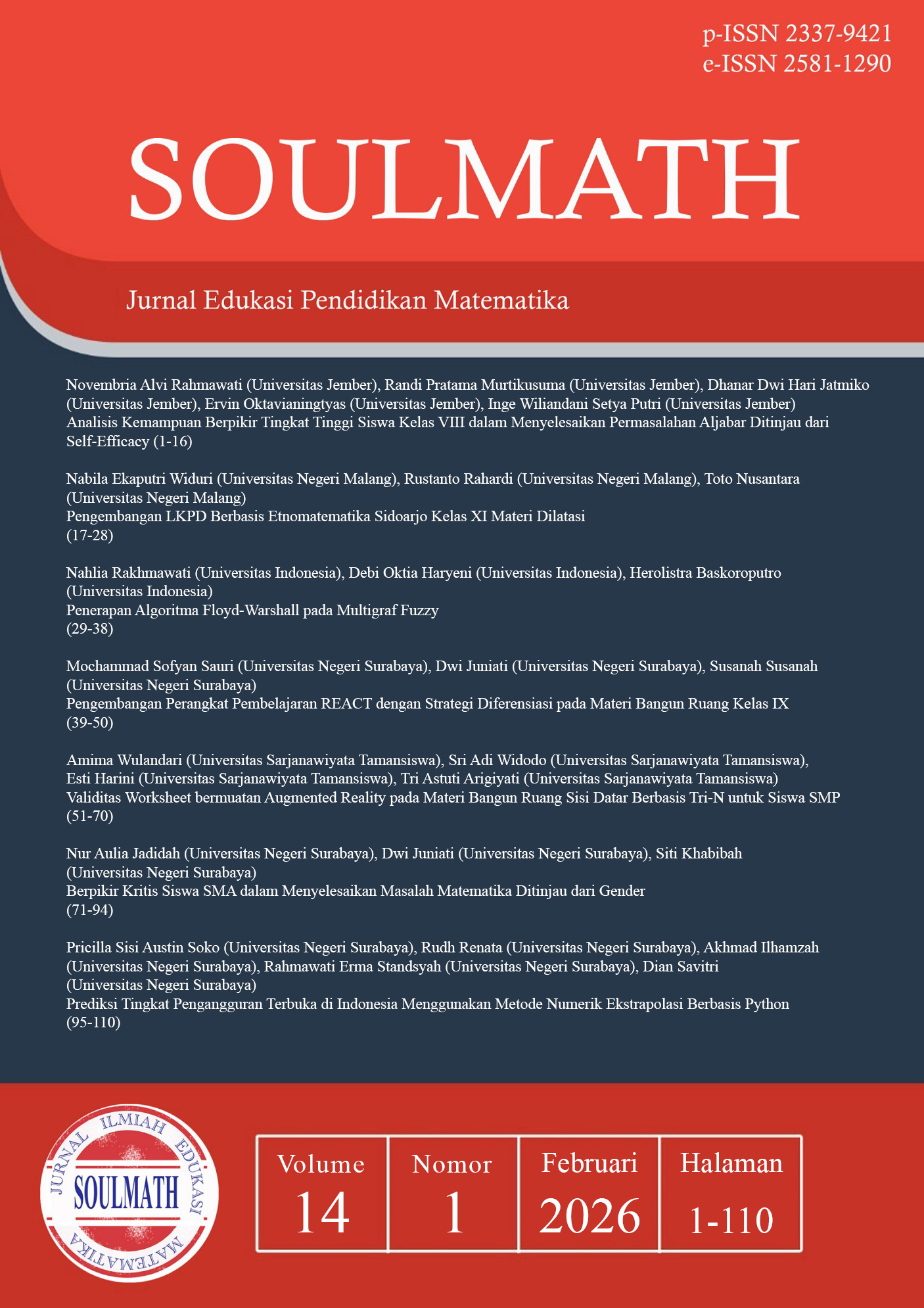
Berpikir Kritis Siswa SMA dalam Menyelesaikan Masalah Matematika Ditinjau dari Gender
DOI:
https://doi.org/10.25139/smj.v14i1.11546Abstract
Abstract
Critical thinking is an important 21st-century skill to be developed in mathematics learning because it supports students' ability to analyse information, evaluate arguments, and make logical decisions. One factor that influences students' critical thinking is gender. This study aims to describe high school students' critical thinking in solving mathematical problems in terms of gender roles (masculine and feminine) as measured by the Bem Sex Role Inventory (BSRI). This study is a qualitative descriptive study with two subjects from class X MAN 7 Jombang, namely one masculine male student and one feminine female student, who were selected purposively to describe the critical thinking process in depth. Data were collected through problem-solving tasks and interviews, then analysed using the Miles and Huberman model, which includes data reduction, data presentation, and conclusion drawing. Critical thinking analysis was conducted based on Polya's problem-solving stages. The results showed that masculine male students had an inconsistent critical thinking process, especially in the implementation and review stages, characterised by substitution errors and a lack of thoroughness and evaluation of the solution process. In contrast, feminine female students demonstrated a more systematic and consistent critical thinking process, particularly in understanding the problem, planning, and implementing the solution in a sequential and thorough manner, although they did not consider alternative strategies. These findings indicate differences in critical thinking characteristics based on gender roles and imply that teachers need to design learning that is adaptive to student characteristics in developing mathematical critical thinking.
Keywords: critical thinking, mathematical problems, problem solving, gender
Abstrak
Berpikir kritis merupakan keterampilan abad ke-21 yang penting dikembangkan dalam pembelajaran matematika karena mendukung kemampuan siswa dalam menganalisis informasi, mengevaluasi argumen, dan mengambil keputusan secara logis. Salah satu faktor yang memengaruhi berpikir kritis siswa adalah gender. Penelitian ini bertujuan untuk mendeskripsikan berpikir kritis siswa SMA dalam menyelesaikan masalah matematika ditinjau dari gender roles (maskulin dan feminin) yang diukur berdasarkan Bem Sex Role Inventory (BSRI). Penelitian ini merupakan penelitian deskriptif kualitatif dengan dua subjek kelas X MAN 7 Jombang, yaitu satu siswa laki-laki maskulin dan satu siswa perempuan feminin, yang dipilih secara purposif untuk menggambarkan proses berpikir kritis secara mendalam. Data dikumpulkan melalui tugas penyelesaian masalah dan wawancara, kemudian dianalisis menggunakan model Miles dan Huberman yang meliputi reduksi data, penyajian data, dan penarikan kesimpulan. Analisis berpikir kritis dilakukan berdasarkan tahapan pemecahan masalah Polya. Hasil penelitian menunjukkan bahwa siswa laki-laki maskulin memiliki proses berpikir kritis yang kurang konsisten, terutama pada tahap pelaksanaan dan pemeriksaan kembali, ditandai dengan kesalahan substitusi dan kurangnya ketelitian serta evaluasi menyeluruh terhadap proses penyelesaian. Sebaliknya, siswa perempuan feminin menunjukkan proses berpikir kritis yang lebih sistematis dan konsisten, khususnya dalam memahami masalah, merencanakan, dan melaksanakan penyelesaian secara runtut dan teliti, meskipun belum mempertimbangkan strategi alternatif. Temuan ini mengindikasikan adanya perbedaan karakteristik berpikir kritis berdasarkan gender roles serta memberikan implikasi bahwa guru perlu merancang pembelajaran yang adaptif terhadap karakteristik siswa dalam mengembangkan berpikir kritis matematis.
Kata Kunci: berpikir kritis, masalah matematika, penyelesaian masalah, gender.
Downloads
References
Bialik, M., & Fadel, C. (2015). Skills for the 21 st Century: What should students learn? In Center for Curriculum Redesign (Number 4). Massachusetts.
Ennis, R. H. (1991). Critical Thinking: A Streamlined Conception. Teaching Philosophy.
Ennis, R. H. (1996). Critical Thinking. Prentice Hall.
Dhayanti, D., Johar, R., & Zubainur, C. M. (2018). Improving students’ critical and creative thinking through realistic mathematics education using Geometer’s Sketchpad. JRAMathEdu (Journal of Research and Advances in Mathematics Education), 3(1), 25. https://doi.org/https://doi.org/10.23917/jramathedu.v3i1.5618.
Chasanah, A. N. (2019). Cognitive growth learning model to improve the students’ critical thinking skills. JRAMathEdu (Journal of Research and Advances in Mathematics Education), 4(2), 112–123. https://doi.org/https://doi.org/10.23917/jramathedu.v4i2.8127.
Sari, N., Destiniar, & Octaria, D. (2022). Kemampuan Berpikir Kritis Peserta Didik SMA Ditinjau dari Gender Pada Materi Trigonometri. Suska Journal of Mathematics Education, 8(2), 97–106. https://doi.org/http://dx.doi.org/10.24014/sjme.v8i2.17933.
Susilowati, Sajidan, & Ramli, M. (2018). The Effectiveness of Inquiry-Based Module to Empower the Students’ Critical Thinking Skills. Advances in Social Science, Education and Humanities Research, 218.
OECD, (Organisation for Economic Co-operation and Development). (2023). PISA 2022 Results (Volume I): The State of Learning and Equity in Education.
Kusaeri, & Aditomo, A. (2019). Pedagogical Beliefs about Critical Thinking among Indonesian Mathematics Pre-service Teachers. International Journal of Instruction, 12(1), 573–590. www.e-iji.net.
Polya, G. (2004). How to Solve It: A New Aspect of Mathematical Method. Princeton University Press.
Puspitawati, H. (2012). Gender dan Keluarga: Konsep dan Realita di Indonesia (Elviana, Ed.; 1st ed.). PT Penerbit IPB Press.
Leaper, C. (2014). Parents’ Socialization of Gender in Children. Encyclopedia on Early Childhood Development “13”.
Bem, S. L. (1974). The Measurement Of Psychological Androgyny. Journal of Consulting and Clinical
Psychology, 42(2), 155–162.
Mesman, J., & Groeneveld, M. G. (2018). Gendered Parenting in Early Childhood: Subtle But Unmistakable if You Know Where to Look. Child Development Perspectives, 12(1), 22–27. https://doi.org/10.1111/cdep.12250.
Syam, H., Sutawidjaja, A., Sa’dijah, C., & abadyo. (2018). The critical thinking profile of junior high school students in solving geometry problems. International Journal of Multidisciplinary Research and Development , 5(7), 33–37. www.allsubjectjournal.com.
Prameswari, A. N. R., & Ismail, I. (2023). Keterampilan Berpikir Kritis Siswa SMP dalam Memecahkan Masalah Matematika Kontekstual Ditinjau dari Kemampuan Matematika dan Perbedaan Jenis Kelamin. MATHEdunesa, 12(3), 946–981. https://doi.org/10.26740/mathedunesa.v12n3.p946-981.
Facione, P. A. (2015). Critical Thinking: What It Is and Why It Counts. Insight Assessment.
Sugiarti, L., Tamur, M., Jehadus, E., Jundu, R., & Limur, M. (2023). Analysis Of Students’ Mathematical Critical Thinking Ability Reviewed In Solving Mathematics Problems From Gender Differences. Jurnal Pendidikan Matematika (JUPITEK), 6(2), 108–113. https://doi.org/10.30598/jupitekvol6iss2pp108-113.
Paul, Richard., & Elder, Linda. (2019). The miniature guide to critical thinking concepts and tools (8th ed.). Rowman & Littlefield.
Brookfield, S. D. (2012). Teaching for Critical Thinking. Jossey-Bass.
Putriani, F. M., & Purnomo, Y. W. (2025). Analysis of Mathematical Reflective Thinking Skills in Solving Problems in Terms of Gender Differences. Jurnal Paedagogy, 12(2), 285–293. https://doi.org/10.33394/jp.v12i2.14758.
Downloads
Published
How to Cite
Issue
Section
License

Jurnal Ilmiah Soulmath by http://ejournal.unitomo.ac.id/index.php/mipa is licensed under a Creative Commons Attribution 4.0 International License.Â