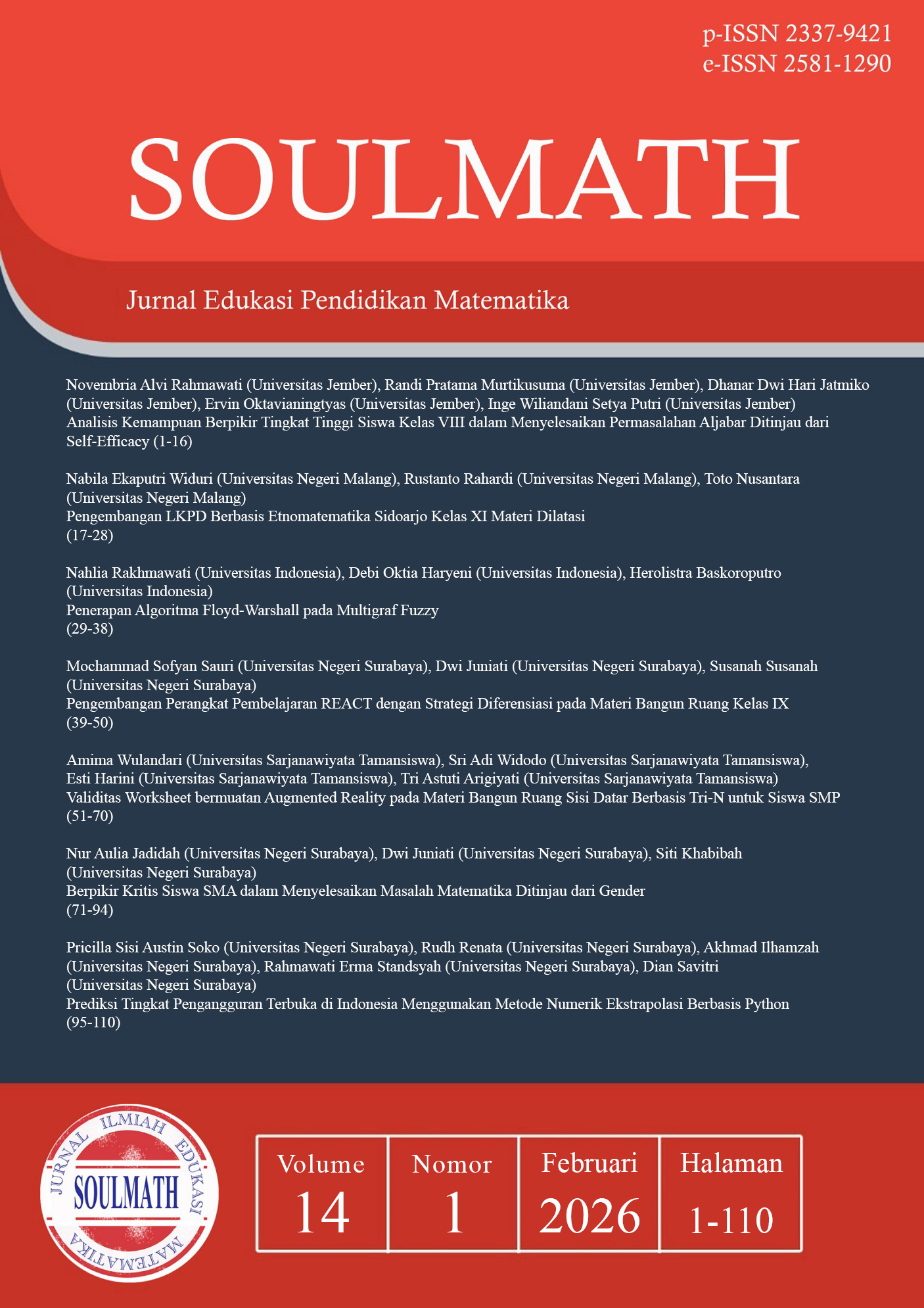
Prediksi Tingkat Pengangguran Terbuka di Indonesia Menggunakan Metode Numerik Ekstrapolasi Berbasis Python
DOI:
https://doi.org/10.25139/smj.v14i1.11547Abstract
Abstract
The Open Unemployment Rate (OUR) is a strategic indicator reflecting labor market conditions and the effectiveness of national economic development policies. The development of Indonesia’s OUR during the 2015-2023 period exhibits a fluctuating pattern, influenced by structural economic dynamics and external shocks, thereby necessitating a predictive approach to support medium-term policy planning. This study aims to analyze the trend of Indonesia’s OUR, project its development through 2029 using a numerical approach, and assess the role of numerical methods as policy-support tools aligned with national development directions. The method employed is numerical extrapolation Lagrange polynomials using time-series OUR data. The results indicate that utilizing the entire historical dataset produces unstable and unrealistic projections due to the emergence of the Runge phenomenon. In contrast, restricting the model to more recent data yields stable and economically plausible projections. The projected OUR for the 2025-2029 period lies within the range of approximately ±4.46% to ±4.81%, reflecting a post-pandemic downward trend and remaining consistent with recent data patterns. These findings demonstrate that numerical approaches can provide relevant quantitative insights into the future trajectory of unemployment and have the potential to function as supportive instruments in labor policy formulation, provided they are applied cautiously and not used as the sole basis for decision-making.
Keywords: Unemployment Rate; Extrapolation; Prediction; Python; Analysis.
Downloads
References
Badan Pusat Statistik, “Tingkat Pengangguran Terbuka Menurut Provinsi (Persen),” Badan Pusat Statistik, 2024. https://www.bps.go.id/id/statistics-table/2/NTQzIzI=/tingkat-pengangguran-terbuka-menurut-provinsi--persen-.html.
V. R. Krisnandika, D. Aulia, and L. Jannah, “Dampak Pandemi Covid-19 Terhadap Pengangguran Di Indonesia,” JISIP (Jurnal Ilmu Sos. dan Pendidikan), vol. 5, no. 4, pp. 720–729, 2021, doi: https://doi.org/10.58258/jisip.v5i4.2229.
C. E. Cabui, “Refleksi Kinerja Pemerintahan Presiden Jokowi Selama Tiga Tahun Pada Periode Kedua Pemerintahan,” J. Adhikari, vol. 1, no. 04, pp. 221–225, 2022, doi: https://doi.org/10.53968/ja.v1i4.51.
T. K. N. Prabowo-Gibran, “Visi dan 8 Misi Asta Cita serta Program Prioritas Prabowo-Gibran 2024.” Tim Kampanye Nasional Prabowo-Gibran, Indonesia, 2024, [Online]. Available: https://gerindra.id/wp-content/uploads/2024/10/33.-Asta-Cita-Visi-Misi-Prabowo-Gibran.pdf.
A. Sulaiman and A. Juarna, “Peramalan Tingkat Pengangguran Di Indonesia Menggunakan Metode Time Series Dengan Model Dengan Model Arima Dan Holt-Winters,” J. Ilm. Inform. Komput., vol. 26, no. 1, pp. 13–28, 2021, doi: https://doi.org/10.35760/ik.2021.v26i1.3512.
M. W. M. Roos and U. Schmidt, “The Importance of Time-Series Extrapolation for Macroeconomic Expectations,” Ger. Econ. Rev., vol. 13, no. 2, pp. 196–210, 2019, doi: https://doi.org/10.1111/j.1468-0475.2011.00551.x.
A. Alonso Rodríguez, L. Bruni Bruno, and F. Rapetti, “Whitney edge elements and the Runge phenomenon,” J. Comput. Appl. Math., vol. 427, p. 115117, 2023, doi: https://doi.org/10.1016/j.cam.2023.115117.
M. A. Wahab, “Interpolation and Extrapolation,” in “Topics in System Engineering,” 2017, pp. 1–6, [Online]. Available: https://www.researchgate.net/publication/313359516_Interpolation_and_Extrapolation.
F. Endriyani, “Pengaruh Jumlah Penduduk, Indeks Pembangunan Manusia (IPM), dan Tingkat Pengangguran Terbuka (TPT) terhadap Tingkat Kemiskinan Dalam Perspektif Ekonomi Islam Periode Tahun 2018-2022,” UIN Raden Intan Lampung, Indonesia, 2024.
OECD, “OECD Employment Outlook 2022: Building Back More Inclusive Labour Markets,” OECD Publishing, Paris, 2022. doi: https://doi.org/10.1787/1bb305a6-en.
J. M. A. C. Permata and M. Habibi, “Autoregressive Integrated Moving Average (ARIMA) Models For Forecasting Sales Of Jeans Products,” Telemat. J. Inform. dan Teknol. Inf., vol. 20, no. 1, pp. 31–40, 2023, doi: https://doi.org/10.31315/telematika.v20i1.7868.
N. I. Khair, Ruslan, and Agusrawati, “Forecasting Analysis of Electricity Consumption in East Kolaka and Konawe Districts Using Prophet Method,” J. Mat. Stat. dan Komputasi, vol. 21, no. 3, pp. 832–846, 2025, doi: https://doi.org/10.20956/j.v21i3.43563.
D. M. Devia-Narváez, G. Correa-Vélez, and F. Mesa, “Comparison between some techniques of interpolators: An application in engineering,” Sci. Tech., vol. 24, no. 01, pp. 173–178, 2019, doi: https://doi.org/10.22517/23447214.21341.
R. M. Alfaritdzi and A. Prathama, “Peran Balai Pelatihan Vokasi Dan Produktivitas (BPVP) Dalam Mengurangi Angka Pengangguran,” J. Kebijak. Publik, vol. 14, no. 1, pp. 111–118, 2023, doi: https://doi.org/10.31258/jkp.v14i1.8171.
R. L. Burden and J. D. Faires, Numerical Analysis, 9th ed. Boston: Richard Stratton, 2011.
T. N. Hidayah, A. K. Nisa, and A. Wibowo, “Implementasi Polinomial Lagrange dalam Prediksi Jumlah Kelahiran di Indonesia menggunakan Microsoft Excel,” Fermat J. Pendidik. Mat., vol. 8, no. 1, pp. 35–43, 2025, doi: https://doi.org/10.36277/defermat.v8i1.2251.
A. Zemkoho, “A Basic Time Series Forecasting Course with Python,” Oper. Res. Forum, vol. 4, no. 2, pp. 1–43, 2022, doi: https://doi.org/10.1007/s43069-022-00179-z.
H. R. Baedowi, Nur Hidayati, and A. Wibowo, “Studi Komparatif Turunan Numerik dengan Metode Selisih Menggunakan Python dan Maple: Akurasi dan Kemudahan Implementasi,” Leibniz J. Mat., vol. 5, no. 02, pp. 76–92, 2025, doi: https://doi.org/10.59632/leibniz.v5i02.534.
D. Hall, Mathematical Computing with Python, 1st ed. California: NICE CXone Expert, 2026.
Downloads
Published
How to Cite
Issue
Section
License

Jurnal Ilmiah Soulmath by http://ejournal.unitomo.ac.id/index.php/mipa is licensed under a Creative Commons Attribution 4.0 International License.Â