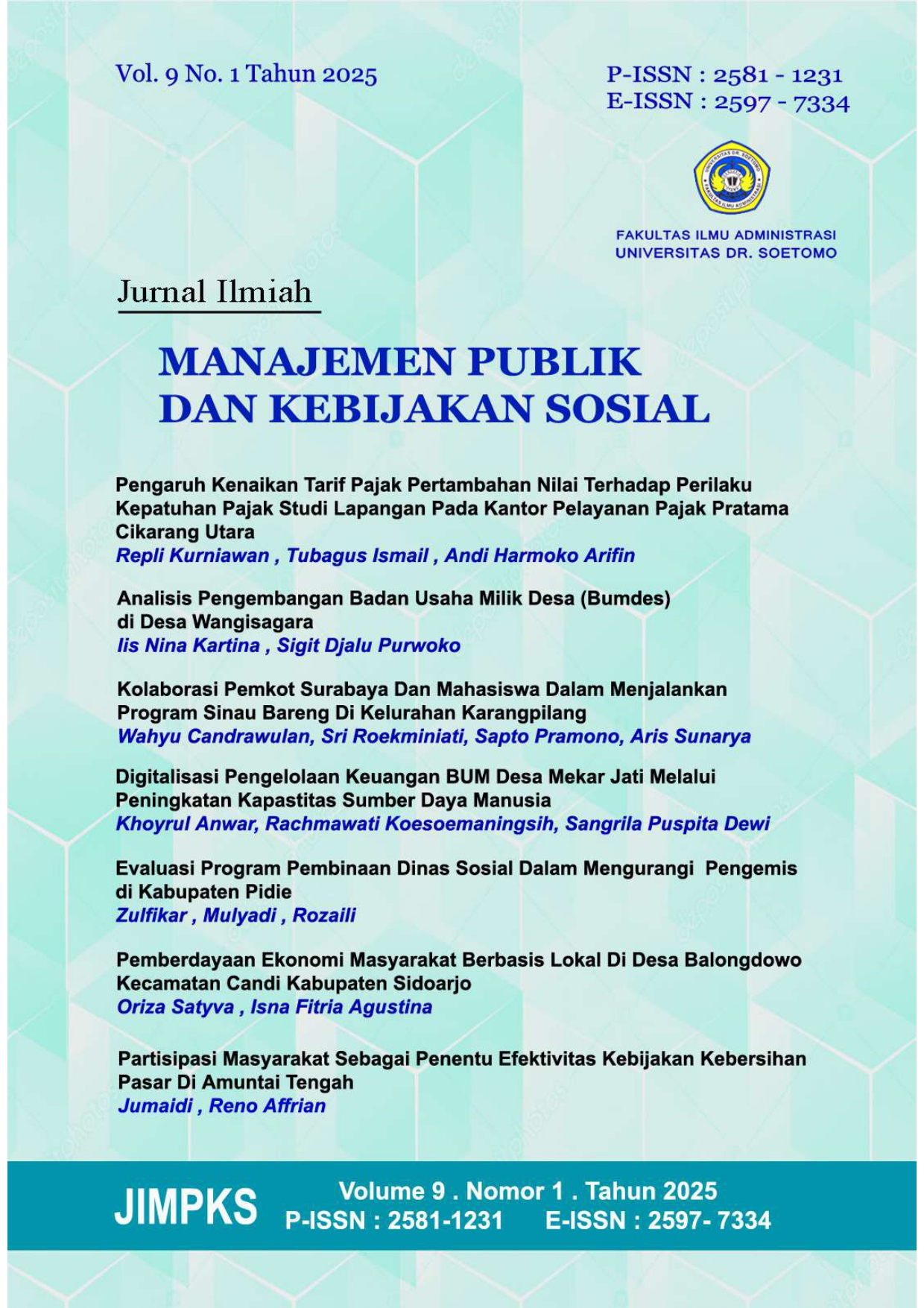
Pemberdayaan Ekonomi Masyarakat Berbasis Lokal Di Desa Balongdowo Kecamatan Candi Kabupaten Sidoarjo
DOI:
https://doi.org/10.25139/jmnegara.v9i1.10498Keywords:
Community Empowerment, Hutomo's Theory, Local UMKMAbstract
The purpose of this study was to analyze and describe efforts to empower the community's economy through a local economic approach according to three main aspects of Hutomo's theory, namely resources, infrastructure, and capital. The research method applied is descriptive qualitative, with data collection techniques through observation, interviews, and documentation. The data analysis technique uses the Miles and Huberman model, including data collection, data reduction, data presentation, and drawing conclusions. The results of this study indicate findings, namely first, from the aspect of human and natural resources, MSME actors have promoted on social media to introduce MSME products and the village government helps MSME actors in administrative matters such as issuing business certificates. Second, from the aspect of facilities and infrastructure, MSME actors make processed products for out-of-town shipping and receive capital assistance from the cooperative office. Third, from the aspect of capital, MSME actors in building a business use personal capital supplemented by capital from external parties and marketing is carried out offline and online.
References
Arisky, Y., & Satriya, H. E. (2022). Perkembangan Kehidupan Sosial Ekonomi Nelayan Kupang Di Desa Balongdowo Kecamatan Candi Kabupaten Sidoarjo Tahun 1990-2020. Journal Pendidikan Sejarah, 12(4), 1–9.
Asrulla, R., Jailani, M. S., & Jeka, F. (2023). Populasi dan sampling (kuantitatif), serta pemilihan informan kunci (kualitatif) dalam pendekatan praktis. Jurnal Pendidikan Tambusai, 7(3), 26320–26332.
Badan Pusat Statistik Kabupaten Sidoarjo. (2023). Kecamatan Candi Dalam Angka 2023. Sidoarjokab.Bps.Go.Id. https://sidoarjokab.bps.go.id/id/publication/2023/09/26/3f30cc76a1daa6f666225595/kecamatan-candi-dalam-angka-2023.html
Chairina, N., Muhayati, Y., Fawwaz, F., Amelianur, M. H., & Aldiansyah, R. (2025). STRATEGI PEMASARAN UMKM DESA PARIGI. GANESHA: Jurnal Pengabdian Masyarakat, 5(1), 229–237.
Chambers, R. (1995). Poverty and livelihoods: whose reality counts? Environment and Urbanization. Sage Journal, 7(1), 173–204. https://doi.org/https://doi.org/10.1177/095624789500700106
Haslinah, A., Tahir, U., Al Imran, H., Asfahani, A., & Larisu, Z. (2023). Pemberdayaan Masyarakat Dalam Program Lingkungan Hijau Bebas Polusi Di Kota Makassar. Community Development Journal: Jurnal Pengabdian Masyarakat, 4(4), 8906–8912. http://journal.universitaspahlawan.ac.id/index.php/cdj/article/view/20062
Hutomo, M. Y. (2000). Pemberdayaan Masyarakat dalam Bidang Ekonomi: Tinjauan Teoritik dan Implementasi. Bappenas.
Kabeer, N. (1999). Resources, Agency, Achievements: Reflections on the Measurement of Women’s Empowerment. Development and Change, 30(3), 435–464. https://doi.org/https://doi.org/10.1111/1467-7660.00125
Kaplan, A. (1999). The development of capacity. United Nations Non-Governmental Service (NGLS).
Korten, D. C. (1984). Strategic organization for people-centered development. Public Administration Review, 44(4), 341–352.
Miles, M. B., & Huberman, A. M. (2014). Qualitative data analysis a methods sourcebook (3rd ed.). SAGE Publications.
Narayan, D. P. (2005). Measuring empowerment: Cross-disciplinary perspectives. World Bank Publications.
Nugroho, R. H., & Andarini, S. (2020). Strategi pemberdayaan UMKM di pedesaan berbasis kearifan lokal di era industri 4.0 menuju era society 5.0. Jurnal Bisnis Indonesia, 1(01).
Rifa’i, Y. (2023). Analisis Metodologi Penelitian Kulitatif dalam Pengumpulan Data di Penelitian Ilmiah pada Penyusunan Mini Riset. Cendekia Inovatif Dan Berbudaya, 1(1), 31–37.
Saputri, S., Dwi Putri, F., Mustari, O., Riyadi, A., Khatijah, S., & Wahyuni, S. (2024). Pemberdayaan Masyarakat Pesisir Berbasis Pengembangan Potensi Di Desa Mantang Lama, Kabupaten Bintan. Jurnal Sosiologi Nusantara, 10(1), 103–123. https://doi.org/10.33369/jsn.10.1.103-123
Tojiri, Y., Putra, H. S., & Faliza, N. (2023). Dasar Metodologi Penelitian: Teori, Desain, dan Analisis Data. Yayasan Cendikia Mulia Mandiri.
Yani, A., & Mustamiin, M. Z. (2024). IMPLEMENTASI PEMBERDAYAAN MASYARAKAT EKONOMI KREATIF PADA MASYARAKAT DUSUN MONTONG MESIRDESA BOROK TOYANG. Journal Ilmiah Rinjani (JIR), 12(1), 48–55.
Downloads
Published
How to Cite
Issue
Section
License
Authors who publish with JIMPKS: Jurnal Ilmiah Manajemen Publik dan Kebijakan Sosial agree to the following terms:
-
Authors retain copyright and grant the journal right of first publication with the work simultaneously licensed under a Creative Commons Attribution License (CC BY-SA 4.0) that allows others to share the work with an acknowledgment of the work's authorship and initial publication in this journal.
-
Authors are able to enter into separate, additional contractual arrangements for the non-exclusive distribution of the journal's published version of the work (e.g., post it to an institutional repository or publish it in a book), with an acknowledgment of its initial publication in this journal.
-
Authors are permitted and encouraged to post their work online (e.g., in institutional repositories or on their website) prior to and during the submission process, as it can lead to productive exchanges, as well as earlier and greater citation of published work.