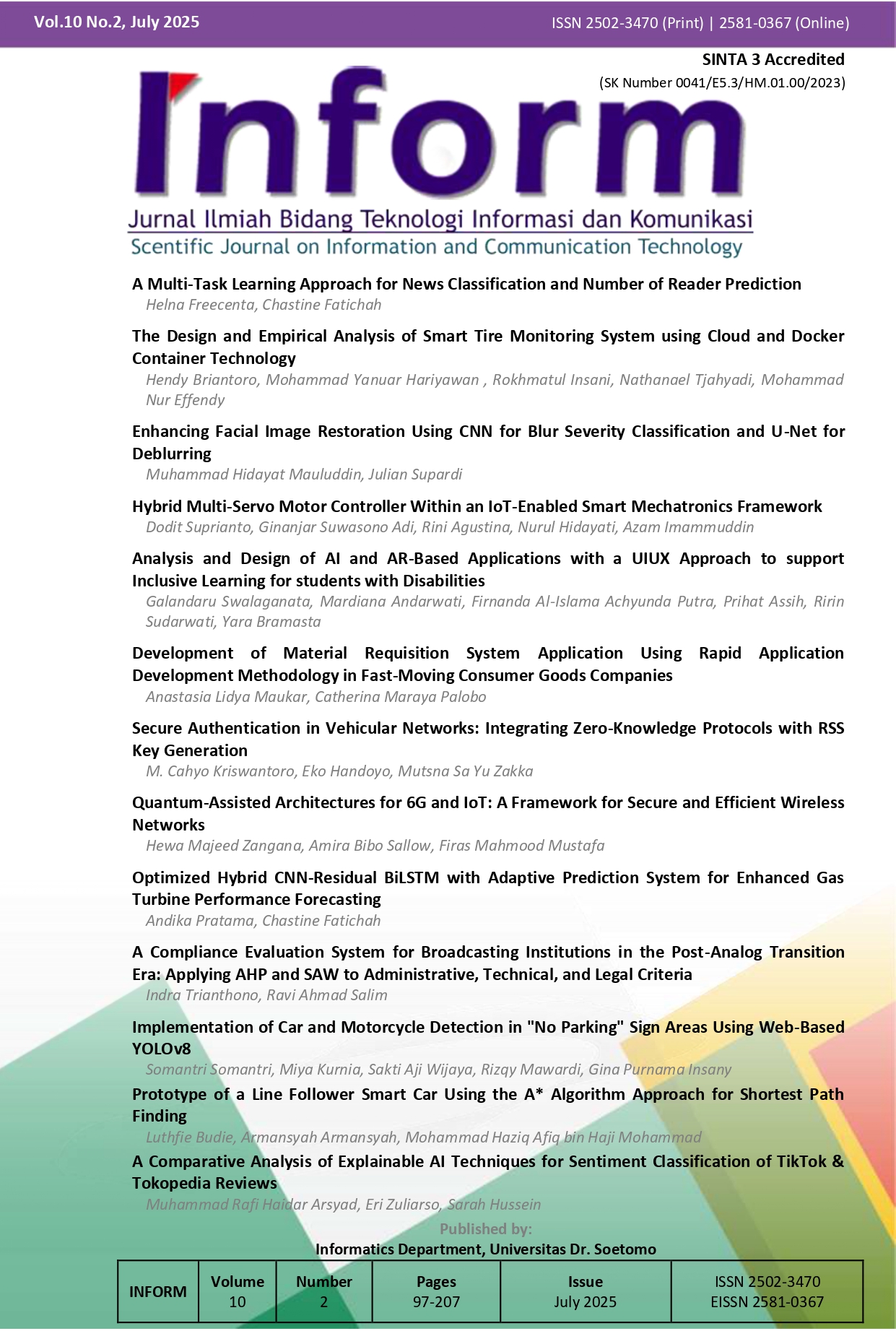
A Compliance Evaluation System for Broadcasting Institutions in the Post-Analog Transition Era: Applying AHP and SAW to Administrative, Technical, and Legal Criteria
DOI:
https://doi.org/10.25139/inform.v10i2.10496Keywords:
Analytical Hierarchy Process, Simple Additive Weighting, Radio Broadcasting Compliance, Decision Support System, Regulatory EvaluationAbstract
This study addresses the pressing need for systematic compliance evaluation of radio broadcasting institutions in Indonesia amid the country's transition to digital broadcasting. As the Ministry of Communication and Information Technology mandates adherence to new regulatory frameworks, ensuring broadcaster compliance has become critical for maintaining media accountability, quality, and governance. To evaluate compliance across administrative, technical, and legal dimensions, this study integrates the Analytic Hierarchy Process (AHP) to determine priority weights and the Simple Additive Weighting (SAW) method to rank 527 radio broadcasters. The AHP method achieved a consistency ratio (CR) of less than 0.1, validating expert-based weight assignments for eight regulatory criteria, including licensing, permit payment, technical equipment standards, and ownership reporting. The SAW method then translated these weights into performance scores, categorizing stations into three compliance levels: High (382 providers, with an average score of 100%), Moderate (120 providers, with an average score of 83.65%), and Low (25 providers, with an average score of 50.85%). These results indicate a relatively high regulatory compliance among radio broadcasters, suggesting improved institutional awareness and the effectiveness of current oversight mechanisms. A data-driven Decision Support System (DSS) developed from this framework offers regulators a scalable tool for formulating targeted policies and interventions based on measurable compliance outcomes.
References
F. Sidiq, "The Role and Challenges of Indonesian Broadcasting Commission (KPI) in Facing the Digitalization Era of Broadcasting Media in Indonesia," Int. J. Linguist. Commun. Broadcast., vol. 1, no. 4, pp. 15–19, Sep. 2023, doi: 10.46336/ijlcb.v1i4.24.
E. Thanassoulis, P. K. Dey, K. Petridis, I. Goniadis, and A. C. Georgiou, "Evaluating higher education teaching performance using combined analytic hierarchy process and data envelopment analysis," J. Oper. Res. Soc., vol. 68, no. 4, pp. 431–445, Apr. 2017, doi: 10.1057/s41274-016-0165-4.
H. Li, T. Li, Q. Yao, W. Li, L. Yang, and G. Sun, "Risk Assessment of Power Monitoring System Based on Fuzzy Analytical Hierarchy Process," J. Phys. Conf. Ser., vol. 2137, no. 1, p. 012023, Dec. 2021, doi: 10.1088/1742-6596/2137/1/012023.
X. Jiang and Y. Zhang, "THE DEVELOPMENT OF PUBLIC HEALTH SPORTS IN COLLEGES AND UNIVERSITIES BASED ON THE ANALYTIC HIERARCHY PROCESS," Rev. Bras. Med. do Esporte, vol. 27, no. spe, pp. 73–75, Mar. 2021, doi: 10.1590/1517-8692202127012020_0119.
H. Kamal El-Din, H. E. Abd El Munim, and H. Mahdi, "Decision-Making in Fuzzy Environment: A Survey," in Application of Decision Science in Business and Management, IntechOpen, 2020. doi: 10.5772/intechopen.88736.
D. Indrawan, A. V. Vitianingsih, and R. N. T. Shanty, “Implementasi Metode Simple Additive Weighting pada Sistem Pendukung Keputusan Pemilihan Pemasok Bahan Baku di PT. Abadi Kimia,” Inf. J. Ilm. Bid. Teknol. Inf. dan Komun., vol. 1, no. 1, Jul. 2017, doi: 10.25139/inform.v1i1.213.
A. M. T. Utomo, “Pemodelan Cluster Loyalitas Customer Menggunakan Algoritma K-Means Dengan Parameter LRIFMQ,” Inf. J. Ilm. Bid. Teknol. Inf. dan Komun., vol. 5, no. 2, pp. 54–61, Aug. 2020, doi: 10.25139/inform.v5i2.2691.
M. Pinho and A. Moura, "A decision support system to solve the problem of health care priority-setting," J. Sci. Technol. Policy Manag., vol. 13, no. 3, pp. 610–624, Aug. 2022, doi: 10.1108/JSTPM-01-2021-0008.
D. Kurniawati, F. N. Lenti, and R. W. Nugroho, "Implementation of AHP and SAW Methods for Optimization of Decision Recommendations," J. Int. Conf. Proc., vol. 4, no. 1, pp. 254–265, Jul. 2021, doi: 10.32535/jicp.v4i1.1152.
J. Stofkova, M. Krejnus, K. R. Stofkova, P. Malega, and V. Binasova, "Use of the Analytic Hierarchy Process and Selected Methods in the Managerial Decision-Making Process in the Context of Sustainable Development," Sustainability, vol. 14, no. 18, p. 11546, Sep. 2022, doi: 10.3390/su141811546.
K. Schmidt, I. Aumann, I. Hollander, K. Damm, and J.-M. G. von der Schulenburg, "Applying the Analytic Hierarchy Process in healthcare research: A systematic literature review and evaluation of reporting," BMC Med. Inform. Decis. Mak., vol. 15, no. 1, p. 112, Dec. 2015, doi: 10.1186/s12911-015-0234-7.
N. Arisanti, N. Rema, I. G. N. Jayanti, and P. Jeraman, "Application of the AHP Method in the Study of Archaeological Resources Management Based on Indigenous Community in Central Sumba Regency," 2023, pp. 370–379. doi: 10.2991/978-2-38476-070-1_32.
H. S. Alsamaray, "AHP as Multi-criteria Decision Making Technique, Empirical Study in Cooperative Learning at Gulf University," Eur. Sci. Journal, ESJ, vol. 13, no. 13, p. 272, May 2017, doi: 10.19044/esj.2017.v13n13p272.
R. F. Batubara and A. H. Hasugian, "Decision Support System For New Employee Acceptance Using AHP and SAW Method," INTECOMS J. Inf. Technol. Comput. Sci., vol. 6, no. 2, pp. 641–649, Aug. 2023, doi: 10.31539/intecoms.v6i2.7371.
M. Liu, X. Zhu, Y. Chen, and Q. Kong, "Evaluation and design of dining room chair based on analytic hierarchy process (AHP) and fuzzy AHP," BioResources, vol. 18, no. 2, pp. 2574–2588, Feb. 2023, doi: 10.15376/biores.18.2.2574-2588.
H. Liu, X. Wang, G. Tan, X. He, and G. Luo, "System Reliability Evaluation of Prefabricated RC Hollow Slab Bridges Considering Hinge Joint Damage Based on Modified AHP," Appl. Sci., vol. 9, no. 22, p. 4841, Nov. 2019, doi: 10.3390/app9224841.
S. K. Sahoo and S. S. Goswami, "A Comprehensive Review of Multiple Criteria Decision-Making (MCDM) Methods: Advancements, Applications, and Future Directions," Decis. Mak. Adv., vol. 1, no. 1, pp. 25–48, Dec. 2023, doi: 10.31181/dma1120237.
K. Nishizawa, "Normalization Method Based on Dummy Alternative with Perfect Evaluation Score in AHP and ANP," 2012, pp. 253–262. doi: 10.1007/978-3-642-29977-3_26.
C. F. Goh, T. Chen, and L. Chien, "The indicators of human capital for hospital‐based nursing workforce in Taiwan," J. Nurs. Manag., vol. 28, no. 3, pp. 577–585, Apr. 2020, doi: 10.1111/jonm.12959.
M. Papathoma-Köhle, A. Ghazanfari, R. Mariacher, W. Huber, T. Lücksmann, and S. Fuchs, "Vulnerability of Buildings to Meteorological Hazards: A Web-Based Application Using an Indicator-Based Approach," Appl. Sci., vol. 13, no. 10, p. 6253, May 2023, doi: 10.3390/app13106253.
Downloads
Published
How to Cite
Issue
Section
License
Authors who publish with Inform: Jurnal Ilmiah Bidang Teknologi Informasi dan Komunikasi agree to the following terms:
-
Authors retain copyright and grant the journal right of first publication with the work simultaneously licensed under a Creative Commons Attribution License (CC BY-SA 4.0) that allows others to share the work with an acknowledgment of the work's authorship and initial publication in this journal.
-
Authors are able to enter into separate, additional contractual arrangements for the non-exclusive distribution of the journal's published version of the work (e.g., post it to an institutional repository or publish it in a book), with an acknowledgment of its initial publication in this journal.
-
Authors are permitted and encouraged to post their work online (e.g., in institutional repositories or on their website) prior to and during the submission process, as it can lead to productive exchanges, as well as earlier and greater citation of published work.