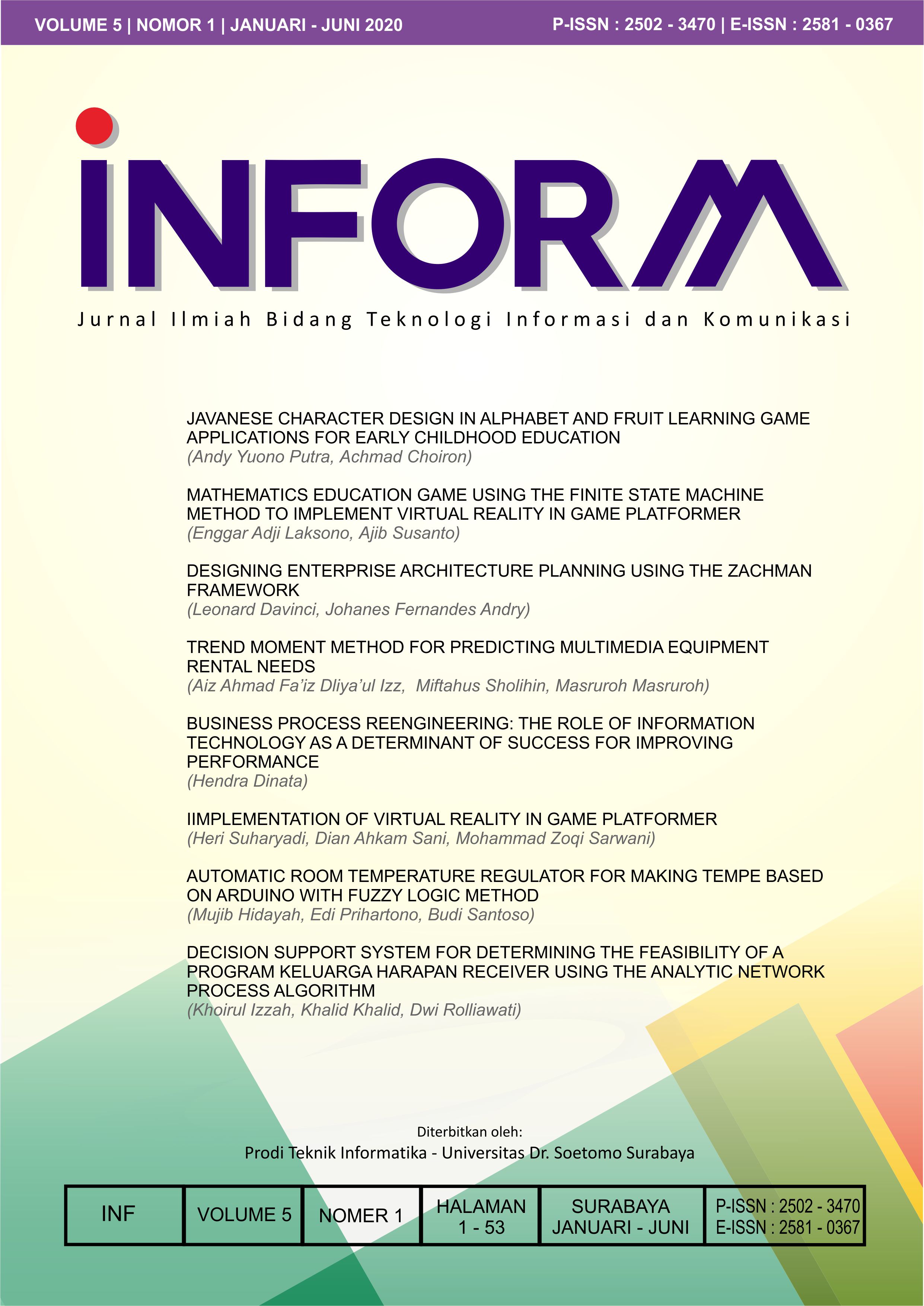
Decision Support System for Determining the Feasibility of a Program Keluarga Harapan Receiver Using the Analytic Network Process Algorithm
DOI:
https://doi.org/10.25139/inform.v5i1.2300Keywords:
Analytic Network Process, Blackbox Testing, Confussion Matix, PKHAbstract
One of the goals of the Indonesian state is to prosper the people by reducing total poverty. To overcome poverty levels, the Indonesian government created a policy of the Program Keluarga Harapan(PKH) in the form of subsidized assistance. PKH beneficiaries are families registered in Basis Data Terpadu(BDT) data that meet the criteria of pregnant(K1), childhood(K2), elementary school(K3), junior high school(K4), high school(K5), elderly(K6), and disability(K7). This study aims to assist the Bojonegoro Social Office in choosing the right target in determining the eligibility of PKH recipients by automation. PKH recipient decision support systems are developed with PHP, MySQL databases, and the Analytic Network Process (ANP) algorithm. By using test data of 3 villages namely Bangilan Village, Sembung Village, and Tapelan Village, Kapas District, Bojonegoro Regency in 2019, the system was able to provide PKH recipient data recommendations in accordance with the criteria weights requirements. Based on the confusion test matrix, the SPK precision level is 39.64% (moderate), recall is 39.29% (moderate), and accuracy is 69.12% (high). While testing system functionality using black box testing resulted in 93.35% of the system running well. This shows that the PKH recipient Decision Support System is feasible to be implemented in the Dinas Sosial BojonegoroReferences
Mensos, “Peraturan Menteri Sosial Republik Indonesia Tentang Program Keluarga Harapan,†vol. III, pp. 224–234, 2018.
H. Marhaeni, “Profil Kemiskinan di Indonesia Maret 2019,†no. 57, 2019, pp. 1–8.
E. Turban, J. E. Aronson, and T. Liang, “Decision Support Sistems and Intelligent Sistem.â€
N. Aminudin and A. I. S. Puspita, “Sistem Pendukung Keputusan (SPK) Penerima Bantuan Program Keluarga Harapan (PKH) Pada Desa Bangun Rejo Kec. Punduh Pidana Pesawarang Dengan Menggunakan Metode analytical Hierarchy Process (AHP),†pp. 66–72.
a Görener, “Comparing AHP and ANP: An Application of Strategic Decisions Making in a Manufacturing Company,†Int. J. Bus. Soc. Sci., vol. 3, no. 11, pp. 194–208, 2012.
S. Ali et al., “Peraturan Menteri Sosial No. 1 Tahun 2018,†no. 2, 2018.
I. Subakti, “Sistem Pendukung Keputusan Jurusan Teknik Informatika Fakultas Teknologi Informasi Institut Teknologi Sepuluh Nopember Surabaya,†JJurnal Ilm. Teknol. Inf. Inst. Teknol. Sepuluh Nop., vol. 4, no. Management Support System, pp. 5–9, 2013.
Saaty, T. L. (2008). The Analytic Network Process. Pittsburgh: Ellsworth Avenue. Tersedia: http://www.sid.ir/en/VEWSSID/J_pdf/115720080101.pdf[31 Mei 2013]
P. T. Pungkasanti, “Penerapan Analytical Network Process (ANP) Sebagai Sistem Pendukung Keputusan dalam Pemberian Reward Dosen,†2013.
T. Arifin, “Implementasi Metode K-Nearest Neighbor Untuk Klasifikasi Citra Sel Pap Smear Menggunakan Analisis Tekstur Nukleus,†J. Inform., vol. 2, no. 1, pp. 287–295, 2016, doi: 10.31311/ji.v2i1.83.
C. D. Manning, “Intro to Information Retrieval,†Inf. Retr. Boston., no. c, pp. 1–18, 2009, doi: 10.1109/LPT.2009.2020494.
W. Wahyuni, “Prioritas Penerima Bantuan Program Keluarga Harapan Menggunakan Metode Technique For Other Refference By SimilarityTo Ideal Solution (TOPSIS),†Skripsi, 2018.
D. Nurlaila, D. Supriyadi, and A. E. Amalia, “Penerapan Metode Analytic Network Process (ANP) Untuk Pendukung Keputusan Pemilihan Tema Tugas Akhir (Studi Kasus: Program Studi S1 Informatika ST3 Telkom),†J. Inform. J. Pengemb. IT Poltek Tegal, vol. 2, no. 2, pp. 63–68, 2017.
R. Govindaraju and J. Pratama Sinulingga, “Pengambilan Keputusan Pemilihan Pemasok di Perusahaan Manufaktur dengan Metode Fuzzy ANP,†J. Manaj. Teknol., vol. 16, no. 1, pp. 1–16, 2017, doi: 10.12695/jmt.2017.16.1.1.
Downloads
Published
How to Cite
Issue
Section
License
Authors who publish with Inform: Jurnal Ilmiah Bidang Teknologi Informasi dan Komunikasi agree to the following terms:
-
Authors retain copyright and grant the journal right of first publication with the work simultaneously licensed under a Creative Commons Attribution License (CC BY-SA 4.0) that allows others to share the work with an acknowledgment of the work's authorship and initial publication in this journal.
-
Authors are able to enter into separate, additional contractual arrangements for the non-exclusive distribution of the journal's published version of the work (e.g., post it to an institutional repository or publish it in a book), with an acknowledgment of its initial publication in this journal.
-
Authors are permitted and encouraged to post their work online (e.g., in institutional repositories or on their website) prior to and during the submission process, as it can lead to productive exchanges, as well as earlier and greater citation of published work.