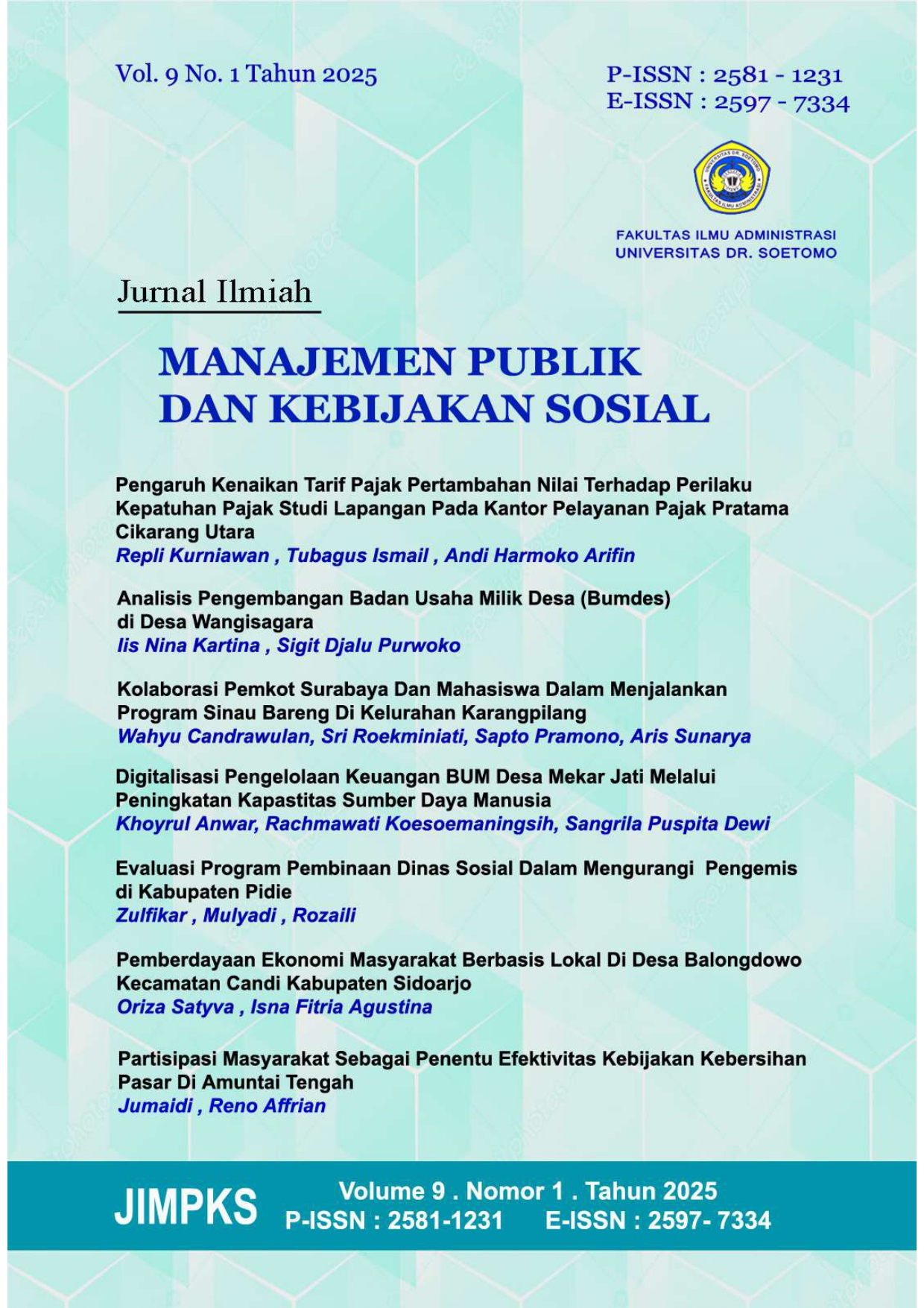
Partisipasi Masyarakat Sebagai Penentu Efektivitas Kebijakan Kebersihan Pasar Di Amuntai Tengah
DOI:
https://doi.org/10.25139/jmnegara.v9i1.10500Keywords:
Community participation, Policy implementation, Traditional market, Environmental hygiene, Local governanceAbstract
This study investigates the role of community participation in the effectiveness of implementing local policy on market cleanliness in Amuntai Tengah District, focusing on the enforcement of Local Regulation No. 7/2016. Employing a qualitative approach, data were gathered through interviews, observations, and document analysis at Unggas Market. The findings indicate that while some traders adhere to cleanliness rules, policy implementation is hindered by poor information dissemination, weak enforcement, and insufficient infrastructure. Community engagement remains fragmented and primarily individual. Strengthening policy communication, enhancing collaboration, and promoting collective awareness are critical to achieving sustainable outcomes in public space governance
References
Arnstein, S. R. (1969). A ladder of citizen participation. Journal of the American Institute of Planners, 35(4), 216–224. https://doi.org/10.1080/01944366908977225
Cantika, F. (2023). Implementasi Peraturan Daerah Kabupaten Hulu Sungai Utara Nomor 7 Tahun 2016 tentang Penyelenggaraan Kebersihan dan Keindahan Lingkungan pada Pasar Ikan Banua Lima Amuntai Kabupaten Hulu Sungai Utara (Skripsi). Sekolah Tinggi Ilmu Administrasi Amuntai.
Cohen, J. M., & Uphoff, N. T. (1980). Participation's place in rural development: Seeking clarity through specificity. World Development, 8(3), 213–235. https://doi.org/10.1016/0305-750X(80)90095-5
Dwiyanto, A. (2018). Manajemen Pelayanan Publik: Peduli, Inklusif, dan Kolaboratif. Yogyakarta: Gadjah Mada University Press.
Effendy, O. U. (2017). Ilmu Komunikasi: Teori dan Praktek. Bandung: Remaja Rosdakarya.
Emerson, K., Nabatchi, T., & Balogh, S. (2012). An Integrative Framework for Collaborative Governance. Journal of Public Administration Research and Theory, 22(1), 1–29.
Fatmasari, A., & Sutrisno, E. (2020). Peran Komunikasi dalam Implementasi Kebijakan Kebersihan di Ruang Publik. Jurnal Administrasi Publik, 17(1), 45–56.
Goggin, M. L., Bowman, A. O., Lester, J. P., & O’Toole, L. J. (1990). Implementation Theory and Practice: Toward a Third Generation. New York: HarperCollins.
Nugroho, R. (2017). Public Policy: Dinamika Kebijakan, Analisis Kebijakan, Manajemen Kebijakan. Jakarta: Elex Media Komputindo.
Rajagukguk. (2023). Implementasi Peraturan Daerah Kota Sibolga Nomor 7 Tahun 2016 tentang Perlindungan dan Pemberdayaan Pasar Tradisional, Penataan dan Pengendalian Pasar Modern (Skripsi). Universitas Medan Area.
Subarsono, A. G. (2015). Analisis Kebijakan Publik: Konsep, Teori dan Aplikasi. Yogyakarta: Pustaka Pelajar.
Sulastri, N. (2020). Penguatan Partisipasi Masyarakat dalam Implementasi Kebijakan Publik di Wilayah Perkotaan. Jurnal Ilmu Administrasi Negara, 10(2), 102–113.
Tahir, M. (2015). Implementasi Kebijakan Publik. Jakarta: Rajawali Pers.
Wibawa, S. (2019). Komunikasi Kebijakan dalam Perspektif Partisipatif. Jurnal Ilmu Administrasi Negara, 9(2), 133–144.
Wibawa, S. (2021). Model Partisipasi Masyarakat dalam Implementasi Kebijakan Publik. Jurnal Administrasi dan Kebijakan Publik, 12(1), 1–13.
Winarno, B. (2012). Kebijakan Publik: Teori, Proses dan Studi Kasus. Yogyakarta: CAPS (Center for Academic Publishing Service).
Downloads
Published
How to Cite
Issue
Section
License
Authors who publish with JIMPKS: Jurnal Ilmiah Manajemen Publik dan Kebijakan Sosial agree to the following terms:
-
Authors retain copyright and grant the journal right of first publication with the work simultaneously licensed under a Creative Commons Attribution License (CC BY-SA 4.0) that allows others to share the work with an acknowledgment of the work's authorship and initial publication in this journal.
-
Authors are able to enter into separate, additional contractual arrangements for the non-exclusive distribution of the journal's published version of the work (e.g., post it to an institutional repository or publish it in a book), with an acknowledgment of its initial publication in this journal.
-
Authors are permitted and encouraged to post their work online (e.g., in institutional repositories or on their website) prior to and during the submission process, as it can lead to productive exchanges, as well as earlier and greater citation of published work.