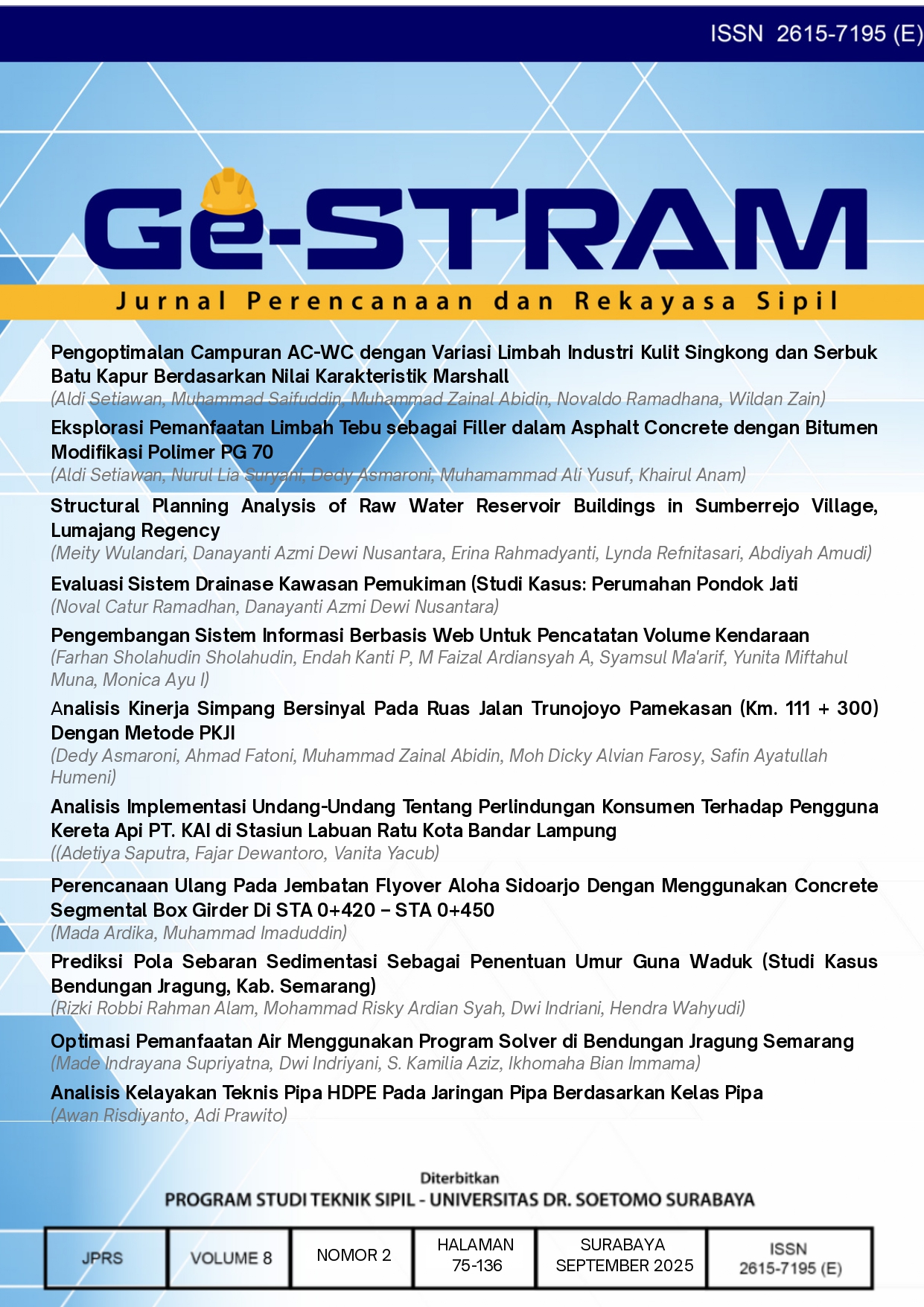
Prediksi Pola Sebaran Sedimentasi Sebagai Penentuan Umur Guna Waduk (Studi Kasus Bendungan Jragung, Kab. Semarang)
An Integrated Approach of USLE, Sediment Transport, and Distribution Simulation for Reservoir Management Strategies
DOI:
https://doi.org/10.25139/jprs.v8i2.10874Keywords:
Sedimentation, USLE, Mike 21, Reservoir Service Life, DAMAbstract
The Jragung Dam in Semarang Regency is designed for a 50-year service life, serving as flood control, irrigation supply, micro-hydropower generation (1,400 kW), tourism, and raw water provision. However, sedimentation can reduce storage capacity and shorten its operational lifespan. This study aims to predict sediment distribution patterns to estimate reservoir service life and develop appropriate sediment management strategies. Hydrological analysis was conducted using the Thomas Fiering and FJ Mock methods, erosion rates were calculated using the Universal Soil Loss Equation (USLE), sediment transport (bed load and suspended load) was analyzed using multiple methods, and distribution modeling was performed with MIKE 21 software. Results indicate an average inflow discharge of 6.20 m³/s and an annual sediment load of 0.753 million m³, dominated by sand fractions (d50 ≈ 1.07 mm). Modeling suggests the reservoir’s service life will be only 39 years, significantly shorter than planned, with sediment deposition concentrated in the upstream and middle reservoir zones. Dredging is proposed as a mitigation strategy, requiring a total removal volume of 20.095 million m³ to extend the reservoir’s service life.
References
Asdak, C. (2023). Hydrology and Watershed Management. Gadjah Mada University Press, Yogyakarta.
Aurellia, N., Rahmasari, S. E., Prabawa, R., & Faridatunisa, W. (2023). Identification of Built-Up and Non-Built-Up Land Changes Using the Enhanced Built-Up and Bare Soil Index (EBBI) Method in West Surabaya. Jurnal Geodesi Undip, October Edition.
Azhar, R. M., Wurjanto, A., & Yuanita, N. (2012). Study of Submerged Breakwater Type Coastal Protection at Tanjung Kait Beach. Institut Teknologi Bandung.
Aqillaa, Fauzi, M., & Sebayang, M. (2023). Generation of River Basin Flow Data Using the Thomas Fiering Method: Case of Rokan River Basin. JICE - Journal of Infrastructure and Civil Engineering.
Einstein, H. A. (1950). The Bed-Load Function for Sediment Transportation in Open Channels. United States Department of Agriculture, Washington DC.
Hadisusanto, N. (2010). Hydrology Applications (Vol. 22, Issue 2). Jogja Mediautama, Yogyakarta.
Hermawan, F. D. (2016). Analysis of Sediment Distribution Patterns Using Surface-Water Modelling System at the Head of PLTA Genyem Weir, Jayapura Regency, Papua Province. Undergraduate Thesis, Universitas Brawijaya.
Liu, Z. (1998). Sediment Transport. Aalborg Universitetsforlag, Denmark.
Marlina, S. (2018). Identification of Kahayan River Siltation due to Sedimentation. Media Ilmiah Teknik Sipil, 7(1).
Perum Jasa Tirta-1 (PJT-1). (2015). Technical Study on Sedimentation Management of Sengguruh Reservoir, Malang.
Prabandari, A. A., & Manessa, M. D. M. (2024). Analysis of Built-Up Land Development Based on the Supervised Classification Method Using Google Earth Engine (Case Study: Ciputi Village, Pacet District, Cianjur Regency). Jurnal Tanah dan Sumberdaya Lahan, 11(2), 403–412. https://doi.org/10.21776/ub.jtsl.2024.011.2.11
Putra, D. S., Siwu, W. P., & Wulandari, D. A. (2019). The Effect of Sedimentation on the Function of Karian Reservoir. Teknisia Journal. https://journal.uii.ac.id/teknisia/article/download/13596/9740/33042
Shiami, F. A. R. (2017). Prediction of Sedimentation Rate in Tugu Trenggalek Dam Reservoir. Undergraduate Thesis, Institut Teknologi Sepuluh Nopember.
Sisinggih, D., Wahyuni, S., & Hidayat, F. (2021). Reservoir Sedimentation. UB Press, Malang.
Soeyanto, E., & Arifiyana, A. (2018). Dynamics of Sedimentation Process in the Estuary of Riko River, Balikpapan Bay. Oseanologi dan Limnologi di Indonesia, 3, 63–75. https://doi.org/10.14203/oldi.2018.v3i1.139
Downloads
Published
How to Cite
Issue
Section
License
Authors who publish with this journal agree to the following terms:
- Authors retain copyright and grant the journal right of first publication with the work simultaneously licensed under a Creative Commons Attribution-ShareAlike 4.0 International License that allows others to share the work with an acknowledgement of the work's authorship and initial publication in this journal.
- Authors are able to enter into separate, additional contractual arrangements for the non-exclusive distribution of the journal's published version of the work (e.g., post it to an institutional repository or publish it in a book), with an acknowledgement of its initial publication in this journal.
- Authors are permitted and encouraged to post their work online (e.g., in institutional repositories or on their website) prior to and during the submission process, as it can lead to productive exchanges, as well as earlier and greater citation of published work (See The Effect of Open Access).

This work is licensed under a Creative Commons Attribution-ShareAlike 4.0 International License.