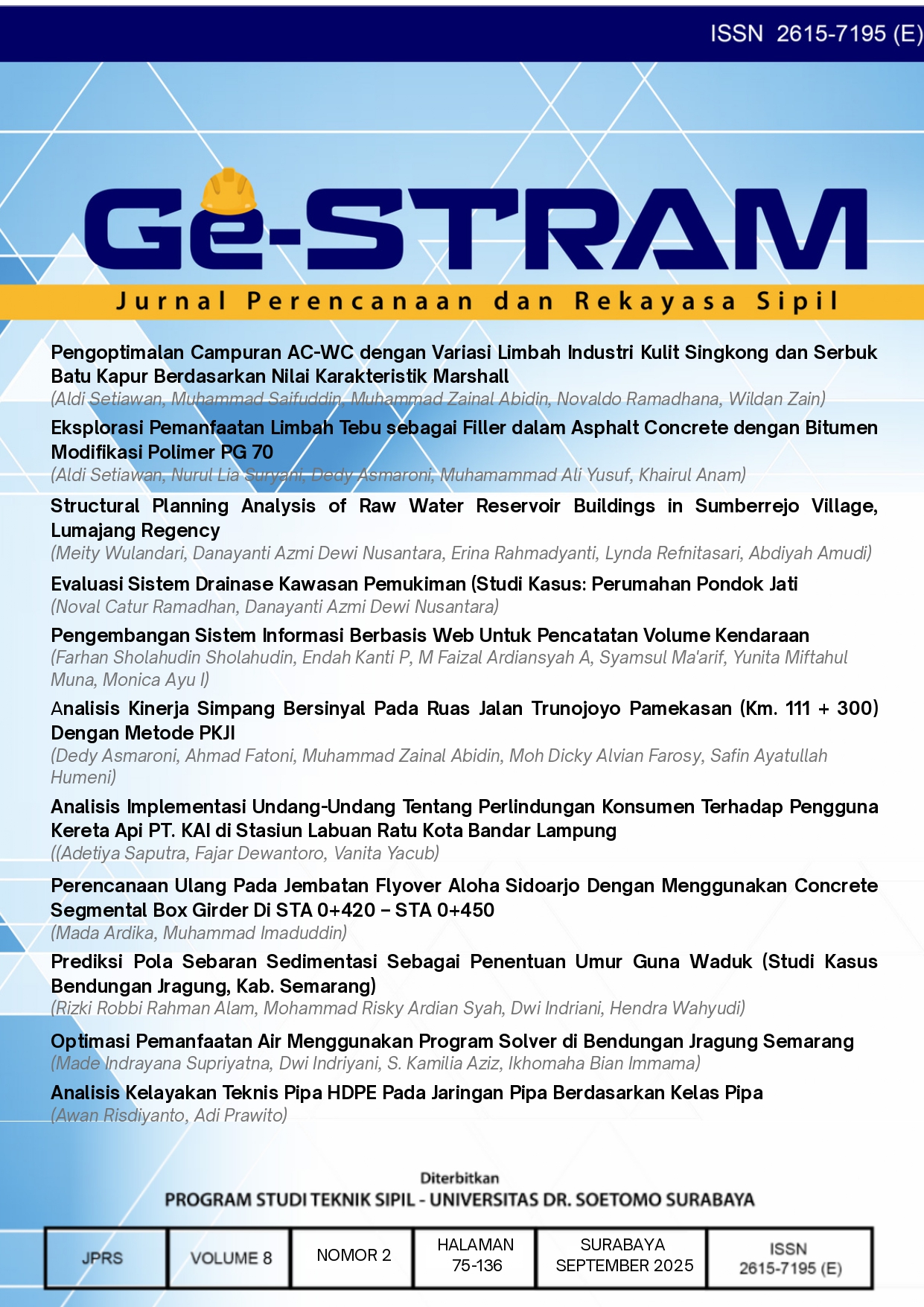
Analisis Kelayakan Teknis Pipa HDPE Pada Jaringan Pipa Berdasarkan Kelas Pipa
DOI:
https://doi.org/10.25139/jprs.v8i2.11043Keywords:
Hydraulic Analysis; Nominal Pressure; Polyethylene Pipe.Abstract
High-density polyethylene (HDPE) pipes are one type of pipe used in raw water transmission pipelines. The requirements for polyethylene pipes for drinking water based on SNI 06-4829-2005 must have a type and classification of material with a minimum required strength (MRS) of 10 MPa (PE 100) tested in the form of pipes at a temperature of 20o with a test period equivalent to 50 years. Therefore, HDPE pipe material used technically has a service life of up to 50 years when used under normal conditions. With a sufficiently long service life, in order to optimize the use of HDPE pipes, an in-depth analysis of planning parameters including discharge, flow velocity, and pipe class needs to be carried out to ensure feasibility in terms of both technical and cost aspects. The hydraulic analysis was refined at the same diameter but with different pipe pressure (nominal pressure, PN), flow rate, and pipe length variables. A sensitivity analysis of changes in flow rate variables based on projected flow rate increases was conducted on three pipe classes, namely PN. 6.3, PN. 8, and PN. 10. The analysis results show that the PN. 8 pipe class is more optimal for medium and long pipe routes, while the PN. 6.3 pipe class is more optimal for short pipe routes with a wider range of gravity flow.
References
Badan Penelitian dan Pengembangan Departemen Pekerjaan Umum Republik Indonesia.(2005), Pd-T-09-2005 C, Jakarta.
Badan Penelitian dan Pengembangan Departemen Permukiman dan Prasarana Wilayah, (2002), Pedoman/Petunjuk Teknik dan Manual. Bagian : 6. Edisi Pertama, Jakarta.
Badan Standardisasi Nasional, Departemen Pekerjaan Umum Republik Indonesia.(2012), SNI 7829 : 2012, Jakarta
Departemen Pemukiman dan Prasarana Wilayah Badan Penilitian dan Pengembangan Departemen Pekerjaan Umum Republik Indonesia (1998). Pedoman/Petunjuk Teknik dan Manual.Jakarta
Linsley, Ray K, dan Yoseph B. Franzini. (1996). Teknik Sumber Daya Air. Jilid I. Erlangga, Jakarta.
Moelyowati,I., Pemilihan dan Pemanfaatan Pompa Dalam Aplikasi di Bidang Teknik Lingkungan. ITS. Surabaya.
Peavy, Howard S et.al. (1985). Environmental Engineering. McGraw-Hill. Singapura
Risdiyanto, Harliansyah (2019), Pemilihan Diameter Pipa Untuk Optimasi Usia Layan Pipa HDPE Dalam Perencanaan Sistem Transmisi Air Baku Intake Linuh Di Kabupaten Tapin, Prosiding Fintek I 2021, www.intakindojatim.org/prosidingfintek.
Peraturan Menteri Pekerjaan Umum dan Perumahan Rakyat Republik Indonesia Nomor 27/PRT/M/2016 Tentang Penyelenggaraan Sistem Penyediaan Air Minum
Peraturan Menteri Kesehatan Republik Indonesia Nomor 492/MENKES/PER/IV/2010 Tentang Persyaratan Kualitas Air Minum
Priyantoro, Dwi. (1991). Hidraulika Saluran Tertutup. Jurusan Teknik Pengairan Universitas Brawijaya, Malang.
Pusdiklat Jalan, Perumahan, Permukiman, dan Pengembangan Infrastruktur Wilayah. Badan Pengembangan Sumber Daya Manusia, Kementerian Pekerjaan Umum dan Perumahan Rakyat. (2018), Pelaksanaan Pekerjaan Perpipaan Pembangunan SPAM. Bandung
Sularso dan Tahara,Haruo.(2000). Pompa dan Kompresor. Pradnya Paramita : Jakarta
Triatmodjo, Bambang. (1995). Hidraulika II. Beta Offset.Yogyakarta
Webber, N. B. (1971). Fluid Mechanics For Civil Engineering, S.I Edition. Chapman and Hall Ltd., London.
Downloads
Published
How to Cite
Issue
Section
License
Authors who publish with this journal agree to the following terms:
- Authors retain copyright and grant the journal right of first publication with the work simultaneously licensed under a Creative Commons Attribution-ShareAlike 4.0 International License that allows others to share the work with an acknowledgement of the work's authorship and initial publication in this journal.
- Authors are able to enter into separate, additional contractual arrangements for the non-exclusive distribution of the journal's published version of the work (e.g., post it to an institutional repository or publish it in a book), with an acknowledgement of its initial publication in this journal.
- Authors are permitted and encouraged to post their work online (e.g., in institutional repositories or on their website) prior to and during the submission process, as it can lead to productive exchanges, as well as earlier and greater citation of published work (See The Effect of Open Access).

This work is licensed under a Creative Commons Attribution-ShareAlike 4.0 International License.