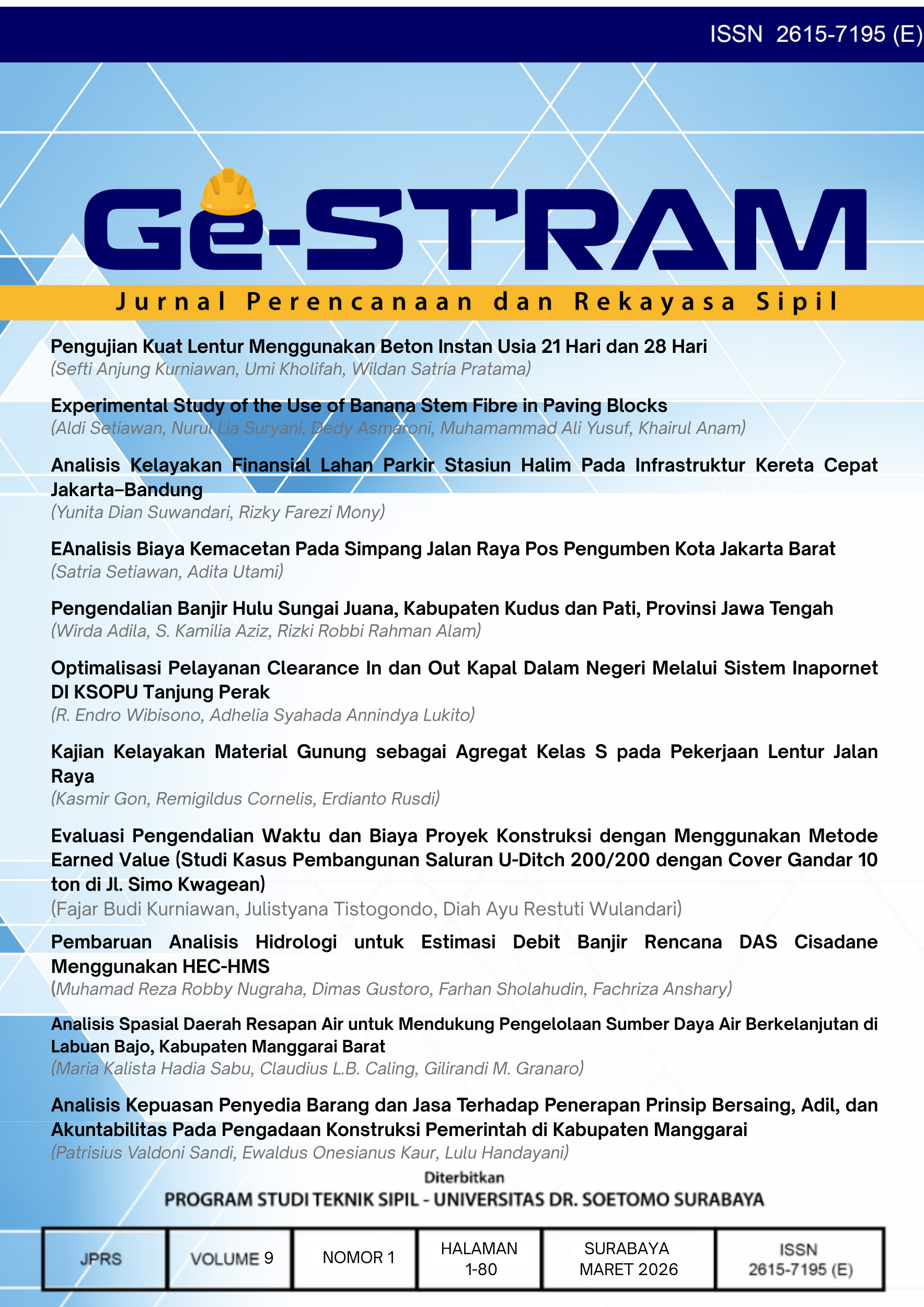
Pembaruan Analisis Hidrologi untuk Estimasi Debit Banjir Rencana DAS Cisadane Menggunakan HEC-HMS
DOI:
https://doi.org/10.25139/jprs.v9i1.11537Keywords:
Hyetograph, Hydrology, Flood, HEC-HMS, Cisadane RiverAbstract
Design flood estimation is a critical component in hydraulic infrastructure planning, particularly for large bridges located in watersheds characterized by complex hydrological dynamics and rapid regional development. This study aims to update the design flood estimation for the Cisadane River Bridge in the PIK 2 Extension area by incorporating updated hydrological data and evaluating the influence of changes in rainfall characteristics on flood estimation results. The 100-year return period design flood (Q100) was adopted in accordance with bridge classification standards. The analysis was conducted using a rainfall–runoff approach implemented in the HEC-HMS model. A previous hydrological study conducted in 2015 was reconstructed as a baseline, with updates to the rainfall data series and explicit representation of infiltration based on land use and soil type using the Soil Conservation Service Curve Number (SCS-CN) method. The design rainfall pattern (hyetograph) was updated to reflect increased rainfall intensity observed after 2014. The modeling results indicate a peak discharge of the Q100 design flood of 2,090.4 m³/s, representing a significant increase compared to the 2015 study result of 1,422.8 m³/s. This increase is primarily attributed to changes in rainfall intensity and temporal distribution reflected in the updated hyetograph, while the watershed hydrological response is assumed to remain relatively unchanged. These findings highlight the importance of regularly updating rainfall data and design rainfall patterns to ensure the reliability and safety of bridge design under increasingly extreme rainfall conditions
References
Alsilibe, F., & Bene, K. (2022). Watershed subdivision and weather input effect on streamflow simulation using SWAT model. Pollack Periodica, 17(1), 88–93. https://doi.org/10.1556/606.2021.00349
Bhunya, P. K., Panda, S. N., & Goel, M. K. (2011). Synthetic Unit Hydrograph Methods: A Critical Review. In The Open Hydrology Journal (Vol. 5).
Brandão, A. R. A., Schwamback, D., Ballarin, A. S., Ramirez-Avila, J. J., Vasconcelos Neto, J. G., & Oliveira, P. T. S. (2025). Toward a better understanding of curve number and initial abstraction ratio values from a large sample of watersheds perspective. Journal of Hydrology, 655, 132941. https://doi.org/https://doi.org/10.1016/j.jhydrol.2025.132941
Breinl, K., Lun, D., Müller-Thomy, H., & Blöschl, G. (2021). Understanding the relationship between rainfall and flood probabilities through combined intensity-duration-frequency analysis. Journal of Hydrology, 602. https://doi.org/10.1016/j.jhydrol.2021.126759
Delani, O. M., & Dasanto, B. D. (2015). Perbandingan hidrograf banjir menggunakan beberapa metode perhitungan curah hujan efektif (studi kasus: Das Cisadane Hulu). JURNAL SUMBER DAYA AIR, 12(2), 187–198. https://doi.org/10.32679/jsda.v12i2.65
Ezz, H., Gomaah, M., & Abdelwares, M. (2019). Watershed Delineation and Estimation of Groundwater Recharge for Ras Gharib Region, Egypt. Journal of Geoscience and Environment Protection, 07(04), 202–213. https://doi.org/10.4236/gep.2019.74013
Ganora, D., Evangelista, G., Mazzoglio, P., & Claps, P. (2024). Hydrological models and datasets to support flood flow estimation at river-bridge intersections. Procedia Structural Integrity, 62, 653–660. https://doi.org/10.1016/j.prostr.2024.09.091
Ginting, B. M., Lidyana, P., Christopher, C., Yudianto, D., & Yuebo, X. (2025). Evaluating the satellite-derived DEM accuracy with rain-on-grid modeling for flood hydrograph prediction of Katulampa Watershed, Indonesia. International Journal of River Basin Management, 23(3), 369–386. https://doi.org/10.1080/15715124.2024.2312857
Guduru, J. U., & Mohammed, A. S. (2024). Hydrological modeling using HEC-HMS model, case of Tikur Wuha River Basin, Rift Valley River Basin, Ethiopia. Environmental Challenges, 17, 101017. https://doi.org/https://doi.org/10.1016/j.envc.2024.101017
Kent, S., Yudianto, D., & Fitriana, F. (2022). STUDI Pengelolaan Air Hujan Dalam Rangka Pengembangan Taman Konservasi Di Kota Sawahlunto, Sumatera Barat. Jurnal Sumber Daya Air, 18(2), 109–120. https://doi.org/10.32679/jsda.v18i2.820
Manual No 01-2 BM 2005 Hidrolika Untuk Pekerjaan Jalan dan Jembatan Buku 2 Perencanaan Hidrolika_Departemen PU, Dirjen Binamarga. (n.d.).
Maulana, A. A., & Rosalina, H. (2022). Evaluasi Dampak Banjir Akibat Perubahan Alur Sungai Citanduy Hulu Di Desa Tanjungkerta, Tasikmalaya-Jawa Barat. Jurnal Sumber Daya Air, 18(1), 55–67. https://doi.org/10.32679/jsda.v18i1.745
Nomeritae, Nasir, D., & Salonten. (2025). Modeling Rainfall-Flow in the Kahayan Watershed Central Kalimantan Province. In K.-C. Tsai, M. Shahin, S. A. Kristiawan, A. R. M. Sam, & P. D. Hai (Eds.), Proceedings of the 6th International Conference on Rehabilitation and Maintenance in Civil Engineering—Volume 1 (pp. 585–594). Springer Nature Singapore.
Noor Annisa Ramadan, A., Nurmayadi, D., Sadili, A., Rizaldy Solihin, R., & Sumardi, Z. (2020). Studi Penentuan Nilai Curve Number DAS Pataruman berdasarkan Satuan Peta Tanah Indonesia. In Media Komunikasi TeknikSipil (Vol. 26, Issue 2).
Pratiwi, D. W., & Satria Negara, A. (2023). Perbandingan Pola Distribusi Hujan Terukur dan Metode Empiris dalam Perhitungan Debit Banjir Rencana DAS Jurug. Jurnal Teknik Sumber Daya Air, 29–42. https://doi.org/10.56860/jtsda.v3i1.55
Raji, S. A., Odunuga, S., & Fasona, M. (2021). Spatial Appraisal of Seasonal Water Yield of the Sokoto-Rima Basin. Sakarya University Journal of Science, 25(4), 950–968. https://doi.org/10.16984/saufenbilder.800302
Samatan, S. (2020). Perbandingan Perkiraan Debit Banjir Rancangan Menggunakan Data Hujan dan Debit di DAS Kaliwadas Kab. Pekalongan, Jawa Tengah (Vol. 1, Issue 2). https://doi.org/https://doi.org/10.22487/renstra.v1i2.23
Shaikh, M. P., Yadav, S. M., & Manekar, V. L. (2022). Assessment of the empirical methods for the development of the synthetic unit hydrograph: A case study of a semi-arid river basin. Water Practice and Technology, 17(1), 139–156. https://doi.org/10.2166/wpt.2021.117
Sofyan, P., Febrianti, N., & Prasasti, I. (2014). Estimasi Limpahan Permukaan Dari Data Satelit Untuk Mendukung Peringatan Dini Bahaya Banjir Di Wilayah Jabodetabek. Jurnal Penginderaan Jauh Dan Pengolahan Data Citra Digital, 11(1), 43–62. https://doi.org/10.30536/inderaja.v11i1.3299
Suhartanto, E., Montarcih Limantara, L., Noviadriana, D., Iman Harta, F., & Aryani, D. K. (2018). Estimation of Design Flood with Four Frequency Analysis Distributions. In Asian Journal of Applied Science and Technology (AJAST) (Open Access Quarterly International Journal (Vol. 2, Issue 1). www.ajast.net
Downloads
Published
How to Cite
Issue
Section
License
Authors who publish with this journal agree to the following terms:
- Authors retain copyright and grant the journal right of first publication with the work simultaneously licensed under a Creative Commons Attribution-ShareAlike 4.0 International License that allows others to share the work with an acknowledgement of the work's authorship and initial publication in this journal.
- Authors are able to enter into separate, additional contractual arrangements for the non-exclusive distribution of the journal's published version of the work (e.g., post it to an institutional repository or publish it in a book), with an acknowledgement of its initial publication in this journal.
- Authors are permitted and encouraged to post their work online (e.g., in institutional repositories or on their website) prior to and during the submission process, as it can lead to productive exchanges, as well as earlier and greater citation of published work (See The Effect of Open Access).

This work is licensed under a Creative Commons Attribution-ShareAlike 4.0 International License.