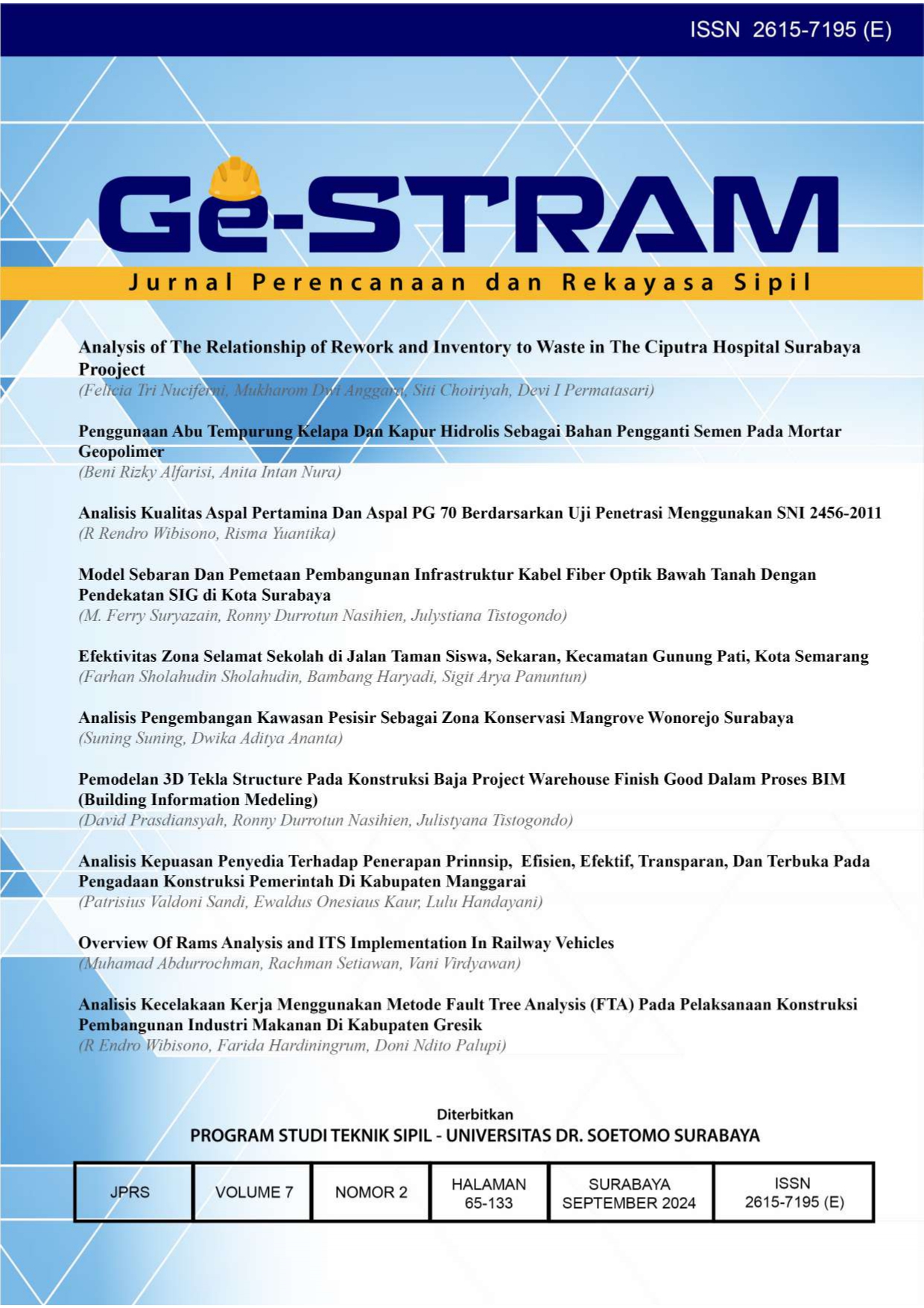
Efektivitas Zona Selamat Sekolah di Jalan Taman Siswa, Sekaran, Kecamatan Gunungpati, Kota Semarang
Keywords:
School Safe Zone, Effectiveness, Pedestrians, Speed, Road EquipmentAbstract
The installation of School Safe Zones on Taman Siswa Street is considered suboptimal, given that many road users still travel at high speeds and pedestrians, especially students, teachers, and the surrounding community, have not utilized the School Safe Zones facilities. The purpose of this study is to determine the effectiveness of School Safe Zones on Taman Siswa Street, particularly in the school areas of SD N Sekaran 1, SD N Sekaran 2, and MI Roudlotul Huda. The urgency of this research is to evaluate the installation of School Safe Zones on Taman Siswa Street, especially in the school areas of SD N Sekaran 1, SD N Sekaran 2, and MI Roudlotul Huda. The approach taken includes surveys of vehicle speed, pedestrian behavior, drop-off behavior, and road equipment facilities. The results of this study are expected to benefit road users, particularly pedestrians in the school areas, by enhancing safety and security when walking and crossing the street. Based on the analysis results, it can be concluded that the effectiveness at School Safe Zones locations is still inadequate, as many students are crossing improperly, and the behavior of escorts is also not ideal. Additionally, road users are still driving at high speeds despite the presence of School Safe Zones signage.
References
Boarnet, M.G., Anderson, C.L., Day, K., McMillan, T., Alfonzo, M. (2005). Evaluation of the California Safe Routes to School Legislation Urban Form Changes and Children’s Active Transportation to School. American Journal of Preventive Medicine.
Macridis, S., Garcia Bengoechea, E. (2015). Adoption of Safe Routes to School in Canadian and the United States Contexts: Best Practices and Recommendations. Journal of School Health.
McDonald, N.C., Yang, Y., Abbott, S.M., Bullock, A.N. (2013). Impact of the Safe Routes to School program on walking and biking: Eugene Oregon study. Transport Policy.
Hubsmith, D.A. (2006). Safe Route to School in the United States. Children Youth and Environments.
Hidayati, N., Liu, R., & Montgomery, F. (2012). The Impact of School Safety Zone and Roadside Activities on Speed Behaviour: the Indonesian Case. Procedia - Social and Behavioral Sciences.
McDonald, N.C., Steiner, R.L., Lee, C., Rhoulac Smith, T., Zhu, X., Yang, Y. (2014). Impact of the Safe Routes to School Program on Walking and Bicycling. Journal of the American Planning Association.
Stewart, O., Moudon, A.V., Claybrooke, C. (2014). Multistate Evaluation of Safe Routes to School Programs. The Journal of School Nursing.
Parisi, D., Hondorp, B. (2005). Transportation professionals get involved with safe routes to school. Institute of transportation engineers journal.
Stewart, O. (2011). Findings from Research on Active Transportation to School and Implications for Safe Routes to School Programs. Journal of Planning Literature.
Handayani, D.L., Sumiyattinah, Kadarini, S.N. (2023). Evaluasi Kinerja Penerapan Zona Selamat Sekolah (Zoss) Pada Ruas Jalan Nasional Batas Kota Singkawang – Sungai Duri. JeLAST - Jurnal PWK Laut Sipil Tambang.
Zegeer, C.V. (2002). Pedestrian facilities users guide: Providing safety and mobility. Diane Publishing.
Direktorat Jenderal Bina Marga. (2023). Pedoman Kapasitas Jalan Indonesia. Dirjen Bina Marga Departemen Pekerjaan Umum Jakarta.
Cambon de Lavalette, B., Tijus, C., Poitrenaud, S., Leproux, C., Bergeron, J., Thouez, J. (2009). Pedestrian crossing decision-making: A situational and behavioral approach. Safety Science.
Salisu, U.O., Oyesiku, O.O. (2020). Traffic Survey Analysis: Implications for Road Transport Planning In Nigeria. LOGI – Scientific Journal on Transport and Logistics.
Akram, M., Sulaiman, N., Zainuddin, N.I., Besar, T.B.H. (2013). Vehicle speed measurement technique using various speed detection instrumentation. IEEE Business Engineering and Industrial Applications Colloquium.
Jagannathan, R., Bared, J.G. (2005). Design and Performance Analysis of Pedestrian Crossing Facilities for Continuous Flow Intersections. Transportation Research Record: Journal of the Transportation Research Board.
Sisiopiku, V.P., Akin, D. (2003). Pedestrian behaviors at and perceptions towards various pedestrian facilities: an examination based on observation and survey data. Transportation Research Part F: Traffic Psychology and Behaviour.
Direktur Jenderal Perhubungan Darat. (2006). Peraturan Direktur Jenderal Perhubungan Darat Nomor: SK 3236/AJ 403/DRJD/2006 Tentang Uji Coba Penerapan Zona Selamat Sekolah Di 11 (Sebelas) Kota Di Pulau Jawa. Jakarta.
Dinas Pekerjaan Umum. (2016). Penetapan Status Ruas-Ruas Jalan Sebagai Jalan Kota Dan Fungsinya Sebagai Jalan Lokal Dan Jalan Lingkungan Di Wilayah Kota Semarang. Keputusan Walikota Semarang No. 621/9727.
Direktur Jenderal Perhubungan Darat. (2014). Peraturan Direktur Jenderal Perhubungan Darat Nomor: SK 1304/AJ.403/DJP/2014 Tentang Zona Selamat Sekolah (ZoSS). Jakarta.
Farhan S., et al., (2023). Analisis Kebutuhan Zona Selamat Sekolah (Zoss) Di Ruas Jalan Taman Siswa, Sekaran, Kec. Gunungpati, Kota Semarang. Jurnal Ge-STRAM (Geotechnics, Structure, Transportation, Water, Construction Management), Surabaya.
Downloads
Published
How to Cite
Issue
Section
License
Authors who publish with this journal agree to the following terms:
- Authors retain copyright and grant the journal right of first publication with the work simultaneously licensed under a Creative Commons Attribution-ShareAlike 4.0 International License that allows others to share the work with an acknowledgement of the work's authorship and initial publication in this journal.
- Authors are able to enter into separate, additional contractual arrangements for the non-exclusive distribution of the journal's published version of the work (e.g., post it to an institutional repository or publish it in a book), with an acknowledgement of its initial publication in this journal.
- Authors are permitted and encouraged to post their work online (e.g., in institutional repositories or on their website) prior to and during the submission process, as it can lead to productive exchanges, as well as earlier and greater citation of published work (See The Effect of Open Access).

This work is licensed under a Creative Commons Attribution-ShareAlike 4.0 International License.