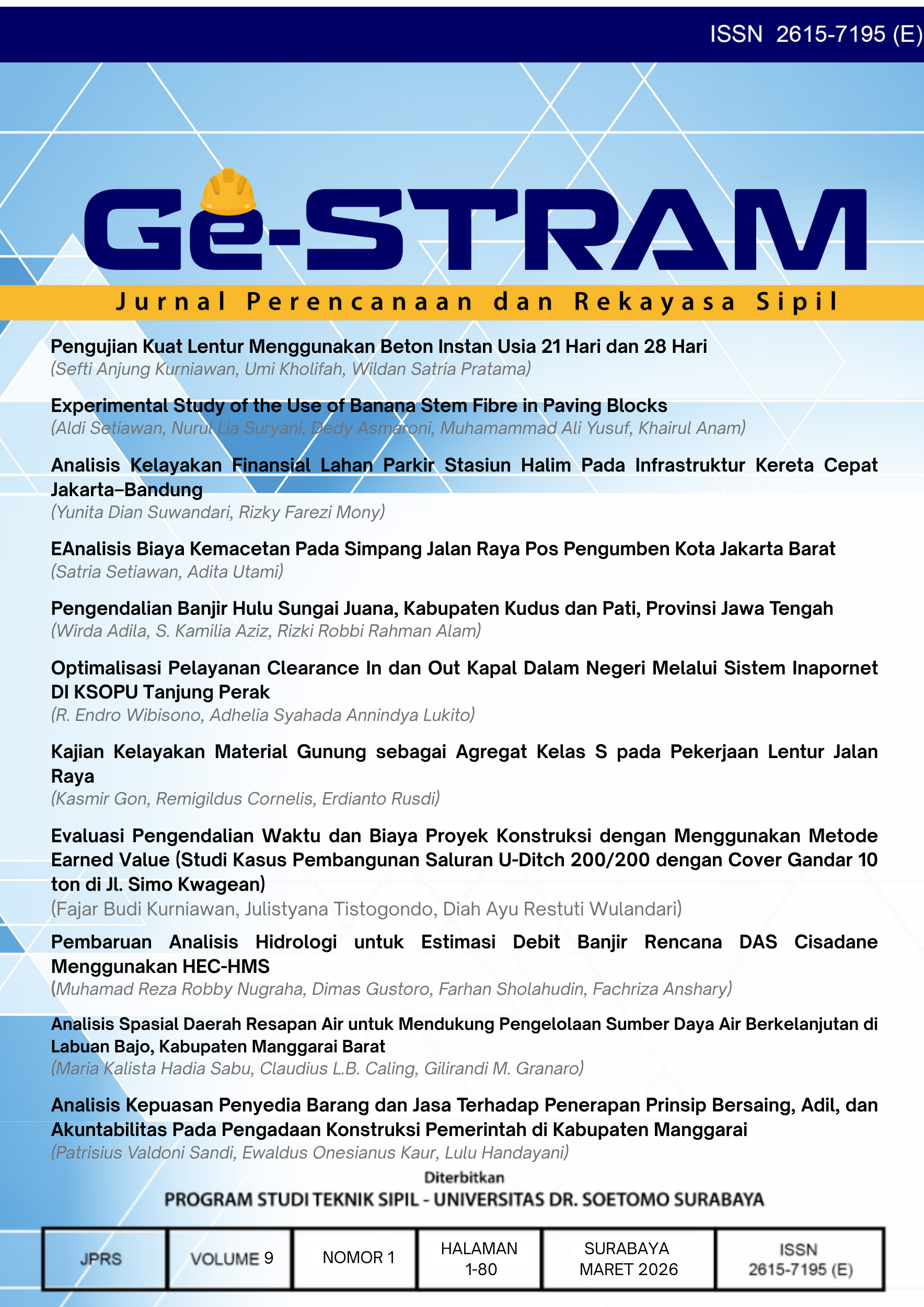
Pengujian Kuat Lentur Menggunakan Beton Instan Usia 21 Hari dan 28 Hari
DOI:
https://doi.org/10.25139/jprs.v9i1.9689Keywords:
Instant Concrete, Flexural BeamAbstract
This research focused on testing instant concrete from a manufacturer that was developed to achieve design capacity within a certain period of time based on user needs. The manufacturer has an innovative concrete product that can reach its design capacity within the timeframe desired by consumers. From the time of this research, the instant concrete offers specifications of 7 days, 14 days, 21 days, and 28 days as the time span for the concrete to reach its design compressive capacity. The test will be carried out by making 2 beam specimens with medium length flexural collapse based on (Chu-Kia Wang & Charles G. Salmon, 1993). The product specification used is the achievement of fc' 25MPa at the age of 21 days and 28 days. This research resulted in a flexural strength Mn value of 2 beam specimens of 57.1250 kNm and 59.8750 kNm. The difference in the nominal moment value of the experimental results between 21 days and 28 days is only 0.804 kNm (greater than 28 days) or 95.4% of 28 days.
References
Badan Standardisasi Nasional. (2011). Cara Uji Kuat Tekan Beton dengan Benda Uji Silinder,SNI 1974-2011. Badan Standardisasi Nasional Indonesia.
Badan Standardisasi Nasional. (2011). Tata Cara Pembuatan dan Perawatan Benda Uji Beton di Laboratorium,SNI 2493-2011. Badan Standardisasi Nasional Indonesia.
Badan Standarisasi Nasional. (2019). SNI 2847:2019. Persyaratan Beton Struktural Untuk Bangunan Gedung, 8.
Badan Standardisasi Nasional. (2011). Cara Uji Kuat Tekan Beton dengan Benda Uji Silinder,SNI 1974-2011. Badan Standardisasi Nasional Indonesia.
Badan Standardisasi Nasional. (2011). Tata Cara Pembuatan dan Perawatan Benda Uji Beton di Laboratorium,SNI 2493-2011. Badan Standardisasi Nasional Indonesia.
Badan Standarisasi Nasional. (2019). SNI 2847:2019. Persyaratan Beton Struktural Untuk Bangunan Gedung, 8.
Chu-Kia Wang, & Charles G.Salmon. (1993). Desain Beton Bertulang (B. Hariandja, Ed.; Edisi Ke-4). Erlangga.
Dipohusodo, I. (1996). Manajemen proyek dan konstruksi ; jilid 2. Kanisius.
gun, A. (2019). Perbandingan Peningkatan Kuat Tekan dengan Kuat Lentur pada Berbagai Umur Beton. Jurnal Teknik Sipil, 7(2). https://doi.org/10.28932/jts.v7i2.1345
Kamal, M., Wibowo, W., & Safitri, E. (2022). Kajian Kuat Kejut dan Keuletan Pada Beton Mutu Tinggi Memadat Mandiri Menggunakan Bahan Tambah Metakaolin dengan Variasi Perbandingan Alkali Aktivator. Matriks Teknik Sipil, 10(1). https://doi.org/10.20961/mateksi.v10i1.55561
Sabariman, B., Sutikno, S., & Wardhono, A. (2017). Daktilitas Balok Beton Mutu Tinggi tanpa Bahan Kimia Tambahan dengan Dua Bukaan di Badan. INERSIA Lnformasi Dan Ekspose Hasil Riset Teknik Sipil Dan Arsitektur, 12(2). https://doi.org/10.21831/inersia.v12i2.12584
Setiawan, A. (2016). Perencanaan Struktur Beton Bertulang (L. Simarmata, Ed.). Erlangga.
SNI 1972. (2008). SNI 1972 : 2008 Cara Uji Slump Beton. In Badan Standar Nasional.
W. H. Mosley, & J. H. Bungey. (1989). Reinforced Concrete Design. Departement of Civil Engineering University of Liverpool.
Downloads
Published
How to Cite
Issue
Section
License
Authors who publish with this journal agree to the following terms:
- Authors retain copyright and grant the journal right of first publication with the work simultaneously licensed under a Creative Commons Attribution-ShareAlike 4.0 International License that allows others to share the work with an acknowledgement of the work's authorship and initial publication in this journal.
- Authors are able to enter into separate, additional contractual arrangements for the non-exclusive distribution of the journal's published version of the work (e.g., post it to an institutional repository or publish it in a book), with an acknowledgement of its initial publication in this journal.
- Authors are permitted and encouraged to post their work online (e.g., in institutional repositories or on their website) prior to and during the submission process, as it can lead to productive exchanges, as well as earlier and greater citation of published work (See The Effect of Open Access).

This work is licensed under a Creative Commons Attribution-ShareAlike 4.0 International License.