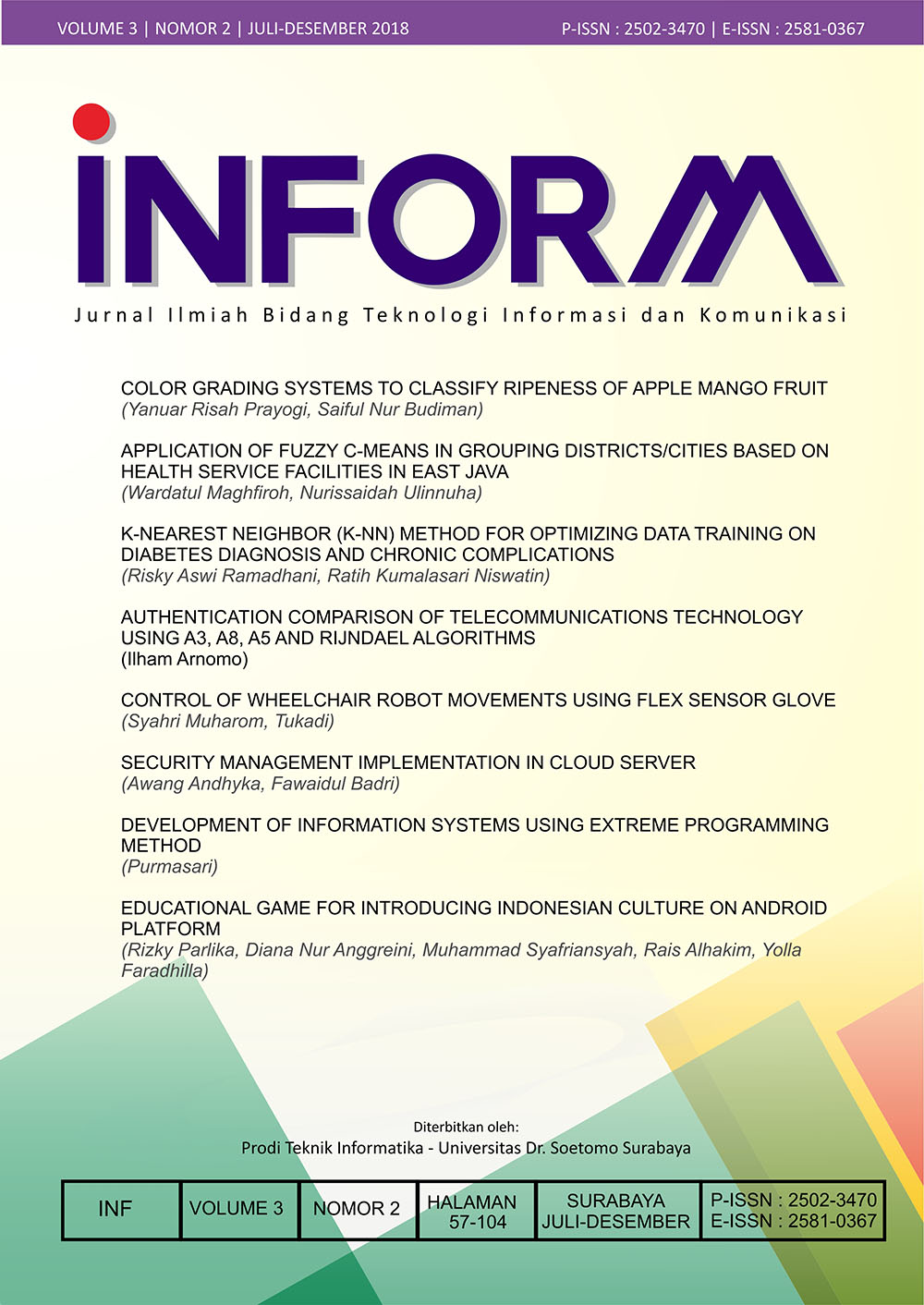
Color Grading Systems to Classify Ripeness of Apple Mango Fruit
DOI:
https://doi.org/10.25139/inform.v3i2.1010Keywords:
grading maturity, mango apple, color region, feed-forward, k-foldAbstract
Harvesting of apple mangoes fruit that simultaneously causes not all apple mango fruits are harvested ripe. Farmers should sort the apple mango manually. So, harvesting in large quantities will take a long time. There are several obstacles to sort the apple mango fruit manually. It needs skills and experiences to sort the apple mangoes fruit and it needs many workers. In addition, when the apple mango is ripe and not immediately sorted, it will be too ripe and decayed, so cause losses. Previous research has already made the apple mango classification system mango level but required an expensive tool and take a long time to process one apple mango. This research proposes a new strategy to measure the ripeness level of apple mango fruit, especially apple mango at low cost, without the expensive device and takes a short time based on the apple mango skin color region using the feed-forward neural network. The test used 214 images consisting of 4 classes. Validation test using k-fold of 7, 9, and 11 with an average accuracy of 90.61%, 91.41%, and 90.82%. Highest accuracy with a value of 91.41% on k-fold 9 while at k-fold 11 accuracy is lower but has the least standard deviation value. A small standard deviation means that the accuracy is more stable than othersReferences
J. Brezmes et al., "Evaluation of an electronic nose to assess fruit ripeness," in IEEE Sensors Journal, vol. 5, no. 1, pp. 97-108, Feb. 2005.
M. Larrain, A. R. Guesalaga and E. Agosin, "A Multipurpose Portable Instrument for Determining Ripeness in Wine Grapes Using NIR Spectroscopy," in IEEE Transactions on Instrumentation and Measurement, vol. 57, no. 2, pp. 294-302, Feb. 2008.
Mohammed Ben Saeed, Osama & Sankaran, Sindhuja & shariff, rashid & Shafri, Helmi & Ehsani, Reza & Alfatni, Meftah & Hafiz, Mohd., “Classification of oil palm fresh fruit bunches based on their maturity using portable four-band sensor system,†Computers and Electronics in Agriculture, vol. 82, pp. 55–60. 2012.
Mason, A., et al., Sensing Technology: Current Status and Future Trends II, Spinger, 2014.
Vikas Gupta. (2017) Understanding Feedforward Neural Networks. [Online]. Available: https://www.learnopencv.com/understanding-feedforward-neural-networks/
Seong-Dae Kim, Jeong-Hwan Lee, Jae-Kyoon Kim, “A new chain-coding algorithm for binary images using run-length codes,†Computer Vision, Graphics, and Image Processing, vol. 41, no. 1, pp 114-128, 1988.
R. C. Gonzalez and R.E. Woods, Digital Image Processing, 2nd ed, Prentice Hall, 2002.
C. S. Nandi, B. Tudu and C. Koley, "A Machine Vision-Based Maturity Prediction System for Sorting of Harvested Mangoes," in IEEE Transactions on Instrumentation and Measurement, vol. 63, no. 7, pp. 1722-1730, July 2014.
Deepak S. Shetel, Dr. M.S. Chavan, “Content Based Image Retrieval: Review,†International Journal of Emerging Technology and Advanced Engineering, vol. 2, pp. 2250-2459, 2012.
E. R. Vimina & K. P. Jacob, “A Sub-Block Based Image Retrieval Using Modified Integrated Region Matching,†International Journal of Computer Science Issues, vol. 10, no. 1, pp. 686–692. 2013.
Downloads
Published
How to Cite
Issue
Section
License
Authors who publish with Inform: Jurnal Ilmiah Bidang Teknologi Informasi dan Komunikasi agree to the following terms:
-
Authors retain copyright and grant the journal right of first publication with the work simultaneously licensed under a Creative Commons Attribution License (CC BY-SA 4.0) that allows others to share the work with an acknowledgment of the work's authorship and initial publication in this journal.
-
Authors are able to enter into separate, additional contractual arrangements for the non-exclusive distribution of the journal's published version of the work (e.g., post it to an institutional repository or publish it in a book), with an acknowledgment of its initial publication in this journal.
-
Authors are permitted and encouraged to post their work online (e.g., in institutional repositories or on their website) prior to and during the submission process, as it can lead to productive exchanges, as well as earlier and greater citation of published work.