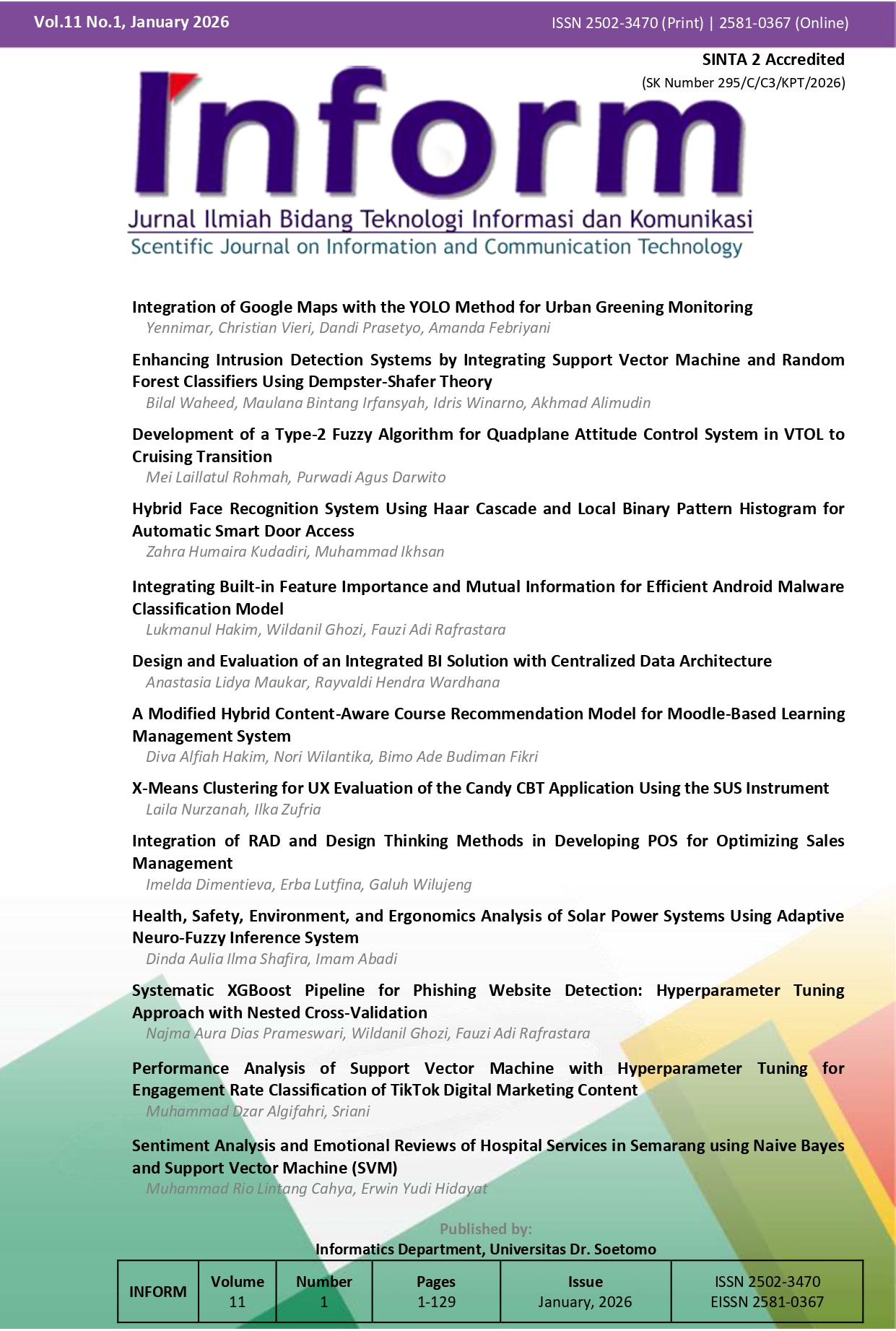
Health, Safety, Environment, and Ergonomics Analysis of Solar Power Systems Using an Adaptive Neuro-Fuzzy Inference System
DOI:
https://doi.org/10.25139/inform.v11i1.10467Keywords:
Health, Safety, Environment, Ergonomics, HSEE, Solar Power System, ANFIS, Adaptive Neuro-Fuzzy Inference SystemAbstract
Solar energy is recognized as a clean energy source; however, its implementation presents various challenges related to Health, Safety, Environment, and Ergonomics (HSEE) aspects that must be addressed. This study aimed to identify subvariables within the HSEE aspects and to analyze HSEE assessments using the Adaptive Neuro-Fuzzy Inference System (ANFIS) method. The identification results indicate that the health aspect comprises two sub-variables: heat stress and toxic materials. The safety aspect includes three sub-variables: electrical risk, fire hazard, and fall risk. The environmental aspect comprises three sub-variables: ecosystem damage, land use, and material recycling. The ergonomics aspect includes three sub-variables: musculoskeletal injury risk, work posture, and manual handling risk. The ANFIS model was developed from questionnaire data categorized into three risk assessment levels: good, fair, and poor. Model performance was evaluated using the Root Mean Square Error (RMSE) as an indicator of accuracy during both the training and testing phases. The evaluation results show RMSE values for the health variable of 0.0120 (training) and 0.0512 (testing); safety of 0.0232 (training) and 0.1515 (testing); environment of 0.0158 (training) and 0.0548 (testing); and ergonomics of 0.0294 (training) and 0.0327 (testing). The overall RMSE values for the health, safety, environment, and ergonomics models were 0.034, 0.140, 0.045, and 0.025, respectively. This study demonstrates that the ANFIS method can serve as a decision-support tool for systematically and adaptively assessing HSEE performance, thereby improving the health, safety, environmental, and ergonomic aspects of solar power plants.
References
A. P. Sisdwinugraha, A. Hapsari, F. Wijaya, and H. M. Padhilah, “Indonesia Energy Transition Outlook 2025,” Dec. 2024.
A. H. Yafi, A. Bagaskara, A. P. Sisdwinugraha, and A. Hapsari, “Indonesia Energy Transition Outlook 2024 IESR Institute for Essential Services Reform,” Jakarta, Dec. 2024.
A. Sen, A. S. Mohankar, A. Khamaj, and S. Karmakar, “Emerging OSH Issues in Installation and Maintenance of Floating Solar Photovoltaic Projects and Their Link with Sustainable Development Goals,” Risk Manag Healthc Policy, vol. 14, pp. 1939–1957, 2021, doi: 10.2147/RMHP.S304732.
A. M. Ismail, R. Ramirez-Iniguez, M. Asif, A. B. Munir, and F. Muhammad-Sukki, “Progress of solar photovoltaic in ASEAN countries: A review,” August 01, 2015, Elsevier Ltd. doi: 10.1016/j.rser.2015.04.010.
K. Ukoba, K. O. Yoro, O. Eterigho-Ikelegbe, C. Ibegbulam, and T. C. Jen, “Adaptation of solar energy in the Global South: Prospects, challenges and opportunities,” April 15, 2024, Elsevier Ltd. doi: 10.1016/j.heliyon.2024.e28009.
P. Behrani, A. Shahrul Nizam Isha, R. Salleh, and A.-B. Abdulrahman Al Mekhlafi, “Determination of Occupational Health and Safety Risks in Solar Energy,” KnE Social Sciences, Dec. 2023, doi: 10.18502/kss.v8i20.14599.
V. Hajipour, H. Amouzegar, A. Gharaei, M. S. Gholami Abarghoei, and S. Ghajari, “An integrated process-based HSE management system: A case study,” Saf Sci, vol. 133, Jan. 2021, doi: 10.1016/j.ssci.2020.104993.
A. Azadeh, M. Rouzbahman, M. Saberi, and F. Valianpour, “An adaptive algorithm for assessment of operators with job security and HSEE indicators,” J Loss Prev Process Ind, vol. 31, no. 1, pp. 26–40, 2014, doi: 10.1016/j.jlp.2014.05.004.
B. Liao, L. Yang, X. Ju, Y. Peng, and Y. Gao, “Experimental study on burning and toxicity hazards of a PET laminated photovoltaic panel,” Solar Energy Materials and Solar Cells, vol. 206, Mar. 2020, doi: 10.1016/j.solmat.2019.110295.
I. Haq, “Environmental Impact Assessment Study: Leaching Of Chemical Contaminants From A Municipal Dump Site Hastsal, DELHI (Capital Of INDIA),” International Journal of Environmental Studies, vol. 60, no. 4, pp. 363–377, Aug. 2003, doi: 10.1080/00207230304732.
A. Nugroho, J. Santoso, I. A. Nugroho, and M. Kom, “Environmental Impact Evaluation of Floating Solar Power Plant in Cirata Reservoir, West Java Article Info ABSTRACT,” 2024.
M. J. Wan, Z. X. Phuang, Z. X. Hoy, N. Y. Dahlan, A. M. Azmi, and K. S. Woon, “Forecasting meteorological impacts on the environmental sustainability of a large-scale solar plant via artificial intelligence-based life cycle assessment,” Science of the Total Environment, vol. 912, Feb. 2024, doi: 10.1016/j.scitotenv.2023.168779.
E. Çakıt, A. J. Olak, W. Karwowski, T. Marek, I. Hejduk, and R. Taiar, “Assessing safety at work using an adaptive neuro-fuzzy inference system (ANFIS) approach aided by partial least squares structural Equation modeling (PLS-SEM),” Int J Ind Ergon, vol. 76, Mar. 2020, doi: 10.1016/j.ergon.2020.102925.
M. F. Sidiq and M. A. Rohman, “A review on safety knowledge and skills for reducing human error and accidents in construction,” in E3S Web of Conferences, EDP Sciences, Sep. 2023. doi: 10.1051/e3sconf/202342901006.
S. R. Revathy et al., “Design and Analysis of ANFIS - Based MPPT Method for Solar Photovoltaic Applications,” International Journal of Photoenergy, vol. 2022, 2022, doi: 10.1155/2022/9625564.
B. G. Bhang et al., “Design methods of underwater grounding electrode array by considering inter-electrode interference for floating PVs,” Energies (Basel), vol. 11, no. 4, Apr. 2018, doi: 10.3390/en11040982.
D. Samaniego-Rascón, M. C. Gameiro da Silva, A. D. Ferreira, and R. E. Cabanillas-Lopez, “Solar energy industry workers under climate change: A risk assessment of the level of heat stresss experienced by a worker based on measured data,” Saf Sci, vol. 118, pp. 33–47, Oct. 2019, doi: 10.1016/j.ssci.2019.04.042.
Z. Wu, Y. Hu, J. X. Wen, F. Zhou, and X. Ye, “A Review for Solar Panel Fire Accident Prevention in Large-Scale PV Applications,” 2020, Institute of Electrical and Electronics Engineers Inc. doi: 10.1109/ACCESS.2020.3010212.
M. Aram, X. Zhang, D. Qi, and Y. Ko, “A state-of-the-art review of fire safety of photovoltaic systems in buildings,” July 25, 2021, Elsevier Ltd. doi: 10.1016/j.jclepro.2021.127239.
J. C. Duroha and G. A. Macht, “Solar installation occupational risks: A systematic review,” Saf Sci, vol. 160, Apr. 2023, doi: 10.1016/j.ssci.2022.106048.
H. Zhang, Z. Yu, C. Zhu, R. Yang, B. Yan, and G. Jiang, “Green or not? Environmental challenges from photovoltaic technology,” March 01, 2023, Elsevier Ltd. doi: 10.1016/j.envpol.2023.121066.
B. Dhiman, D. Zindani, D. Chakrabarti, and G. Singh, “A user-centric assessment of solar-photovoltaic-home-lighting systems in rural parts of Assam, India,” Energy for Sustainable Development, vol. 76, Oct. 2023, doi: 10.1016/j.esd.2023.101290.
J. L. Aznarte M., J. M. Benítez Sánchez, D. N. Lugilde, C. de Linares Fernández, C. D. de la Guardia, and F. A. Sánchez, “Forecasting airborne pollen concentration time series with neural and neuro-fuzzy models,” Expert Syst Appl, vol. 32, no. 4, pp. 1218–1225, May 2007, doi: 10.1016/j.eswa.2006.02.011.
P. Nain and A. Kumar, “Ecological and human health risk assessment of metals leached from end-of-life solar photovoltaics,” Environmental Pollution, vol. 267, p. 115393, Dec. 2020, doi: 10.1016/J.ENVPOL.2020.115393.
A. Afsharian et al., “Work-related psychosocial and physical paths to future musculoskeletal disorders (MSDs),” Saf Sci, vol. 164, Aug. 2023, doi: 10.1016/j.ssci.2023.106177.
D. L. J. Alexander, A. Tropsha, and D. A. Winkler, “Beware of R2: Simple, Unambiguous Assessment of the Prediction Accuracy of QSAR and QSPR Models,” J Chem Inf Model, vol. 55, no. 7, pp. 1316–1322, Jul. 2015, doi: 10.1021/acs.jcim.5b00206.
B. Jamil and N. Akhtar, “Comparative analysis of diffuse solar radiation models based on sky-clearness index and sunshine period for humid-subtropical climatic region of India: A case study,” 2017, Elsevier Ltd. doi: 10.1016/j.rser.2017.04.073.
L. Bi, A. Feleke, and C. Guan, “A review on EMG-based motor intention prediction of continuous human upper limb motion for human-robot collaboration,” May 01, 2019, Elsevier Ltd. doi: 10.1016/j.bspc.2019.02.011.
Downloads
Published
How to Cite
Issue
Section
License
Authors who publish with Inform: Jurnal Ilmiah Bidang Teknologi Informasi dan Komunikasi agree to the following terms:
-
Authors retain copyright and grant the journal right of first publication with the work simultaneously licensed under a Creative Commons Attribution License (CC BY-SA 4.0) that allows others to share the work with an acknowledgment of the work's authorship and initial publication in this journal.
-
Authors are able to enter into separate, additional contractual arrangements for the non-exclusive distribution of the journal's published version of the work (e.g., post it to an institutional repository or publish it in a book), with an acknowledgment of its initial publication in this journal.
-
Authors are permitted and encouraged to post their work online (e.g., in institutional repositories or on their website) prior to and during the submission process, as it can lead to productive exchanges, as well as earlier and greater citation of published work.