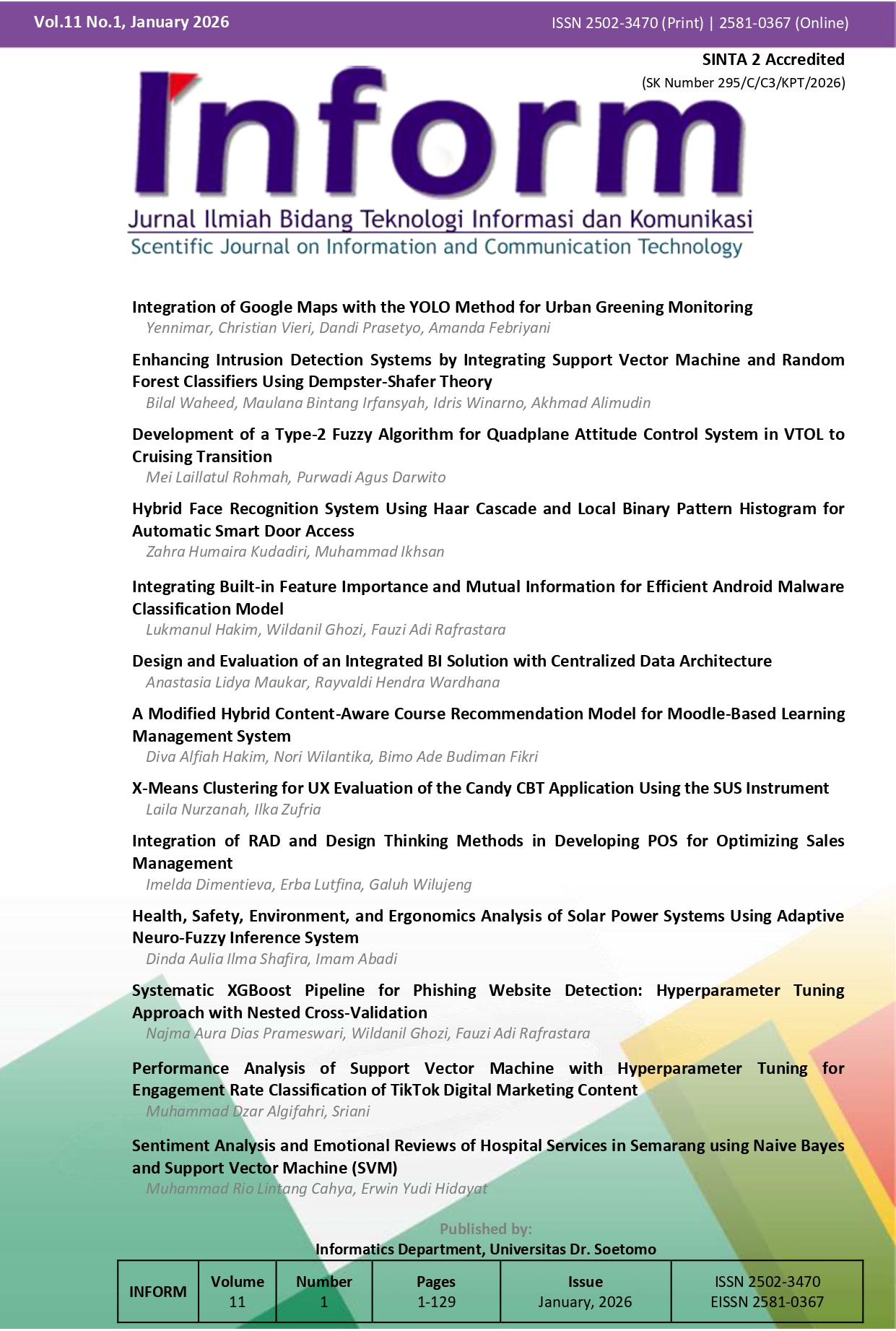
A Modified Hybrid Content-Aware Course Recommendation Model for Moodle-Based Learning Management System
DOI:
https://doi.org/10.25139/inform.v11i1.11207Keywords:
Course Recommendation, Educational Technology, Hybrid Recommender System, Moodle LMS, Usability EvaluationAbstract
Existing course recommendation systems in Learning Management Systems (LMS) often restrict suggestions to the same categories as a user's previously taken courses, limiting diverse course discovery. To address this, this research developed a personalized, cross-category course recommendation system for a data-constrained institutional LMS. This research adapted the Hybrid Content-Aware Course Recommendation (HCACR) framework, integrating a metadata-based user-interest model, a K-Modes-based demographic characteristic model, and a sequential course history model to mitigate data sparsity and cold-start problems. The system was deployed in a Moodle-based environment and evaluated by 171 users. Experimental results show that the model achieved a precision of 26.78% and a recall of 31.07%, which are reasonable given the data constraints in internal government education contexts. Crucially, the system obtained an excellent System Usability Scale (SUS) score of 86.25, indicating high user satisfaction despite the moderate algorithmic precision. While the reliance on sparse metadata limits semantic richness compared to full-content models, this study demonstrates that a hybrid approach is a feasible and effective solution for enhancing course discovery in institutional settings with limited data access.
References
B. Indriyono, N. Pamungkas, I. Zahari, Y. Lestari, and I. Dimentieva, "Application of Mobile-Based Augmented Reality Technology Concepts in Interactive Learning Systems for Liquefaction Phenomena for the Deaf," Inform : Jurnal Ilmiah Bidang Teknologi Informasi dan Komunikasi, vol. 8, no. 2, pp. 116–124, Jun. 2023, doi: 10.25139/inform.v8i2.6223.
G. Swalaganata, M. Andarwati, F. Al-Islama Achyunda Putra, P. Assih, R. Sudarwati, and Y. Bramasta, "Analysis and Design of AI and AR-Based Applications with a UIUX Approach to support Inclusive Learning for students with Disabilities," Inform : Jurnal Ilmiah Bidang Teknologi Informasi dan Komunikasi, vol. 10, no. 2, pp. 129–135, Jul. 2025, doi: 10.25139/inform.v10i2.9996.
A. M. Maatuk, E. K. Elberkawi, S. Aljawarneh, H. Rashaideh, and H. Alharbi, "The COVID-19 pandemic and E-learning: challenges and opportunities from the perspective of students and instructors," J Comput High Educ, vol. 34, no. 1, pp. 21–38, Apr. 2022, doi: 10.1007/s12528-021-09274-2.
Q. Aini, M. Budiarto, P. O. Hadi Putra, and U. Rahardja, "Exploring E-learning Challenges During the Global COVID-19 Pandemic: A Review," 2020.
S. D. Foreman, The LMS guidebook: Learning management systems demystified. Association for Talent Development, 2017.
J. Lin, H. Pu, Y. Li, and J. Lian, "Intelligent Recommendation System for Course Selection in Smart Education," in Procedia Computer Science, Elsevier B.V., 2018, pp. 449–453. doi: 10.1016/j.procs.2018.03.023.
V. Sabnis, P. D. Tejaswini, and G. S. Sharvani, "Course Recommendations In Moocs : Techniques And Evaluation," in 2018 3rd International Conference on Computational Systems and Information Technology for Sustainable Solutions (CSITSS), IEEE, Dec. 2018, pp. 59–66. doi: 10.1109/CSITSS.2018.8768755.
Q. Zhang, J. Lu, and G. Zhang, "Recommender Systems in E-learning," Journal of Smart Environments and Green Computing, 2022, doi: 10.20517/jsegc.2020.06.
H. Altinpulluk and M. Kesim, "A Systematic Review Of The Tendencies In The Use Of Learning Management Systems," Turkish Online Journal of Distance Education, vol. 22, no. 3, pp. 40–54, 2021.
S. H. P. W. Gamage, J. R. Ayres, and M. B. Behrend, "A systematic review on trends in using Moodle for teaching and learning," December 01, 2022, Springer Science and Business Media Deutschland GmbH. doi: 10.1186/s40594-021-00323-x.
Andrew Nicols, "Moodle Local Plugin." Accessed: June 01, 2024. [Online]. Available: https://moodledev.io/docs/4.4/apis/plugintypes/local
A. Felfernig, M. Jeran, G. Ninaus, F. Reinfrank, S. Reiterer, and M. Stettinger, "Basic Approaches in Recommendation Systems," in Recommendation Systems in Software Engineering, Berlin: Springer, 2013, pp. 15–37.
F. Ricci, B. Shapira, and L. Rokach, "Recommender systems: Introduction and challenges," in Recommender Systems Handbook, Second Edition, Springer US, 2015, pp. 1–34. doi: 10.1007/978-1-4899-7637-6_1.
D. B. Guruge, R. Kadel, and S. J. Halder, "The state of the art in methodologies of course recommender systems—a review of recent research," February 01, 2021, MDPI. doi: 10.3390/data6020018.
J. Bobadilla, F. Ortega, A. Hernando, and A. Gutiérrez, "Recommender systems survey," Knowl Based Syst, vol. 46, pp. 109–132, Jul. 2013, doi: 10.1016/j.knosys.2013.03.012.
S. Algarni and F. Sheldon, "Systematic Review of Recommendation Systems for Course Selection," June 01, 2023, MDPI. doi: 10.3390/make5020033.
M. Aamir, "Recommendation System: State of the Art Approach," 2015.
X. Jing and J. Tang, "Guess you like: Course recommendation in MOOCs," in Proceedings - 2017 IEEE/WIC/ACM International Conference on Web Intelligence, WI 2017, Association for Computing Machinery, Inc, Aug. 2017, pp. 783–789. doi: 10.1145/3106426.3106478.
R. W. Saaty, "The Analytic Hierarchy Process-What It Is And How It Is Used," 1987.
Downloads
Published
How to Cite
Issue
Section
License
Authors who publish with Inform: Jurnal Ilmiah Bidang Teknologi Informasi dan Komunikasi agree to the following terms:
-
Authors retain copyright and grant the journal right of first publication with the work simultaneously licensed under a Creative Commons Attribution License (CC BY-SA 4.0) that allows others to share the work with an acknowledgment of the work's authorship and initial publication in this journal.
-
Authors are able to enter into separate, additional contractual arrangements for the non-exclusive distribution of the journal's published version of the work (e.g., post it to an institutional repository or publish it in a book), with an acknowledgment of its initial publication in this journal.
-
Authors are permitted and encouraged to post their work online (e.g., in institutional repositories or on their website) prior to and during the submission process, as it can lead to productive exchanges, as well as earlier and greater citation of published work.