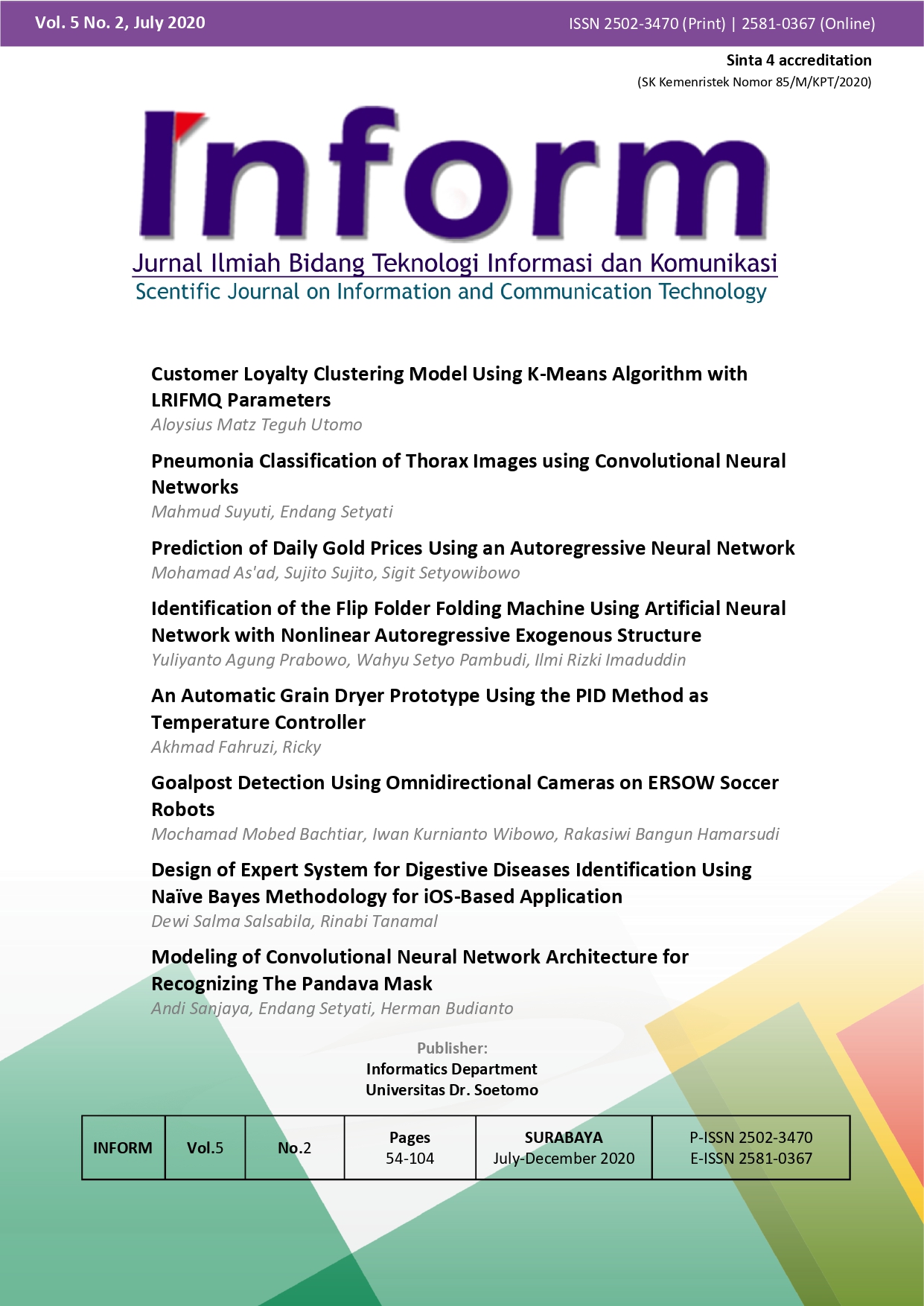
Customer Loyalty Clustering Model Using K-Means Algorithm with LRIFMQ Parameters
DOI:
https://doi.org/10.25139/inform.v5i2.2691Keywords:
customer analysis, k-means, LRIFMQ, analytical hierarchy process, AHP, silhouette coefficient.Abstract
Loyal customers are one of the factors that determine the development of a business. Therefore, businesses need a strategy to keep customers loyal, even making customers who were previously less loyal to become more loyal. The strategy used must be right on target according to customer segmentation. The purpose of this paper is to model a cluster of customer loyalty to help businesses in making the right decisions of marketing strategy. Segmentation is done using the k-means algorithm with LRIFMQ (length, recency, interval, frequency, monetary, quantity) as parameters, and the CLV (customer lifetime value) of each cluster is calculated. Data obtained from PT. XYZ (a company engaged in food processing) for one year (1 January 2019 - 31 December 2019), with 337.739 transactions, and 26.683 customers. AHP (analytical hierarchy process) method is used for LRIFMQ weighting because this method has a consistency index calculation. The silhouette coefficient is used to calculate the cluster quality and determine the optimal number of clusters. The best results are obtained with the silhouette coefficient value of 0,632904 with the number of clusters 6.References
[2] T. Kristanto and R. Arief, "ANALISA DATA MINING METODE FUZZY UNTUK CUSTOMER RELATIONSHIP MANAGEMENT PADA PERUSAHAAN TOUR & TRAVEL," in Seminar Nasional Sistem Informasi Indonesia, 2013.
[3] S. Monalisa, "Klasterisasi Customer Lifetime Value Dengan Model LRFM Menggunakan Algoritma K-Means," Jurnal Teknologi Informasi dan Ilmu Komputer (JTIIK), vol. 5, no. 2, pp. 247-252, 2018.
[4] F. A. Buttle and S. Maklan, Customer Relationship Management: Concepts and Technologies, 2016.
[5] A. Parvaneh, H. Abbasimehr, and M. J. Tarokh, "Integrating AHP and Data Mining for Effective Retailer Segmentation Based on Retailer Lifetime Value," Journal of Optimization in Industrial Engineering, vol. 11, pp. 25-31, 2012.
[6] A. J. Christy, A. Umamakeswari, L. Priyatharsini, and A. Neyaa, "RFM ranking – An effective approach to customer segmentation," Journal of King Saud University – Computer and Information Sciences, 2018.
[7] A. A. Zoeram, "A New Approach for Customer Clustering by Integrating the LRFM Model and Fuzzy Inference System," Iranian Journal of Management Studies, vol. 11, no. 2, pp. 351-378, 2018.
[8] D. Suyanto, Data Mining Untuk Klasifikasi dan Klasterisasi Data, Informatika, 2019.
[9] A. T. Rahman, Wiranto and R. Anggrainingsih, "Coal Trade Data Clusterung Using K-Means," ITSMART: Jurnal Ilmiah Teknologi dan Informasi, vol. 6, no. 1, 2017.
[10] N. P. E. Merliana, Ernawati and A. J. Santoso, "ANALISA PENENTUAN JUMLAH CLUSTER TERBAIK PADA METODE K-MEANS CLUSTERING (SENDI_U)," PROSIDING SEMINAR NASIONAL MULTI DISIPLIN ILMU & CALL FOR PAPERS UNISBANK, p. 978–979–3649–81–8, 2008.
[11] B. Santoso, I. Cholissodin and B. D. Setiawan, "Optimasi K-Means untuk Clustering Kinerja Akademik Dosen Menggunakan Algoritme Genetika," Jurnal Pengembangan Teknologi Informasi dan Ilmu Komputer, pp. 1652-1659, 2017.
[12] D.-C. Li, W.-L. Dai and W.-T. Tseng, "A two-stage clustering method to analyze customer characteristics to build discriminative customer management: A case of textile manufacturing business," Expert Systems with Applications, pp. 7186-7191, 2011.
Downloads
Additional Files
Published
How to Cite
Issue
Section
License
Authors who publish with Inform: Jurnal Ilmiah Bidang Teknologi Informasi dan Komunikasi agree to the following terms:
-
Authors retain copyright and grant the journal right of first publication with the work simultaneously licensed under a Creative Commons Attribution License (CC BY-SA 4.0) that allows others to share the work with an acknowledgment of the work's authorship and initial publication in this journal.
-
Authors are able to enter into separate, additional contractual arrangements for the non-exclusive distribution of the journal's published version of the work (e.g., post it to an institutional repository or publish it in a book), with an acknowledgment of its initial publication in this journal.
-
Authors are permitted and encouraged to post their work online (e.g., in institutional repositories or on their website) prior to and during the submission process, as it can lead to productive exchanges, as well as earlier and greater citation of published work.