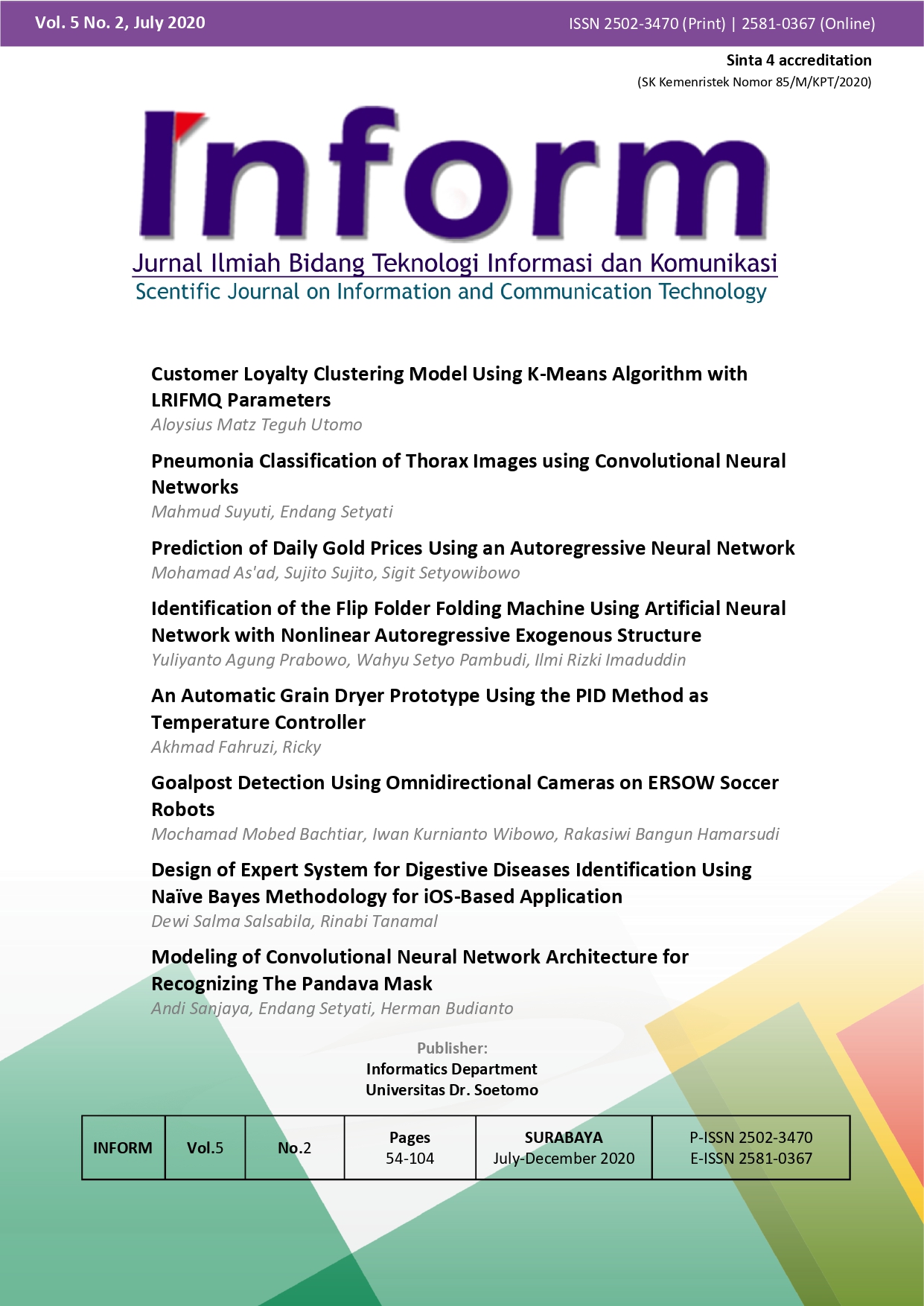
Prediction of Daily Gold Prices Using an Autoregressive Neural Network
DOI:
https://doi.org/10.25139/inform.v5i2.2715Keywords:
prediction, forecasting, daily gold prices, yahoo finance dataset, artificial neural network, neural network autoregressiveAbstract
Gold is a precious metal that functions as a gem and also an investment. Gold investment is the reason for many people because it is practical, not easily damaged, easy cashed, not taxable, and other purposes. Based on this, many people choose gold as an investment. The problem for people who will invest in gold is related to uncertain gold price predictions so that the accuracy of forecasting methods are needed. The purpose of this paper is to forecast accurately daily gold prices using the Neural Network Autoregressive (NNAR) method. Training Data to find out the value of accuracy in the NNAR method uses secondary data obtained from Yahoo Finance in the form of daily gold prices. Test results on the NNAR method produce a better and more accurate level using the NNAR (25,13) model with a MAPE value of 0.370707, a MASE of 0.5851083, and an RMSE of 6.939331. The conclusion of the results of this paper is the daily price of gold is influenced by the daily price of gold a day ago to 24 periods ago with the NNAR (25,13) model.References
[2] F. Aditya, D Devianto and Maiyastri, “Peramalan Harga Emas Indonesia Menggunakan Metode Fuzzy Time Series Klasikâ€, Jurnal Matematika UNAND, Vol. 8 No. 2 p.45-52, 2019.
[3] T. Andriyanto, “Sistem Peramalan Harga Emas Antam Menggunakan Double Exponential Smoothingâ€, Jurnal INTENSIF vol. 1 no. 1, p.1-9, 2017.
[4] F. M. Yuma, “Sistem Peramalan Harga Emas Menggunakan Metode Single Exponential Smoothingâ€, Seminar Nasional Royal (SENAR), hal. 299-302. 2018.
[5] N. A. Izati, B. Warsito and T. Widiharih, “Prediksi Harga Emas Menggunakan Feed Forward Neural Network Dengan Metode Extreme Learning Machineâ€, Jurnal Gausian, vol. 8 no. 2, p.171-183, 2019.
[6] R.J. Hyndman, and G. Athanasopoulos, Forecasting: principles and practice, 2nd edition, OTexts: Melbourne, Australia. 2018. [Online]. Available: OTexts.com/fpp2. Accessed March, 1st 2019.
[7] S. Makridakis, S. C. Wheelwright, and R.J. Hyndman, Forecasting: Methods and Applications, John Wiley & Sons, Inc., 1998.
[8] M. As'ad, "Finding the Best ARIMA Model to Forecast Daily Peak Electricity Demand". 5th Annual Applied Statistics Education and Research Collaboration (ASEARC) - Conference Papers 2012 page 39-42. 2012.
[9] https://finance.yahoo.com /quote /GC%3DF/history?p=GC%3DF.
Yahoo finance Accessed 1 May 2020.
[10] D. Sena, & N.K. Nagwani, "A Neural Network Autoregression Model To Forecast Per Capita Disposable Income", Rpn Journal Of Engineering And Applied Sciences, Vol. 11, No. 22. 2016
[11] L. Safitri, S. Mardiyati, H. Rahim, "Forecasting the mortality rates of Indonesian population by using neural network", Journal of Physics: Conference Series, IOP Publishing, 974-012030. 2018
Downloads
Additional Files
Published
How to Cite
Issue
Section
License
Authors who publish with Inform: Jurnal Ilmiah Bidang Teknologi Informasi dan Komunikasi agree to the following terms:
-
Authors retain copyright and grant the journal right of first publication with the work simultaneously licensed under a Creative Commons Attribution License (CC BY-SA 4.0) that allows others to share the work with an acknowledgment of the work's authorship and initial publication in this journal.
-
Authors are able to enter into separate, additional contractual arrangements for the non-exclusive distribution of the journal's published version of the work (e.g., post it to an institutional repository or publish it in a book), with an acknowledgment of its initial publication in this journal.
-
Authors are permitted and encouraged to post their work online (e.g., in institutional repositories or on their website) prior to and during the submission process, as it can lead to productive exchanges, as well as earlier and greater citation of published work.