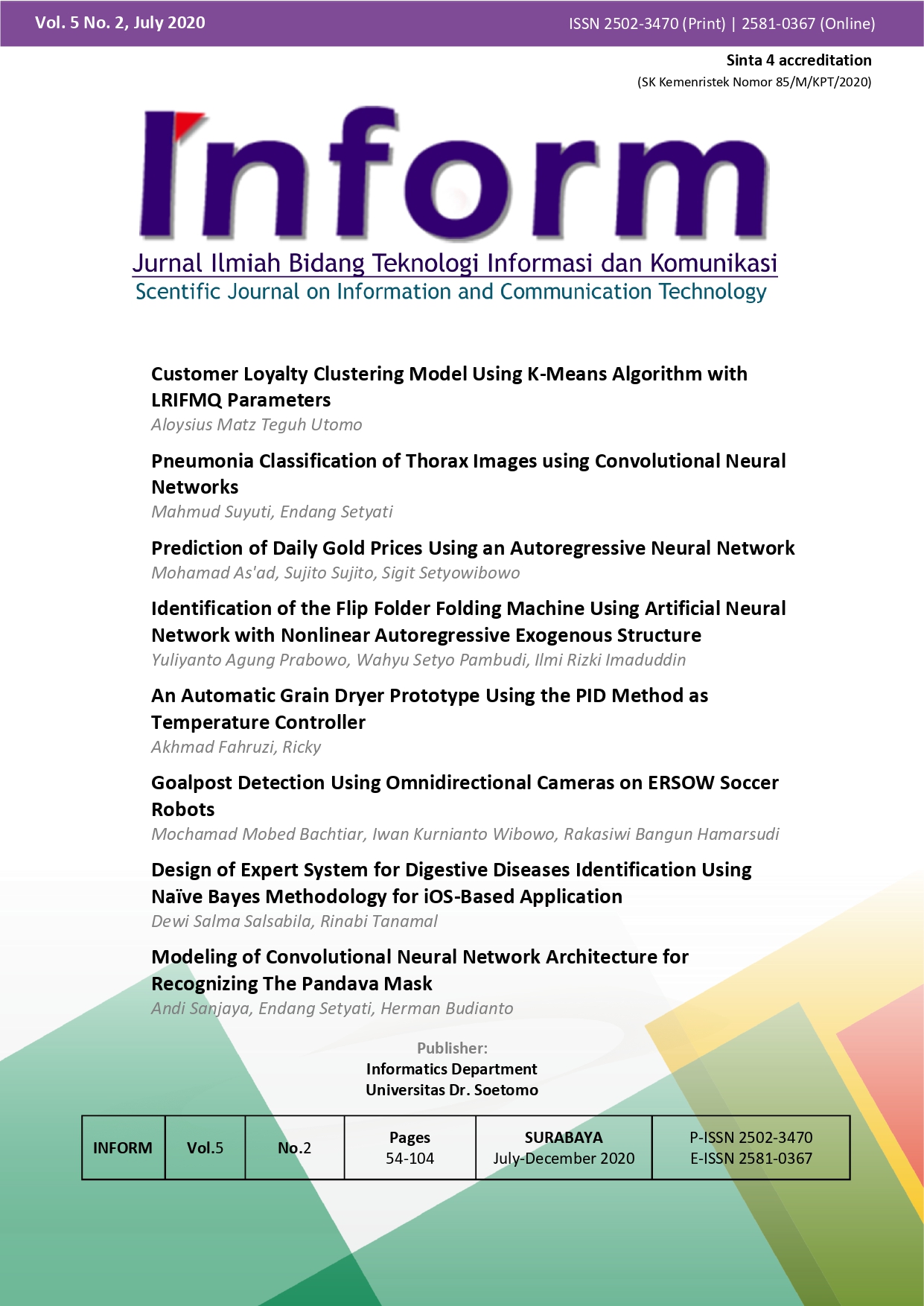
Modeling of Convolutional Neural Network Architecture for Recognizing The Pandava Mask
DOI:
https://doi.org/10.25139/inform.v5i2.2740Keywords:
classification, CNN, lenet, relu, activation, sigmoid activationAbstract
This research was conducted to observe the use of architectural model Convolutional Neural Networks (CNN) LeNEt, which was suitable to use for Pandava mask objects. The Data processing in the research was 200 data for each class or similar with 1000 trial data. Architectural model CNN LeNET used input layer 32x32, 64x64, 128x128, 224x224 and 256x256. The trial result with the input layer 32x32 succeeded, showing a faster time compared to the other layer. The result of accuracy value and validation was not under fitted or overfit. However, when the activation of the second dense process as changed from the relu to sigmoid, the result was better in sigmoid, in the tem of time, and the possibility of overfitting was less. The research result had a mean accuracy value of 0.96.References
[2] S. Sharma, K. Shanmugasundaram, and S. K. Ramasamy, “FAREC - CNN based efficient face recognition technique using Dlib,†Proc. 2016 Int. Conf. Adv. Commun. Control Comput. Technol. ICACCCT 2016, no. 978, pp. 192–195, 2017, doi: 10.1109/ICACCCT.2016.7831628.
[3] R. He, S. Member, X. Wu, Z. Sun, and T. Tan, “Wasserstein CNN : Learning Invariant Features for NIR-VIS Face Recognition,†vol. 14, no. 8, pp. 1–11, 2017.
[4] C. Ding and D. Tao, “Trunk-Branch Ensemble Convolutional Neural Networks for Video-based Face Recognition,†no. X, pp. 1–14, 2017.
[5] H. Zhang, Z. Qu, and L. Yuan, “A Face Recognition Method Based on LBP Feature for CNN,†pp. 544–547, 2017.
[6] M. Y. W. Teow, “Understanding Convolutional Neural Networks Using A Minimal Model for Handwritten Digit Recognition,†no. October, pp. 167–172, 2017.
[7] S. Albawi and T. A. Mohammed, “Understanding of a Convolutional Neural Network,†no. April 2018, 2017, doi: 10.1109/ICEngTechnol.2017.8308186.
[8] F. Ertam, “Data Classification with Deep Learning using Tensorflow,†no. October, 2017, doi: 10.1109/UBMK.2017.8093521.
[9] T. Septianto, E. Setyati, and J. Santoso, “Model CNN LeNet dalam Rekognisi Angka Tahun pada Prasasti Peninggalan Kerajaan Majapahit,†vol. 6, no. April, pp. 106–109, 2018, doi: 10.14710/jtsiskom.6.3.2018.106-109.
[10] S. S. Ahranjany, F. Razzazi, and M. H. Ghassemian, “A very high accuracy handwritten character recognition system for Farsi/Arabic digits using convolutional neural networks,†Proc. 2010 IEEE 5th Int. Conf. Bio-Inspired Comput. Theor. Appl. BIC-TA 2010, pp. 1585–1592, 2010, doi: 10.1109/BICTA.2010.5645265.
[11] T. I. Saputra, F. Fauziah, and N. Hayati, “Implementasi Discrete Wavelet Transform Pada Aplikasi Kompresi Citra Medis,†J. InfomediaTeknik Inform. Multimed. Jar., vol. 4, no. 2, pp. 101–107, 2020, doi: 10.30811/JIM.V4I2.1574.
[12] I. Riadi, R. Umar, and F. D. Aini, “Analisis Perbandingan Detection Traffic Anomaly Dengan Metode Naive Bayes Dan Support Vector Machine (Svm),†Ilk. J. Ilm., vol. 11, no. 1, pp. 17–24, 2019, doi: 10.33096/ilkom.v11i1.361.17-24.
[13] K. Fukushima, “Neocognitron: A self-organizing neural network model for a mechanism of pattern recognition unaffected by shift in position,†Biol. Cybern., vol. 36, no. 4, pp. 193–202, 1980, doi: 10.1007/BF00344251.
[14] A. Carruthers and J. Carruthers, “Handwritten Digit Recognition with a Back-Propagation Network,†Dermatol. Surg., vol. 39, no. 1 Pt 2, p. 149, 2013, doi: 10.1111/dsu.12130.
[15] I. W. S. E. Putra, A. Y. Wijaya, and R. Soelaiman, “Klasifikasi Citra Menggunakan Convolutional Neural Network ( Cnn ) Pada Caltech 101 Image Classfication Using Convolution Neural Network ( Cnn ) on Caltech 101,†Inst. Teknol. Sepuluh Novemb., vol. 5, no. 1, pp. 1–76, 2016.
[16] H. Darmanto, “Pengenalan Spesies Ikan Berdasarkan Kontur Otolith,†Joined J., vol. 2, 2019.
Downloads
Additional Files
Published
How to Cite
Issue
Section
License
Authors who publish with Inform: Jurnal Ilmiah Bidang Teknologi Informasi dan Komunikasi agree to the following terms:
-
Authors retain copyright and grant the journal right of first publication with the work simultaneously licensed under a Creative Commons Attribution License (CC BY-SA 4.0) that allows others to share the work with an acknowledgment of the work's authorship and initial publication in this journal.
-
Authors are able to enter into separate, additional contractual arrangements for the non-exclusive distribution of the journal's published version of the work (e.g., post it to an institutional repository or publish it in a book), with an acknowledgment of its initial publication in this journal.
-
Authors are permitted and encouraged to post their work online (e.g., in institutional repositories or on their website) prior to and during the submission process, as it can lead to productive exchanges, as well as earlier and greater citation of published work.