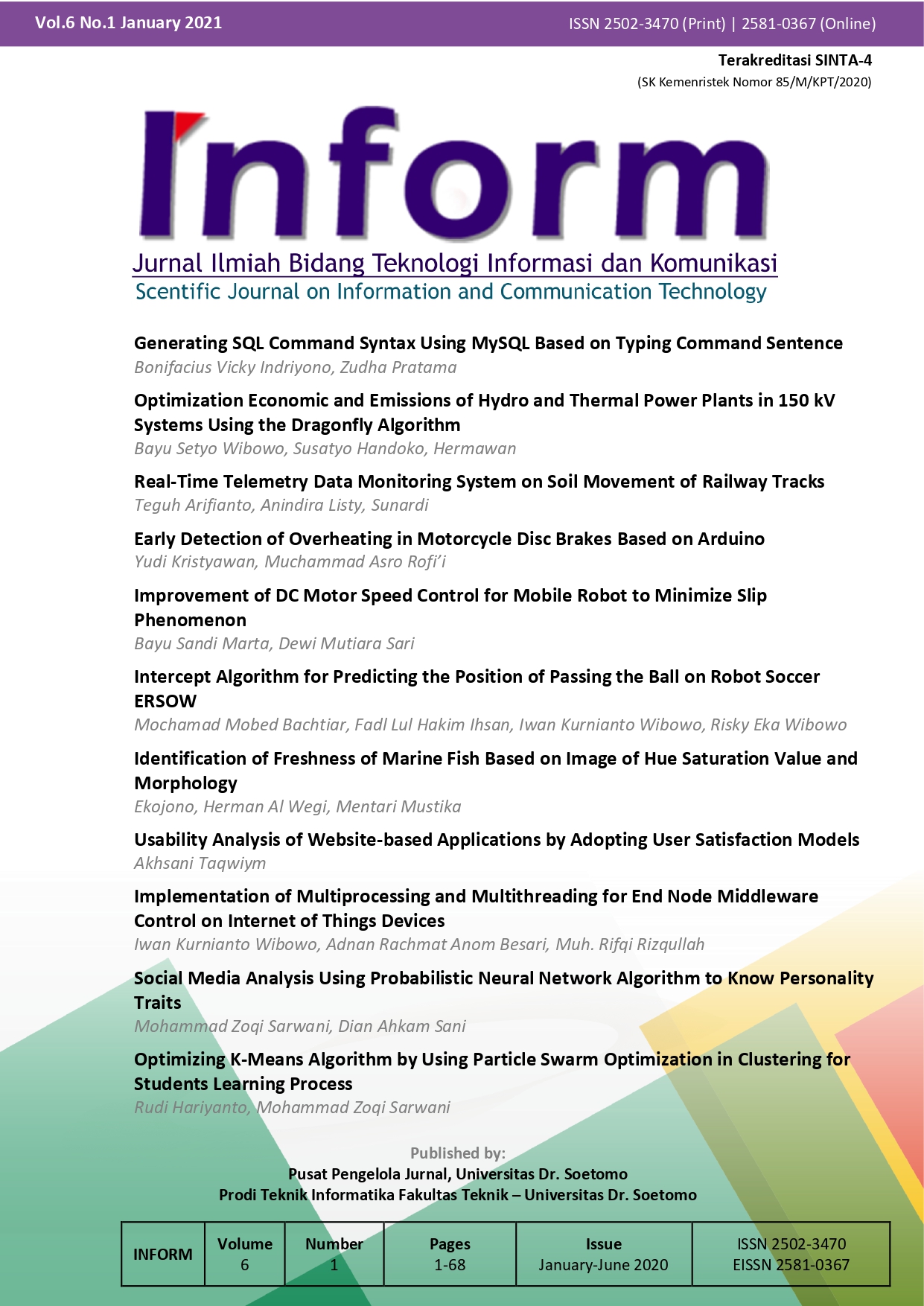
Social Media Analysis Using Probabilistic Neural Network Algorithm to Know Personality Traits
DOI:
https://doi.org/10.25139/inform.v6i1.3307Keywords:
Social Media, Probabilistic Neural Network, Personality Traits, PersonalityAbstract
The Internet creates a new space where people can interact and communicate efficiently. Social media is one type of media used to interact on the internet. Facebook and Twitter are one of the social media. Many people are not aware of bringing their personal life into the public. So that unconsciously provides information about his personality. Big Five personality is one type of personality assessment method and is used as a reference in this study. The data used is the social media status from both Facebook and Twitter. Status has been taken from 50 social media users. Each user is taken as a text status. The results of tests performed using the Probabilistic Neural Network algorithm obtained an average accuracy score of 86.99% during the training process and 83.66% at the time of testing with a total of 30 training data and 20 test data.
References
[2] Ayun, Pq, 2015. The Phenomenon of Adolescents Using Social Media in Forming Identities. Channel, 1-16.
[3] ROSYIDI., 2012. Personality Psychology Psychological Paradigm. Jaudar Press.
[4] Damanik, At, & Khodra, Ml, 2015. Predict the Personality of Big 5 Twitter Users with Support Vector Regression. Cybermatika, vol. 3 - no. 1.
[5] Negara, Abp, Muhardi, H., & Putri, Im, 2020. Analysis of Airline Sentiment Using the Naive Bayes Method and Selection of Information Gain Features. Journal of Information Technology and Computer Science, vol 7.
[6] Sarwani, Mz, & Mahmudy, Wf, 2016 Campus Sentiment Analysis E-Complaint Using Probabilistic Neural Network Algorithm. Cursors, 135 – 140.
[7] Sarwani, Mz, & Mahmudy, Wf, 2015. Twitter Analysis to Determine Someone's Character Using the Naïve Bayes Classifier Algorithm, SESINDO, 291-296.
[8] Shofa, Yasin & Rahmawati., 2015. Data Classification of Birth Weight Using Probabilistic Neural Network and Logistic Regression (Case Study at Sultan Agung Islamic Hospital Semarang, 2014).
[9] Sun, C., Hu Yi., & Shi, P., 2020. Probabilistic Neural Network Based Seabed Sediment Recognition Method For Side-Scan Sonar Imagery. Sedimentary Geology, vol 410.
[10] Alweshah, M., Rababa, L., Ryalat, Mh, Momani, A. A ,. & Ababneh, Mf, 2020. African Buffalo Algorithm: Training The Probabilistic Neural Network To Solve Classification Problem. Journal Of King Saudi University Computer And Information Sciences.
[11] FAN, H., PEI, J., & ZHAO, Y., 2020. An Optimized Probabilistic Neural Network With Unit Hyperspherical Crown Mapping And Adaptive Kernel Coverage. Neurocomputing, Vol 373.
[12] Lhaksamana, Km, Nhita, F., & Anggraini, D., 2017. Personality Classification Based on Facebook Status Using the Backpropagation Method. e-Proceeding of Engineering, 5174.
[13] Saputri, Ee, Wahono, Rs, & Suhartono, V., 2015. Selection of Smoothing Parameters on Probabilistic Neural Network by Using Particle Swarm Optimization for Text Detection on Images. Journal of Intelligent Systems.
[14] Sarwani, Mz, & Sani, Da, Fakhrini, FC, 2019. Personality Classification through Social Media Using Probabilistic Neural Network Algorithms, IJAIR, 9-15.
[15] Sarwani, Mz, & Sani, Da, 2020. Knowing Personality Traits on Facebook Status Using the Naïve Bayes Classifier, IJAIR, 22-28
Downloads
Additional Files
Published
How to Cite
Issue
Section
License
Authors who publish with Inform: Jurnal Ilmiah Bidang Teknologi Informasi dan Komunikasi agree to the following terms:
-
Authors retain copyright and grant the journal right of first publication with the work simultaneously licensed under a Creative Commons Attribution License (CC BY-SA 4.0) that allows others to share the work with an acknowledgment of the work's authorship and initial publication in this journal.
-
Authors are able to enter into separate, additional contractual arrangements for the non-exclusive distribution of the journal's published version of the work (e.g., post it to an institutional repository or publish it in a book), with an acknowledgment of its initial publication in this journal.
-
Authors are permitted and encouraged to post their work online (e.g., in institutional repositories or on their website) prior to and during the submission process, as it can lead to productive exchanges, as well as earlier and greater citation of published work.