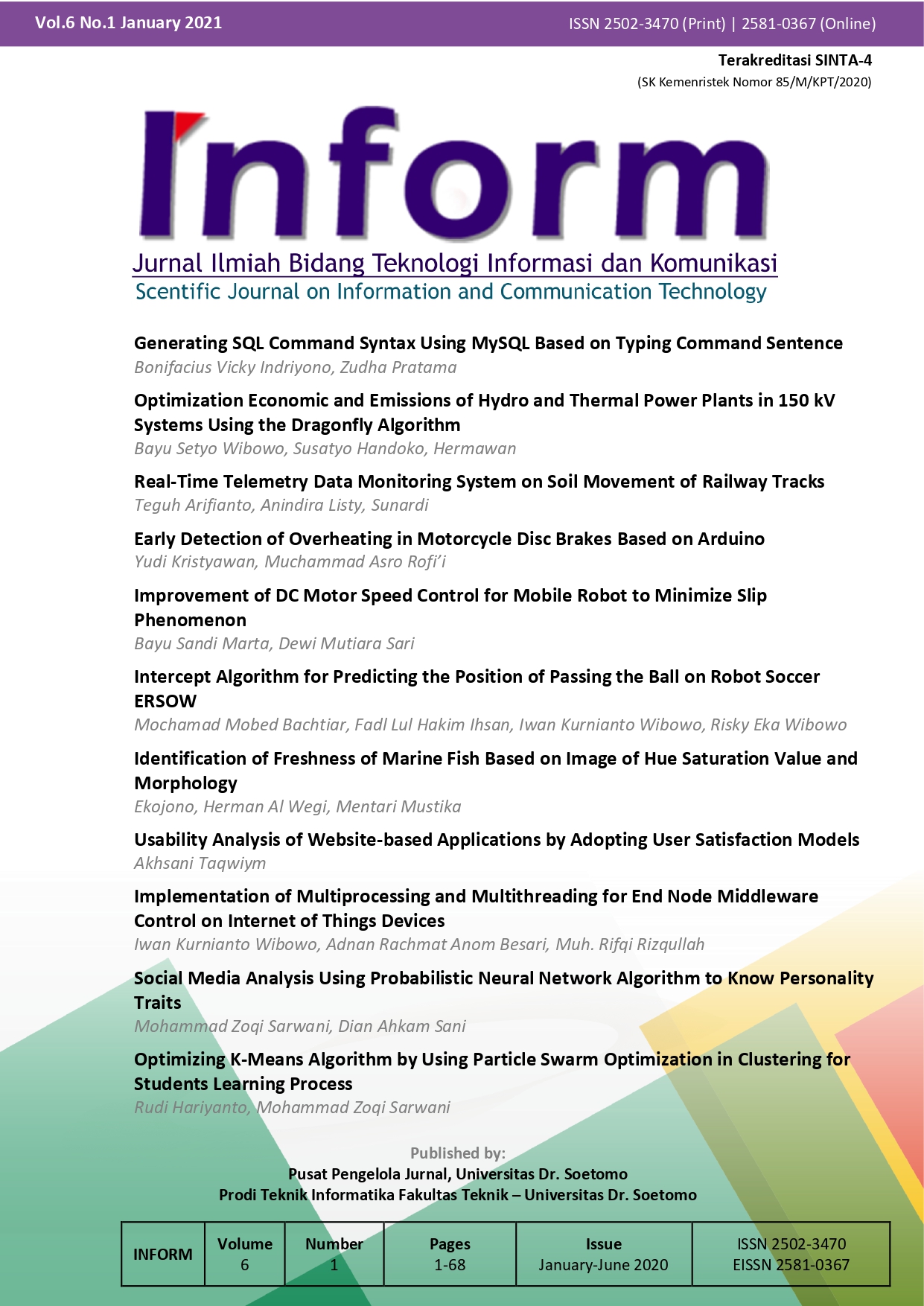
Optimizing K-Means Algorithm by Using Particle Swarm Optimization in Clustering for Students Learning Process
DOI:
https://doi.org/10.25139/inform.v6i1.3459Keywords:
Learning process, Optimization Algorithm, PSO, K-Means, ClusteringAbstract
In the implementation of learning, several factors affect the student learning process, including internal factors, external factors, and learning approach factors. For example, the physical and spiritual condition of students. Physiological aspects (body, eyes and ears and talents of students, student interests). External factors, for example, environmental conditions around students, family, teachers, community, friends) Thus, learning achievement is significant because educational institutions' success can be seen from how many students learning achievement. This research's first focus is to do student clustering based on their learning process using 11 parameters. Second, using the PSO algorithm to get maximum clustering results. The research data were obtained from vocational secondary education institutions in the city of Pasuruan. The data is obtained from the results of school reports and questionnaires as much as 100 student data. Data attributes include environmental features, social features, and related school features to group student data for learning data processing. From the classification results using the PSO method, the silhouette value is 0.97140754, very close. These results indicate that the PSO method can improve the K-Means clustering method's performance in the classification process of student learning interest.ÂReferences
[2] Syah Muhibbin,. 2006. Psikologi Belajar , Jakarta: PT. Raja Grapindo Persada.
[3] Efraim Turban, dkk. 2005. Decision Support Systems and. Intelligent Systems. Edisi 7, Jilid 1, New Jersey: Pearson Education.
[4] Y. A. Auliya, "Improve Hybrid Particle Swarm Optimization and K-Means by Random Injection for Land Clustering of Potato Plants," Proc. - 2019 Int. Conf. Comput. Sci. Inf. Technol. Electr. Eng. ICOMITEE 2019, vol. 4, no. 1, pp. 192–198, 2019, DOI: 10.1109/ICOMITEE.2019.8921207.
[5] M. Sarwani and D. Sani, “Implementasi Metode K-Means Sebagai Pengelompokan Siswa Berdasarkan Proses Belajar Siswa,†pp. 1131–1135, 2018.
[6] J. Aranda and W. A. G. Natasya, “Penerapan Metode K-Means Cluster Analysis Pada Sistem Pendukung Keputusan Pemilihan Konsentrasi Untuk Mahasiswa International Class Stmik Amikom Yogyakarta,†Semin. Nas. Teknol. Dan Multimed. 2016, vol. 4, no. 1, pp. 4-2–1, 2016, [Online]. Available: https://ojs.amikom.ac.id/index.php/semnasteknomedia/article/view/1293.
[7] F. Y. Bisilisin, Y. Herdiyeni, and B. I. B. P. Silalahi, “Optimasi K-Means Clustering Menggunakan Particle Swarm Optimization pada Sistem Identifikasi Tumbuhan Obat Berbasis Citra K-Means Clustering Optimization Using Particle Swarm Optimization on Image Based Medicinal Plant Identification System,†Ilmu Komput. Agri-Informatika, vol. 3, no. 2002, pp. 38–47, 2014.
[8] Sujoto, T.S.Si., M.M.Kom. 2011. “Kecerdasan Buatanâ€. Penerbit ANDI yogjakarta.
[9] A. Saidul and J. L. Buliali, "Implementasi Particle Swarm Optimization pada K-Means Untuk Clustering Data Automatic Dependent Surveillance-Broadcast," Eksplora Inform., vol. 8, no. 1, p. 30, 2018, DOI: 10.30864/eksplora.v8i1.150.
[10] Rahmawati, dkk. 2019. Optimasi K-Means untuk Pengelompokan Data Kinerja Akademik Dosen menggunakan Particle Swarm Optimization, Jurnal Pengembangan Teknologi Informasi dan Ilmu Komputer e-ISSN: 2548-964X Vol. 3, No. 4, April 2019, hlm. 4102-4110 http://j-ptiik.ub.ac.id
[11] Achyani, 2018. Penerapan Metode Particle Swarm Optimization Pada Optimasi Prediksi Pemasaran Langsung. JURNAL INFORMATIKA, Vol.5 No.1 2355-6579, E-ISSN: 2528-2247
[12] S. Kusumadewi, Membangun Jaringan Syaraf Tiruan Menggunakan MATLAB & EXCEL LINK. Yogyakarta: Graha Ilmu, 2004ISSN:
[13] Kusumadewi S, Hartati S, Harjoko A, Wardoyo R. 2006. Fuzzy Multi-Attribute Decision Making (FUZZY MADM). Graha Ilmu, Yogyakarta.
[14] Daihani, DU., 2001, Komputerisasi Pengambilan Keputusan, PT Elex Media Komputindo Gramedia, Jakarta.
[15] Kusrini, 2007, Konsep dan Aplikasi Sistem Pendukung Keputusan, Penerbit Andi, Yogyakarta.
Downloads
Additional Files
Published
How to Cite
Issue
Section
License
Authors who publish with Inform: Jurnal Ilmiah Bidang Teknologi Informasi dan Komunikasi agree to the following terms:
-
Authors retain copyright and grant the journal right of first publication with the work simultaneously licensed under a Creative Commons Attribution License (CC BY-SA 4.0) that allows others to share the work with an acknowledgment of the work's authorship and initial publication in this journal.
-
Authors are able to enter into separate, additional contractual arrangements for the non-exclusive distribution of the journal's published version of the work (e.g., post it to an institutional repository or publish it in a book), with an acknowledgment of its initial publication in this journal.
-
Authors are permitted and encouraged to post their work online (e.g., in institutional repositories or on their website) prior to and during the submission process, as it can lead to productive exchanges, as well as earlier and greater citation of published work.