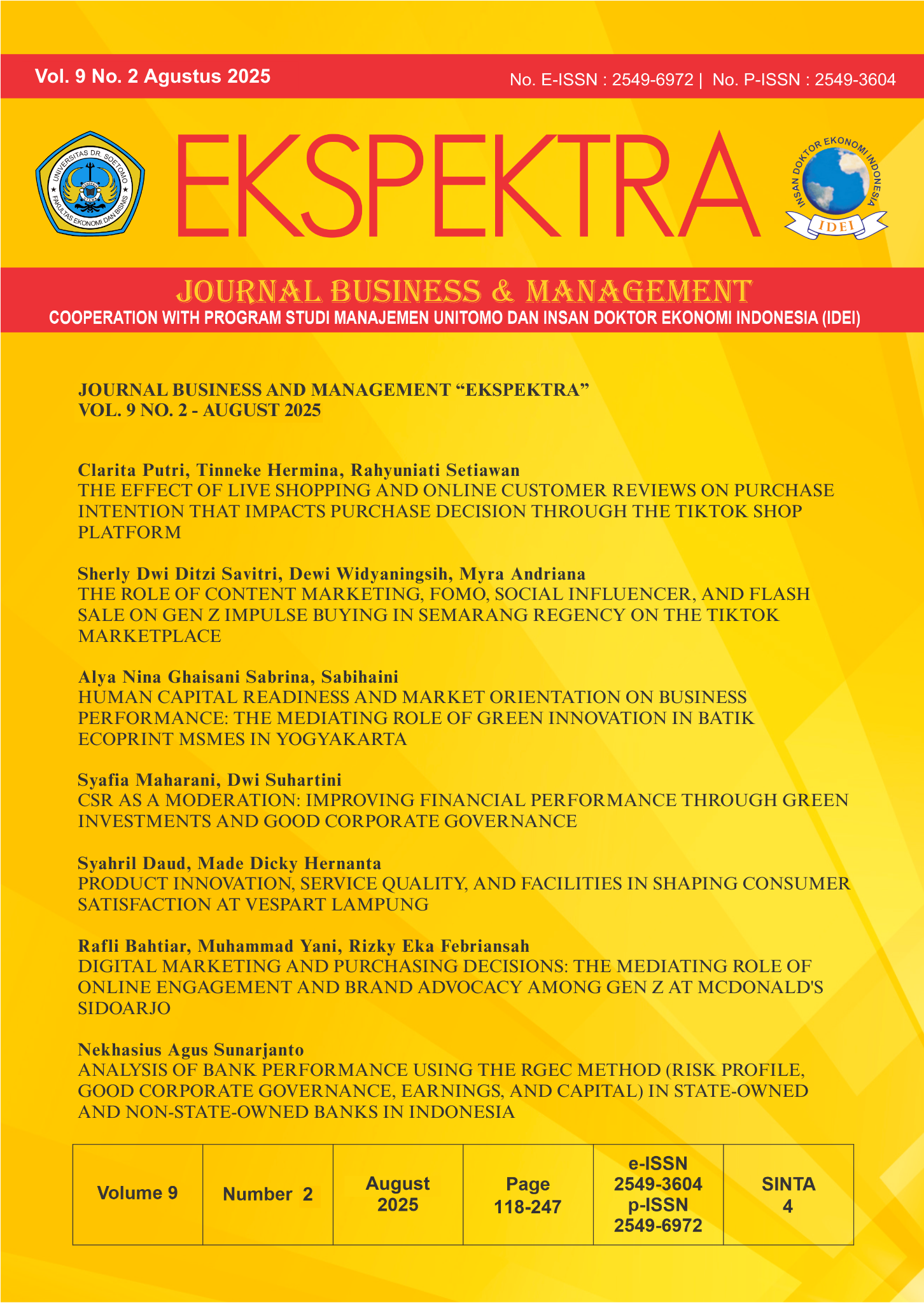
Analysis of Bank Performance Using the RGEC Method (Risk Profile, Good Corporate Governance, Earnings, and Capital) in State-Owned and Non-State-Owned Banks in Indonesia
DOI:
https://doi.org/10.25139/ekt.v9i2.10766Abstract
According to Bank Indonesia Circular Letter Number 13/1/PBI/2011, banks are required to improve and maintain their performance. Bank performance is assessed using the RGEC method. This method consists of Risk Profile, Good Corporate Governance, Earning, and Capital. Good assessment results can increase the trust of external parties. This study aims to determine the differences in performance between state-owned banks and non-state-owned banks. The performance of both types of banks was measured using the RGEC method in accordance with Bank Indonesia regulations. Using purposive sampling, this study collected data from 38 banks listed on the Indonesia Stock Exchange (IDX) for the period 2020 to 2023. The variables measured include Non-Performing Loans (NPL) and Loan-to-Deposit Ratio (LDR) for Risk Profile, composite GCG rating for Good Corporate Governance, Return on Assets (ROA) and Net Interest Margin (NIM) for Earnings, and Capital Adequacy Ratio (CAR) for Capital. The data analysis techniques used were Normality Test followed by Mann-Whitney U Test. The research results indicate that there is a significant difference between the performance of SOE banks and non-SOE banks for the variables of GCG, ROA, and CAR. However, there is no significant difference for risk variables (NPL, LDR, and NIM), implying that SOE banks and non-SOE banks face the same risks.
Downloads
Published
Issue
Section
License

Ekspektra : Jurnal Bisnis dan Manajemenis licensed under a Creative Commons Attribution-ShareAlike 4.0 International License.