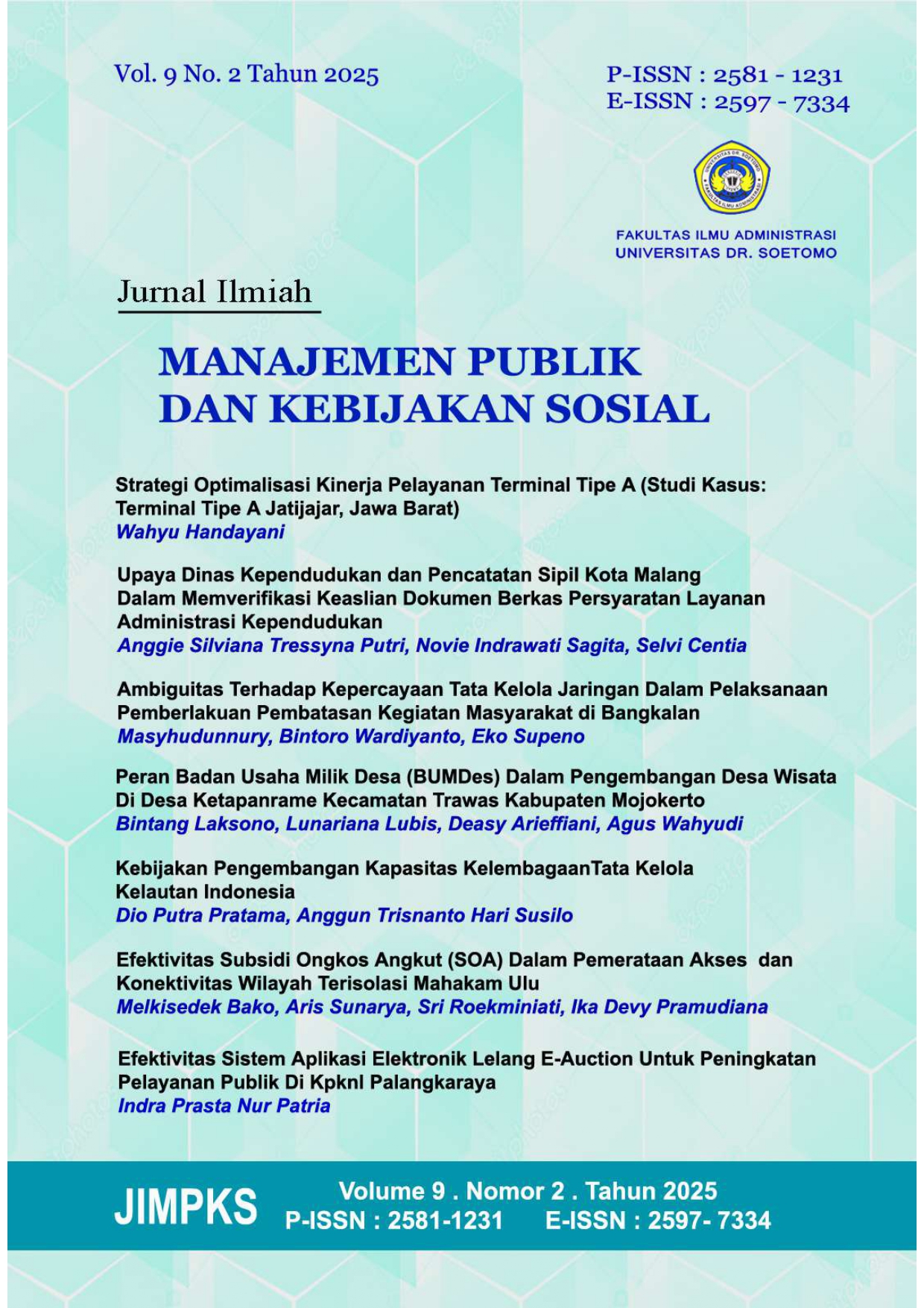
Efektivitas Sistem Aplikasi Elektronik Lelang E-Auction Untuk Peningkatan Pelayanan Publik Di Kpknl Palangkaraya
DOI:
https://doi.org/10.25139/jmnegara.v9i2.11111Keywords:
E-Auction, Auction Winner, ReceiptAbstract
The purpose of this study is to examine and implement E-Auction in public administration and digital transformation from the public perspective and digital transformation theories. This study adopts Richard M. Steers' (1985) organizational effects theory to measure the extent to which electronic application systems are effective in achieving organizational goals and objectives. The assessment of public service quality in this study refers to Sinambela's (2014) public service theory, which views public service as a fundamental issue that must be controlled by a state administrator so that the services provided are accessible and accountable. E-Government, as regulated in Presidential Regulation No. 95 of 2018 concerning the Electronic-Based Government System (SPBE), forms the basis of this theory as a legal framework for bureaucratic digitalization in Indonesia. The purpose of combining the above theories is to measure the extent to which the application of I E overcomes distance limitations, improves cost structures, and offers greater transparency in the auction process at the Palangkaraya State Property and Auction Service Office (KPKNL).
References
Amarathunga, M. k. s. l. d., Welhena, C., Senevirathna, M. M. G. R. M., Kahandage, K. prathibha. ., & Amarakoon, A. m. chamal. (2023). Assessing Stakeholders’ Satisfaction with the Transformation of Conventional Auction into an E-Auction. International Journal of Innovative Approaches in Agricultural Research, 7(2), 169–186. https://doi.org/10.29329/ijiaar.2023.568.2
Amin, S. (2017). Strategi Peningkatan Kualitas Pelayanan Akademik Pada Perguruan Tinggi. Jurnal Madaniyah, 7(2), 222–236.
Andriana, N., Giovanni, R., & Akhmad Priharjanto. (2023). Analysis Implementation of Online Auction (E-Auction) at the State Assets and Auction Service Office (KPKNL) Jakarta. IJESS International Journal of Education and Social Science, 4(1), 57–66. https://doi.org/10.56371/ijess.v4i1.165
Bala, R., Salem, M. A., Taher, A., & Badu, J. A. (2022). Strategi Kepala Madrasah Dalam Pengelolaan Sarana Dan Prasarana Untuk Meningkatkan Mutu Pendidikan. Perspektif, 1(4), 394–411. https://doi.org/10.53947/perspekt.v1i4.206
Bogdan, R. C., Biklen, S. K., 1992, Qualitative Research for Education: an Introduction to Theory and Methods, Boston: Allyn & Bacon.
Chandra Ramdhani, E., Gaja, H., & Ratnawati, R. (2018). Aplikasi Berbasis Dekstop Untuk Persediaan Bahan Baku Produksi Menggunakan Model Waterfall (Study Kasus: PT. Seyon Indonesia). Jurnal Informatika: Jurnal Pengembangan IT, 3(2), 277–284. https://doi.org/10.30591/jpit.v3i2.855
Kementerian Keuangan RI. (2020). Keputusan-DIrektur-Jenderal-Kekayaan-Negara-Nomor-461KN2020.html.pdf.
Kotler, P. (2016). Marketing Management (S. Wall (ed.); 16th ed.). Pearson Education Limited.
Maimonah, & Fanida, E. H. (2018). Faktor-Faktor Kesuksesan Penerapan Aplikasi Taprose (Tuban Public Report Services) Temanku Di Dinas Komunikasi Dan Informatika Kabupaten Tuban. Publika, 6(5), 73–77.
Maramis, F. S., Sepang, J., & Soegoto, A. S. (2018). Pengaruh Kualitas Produk, Harga Dan Kualitas Pelayanan Terhadap Kepuasan Konsumen Pada Pt. Air Manado. Jurnal EMBA: Jurnal Riset Ekonomi, Manajemen, Bisnis Dan Akuntansi, 6(3), 1658–1667. https://doi.org/10.35794/emba.v6i3.20411
Noviandra, N., Marjo, & Utama, K. (2020). Pelaksanaan Lelang Online (E-Auction) Di Kantor Pelayanan Kekayaan Negara Dan Lelang (Kpknl) Kota Semarang. Diponegoro Law Journal, 9(2), 403–414.
Novita, D., Qibthiah, I. M., & Muis, A. (2022). Implementation of Online Auction Services (E-Auction) At Kantor Pelayanan Kekayaan Negara Dan Lelang (Kpknl) Bekasi City. KYBERNAN: Jurnal Ilmiah Ilmu Pemerintahan, 13(1), 47–65. https://doi.org/10.33558/kybernan.v13i1.4529
Nugroho, D. (2018). Kualitas Pelayanan E-Auction Pada Kantor Pelayanan Kekayaan Negara dan Lelang Surakarta. Ji@P, 5(1), 47–58.
Nurchana, A. R. A. (2014). Efektivitas E-Procurement Dalam Pengadaan Barang/Jasa (Studi Terhadap Penerapan E-Procurement Dalam Pengadaan Barang/Jasa Di Kabupaten Bojonegoro). Jurnal Administrasi Publik Mahasiswa Universitas Brawijaya, 2(2), 355–359.
Oktariyanda, T. A., & Rahaju, T. (2018). E-government strategy of Surabaya city government through e-rt / rw to improve the quality of public service. Journal of Physics: Conference Series, 953(1). https://doi.org/10.1088/1742-6596/953/1/012161
Peraturan Presiden RI. (2018). Peraturan Presiden Nomor 95 Tahun 2018 tentang Sistem Pemerintahan Berbasis Elektronik. Menteri Hukum Dan Hak Asasi Manusia Republik Indonesia, 110.
PMK.06 Nomor 213 tahun 2020, Djkn 1 (2020). www.jdih.kemenkeu.go.id
Putriani, F., & Fanida, E. H. (2022). Efektivitas Sistem E-Planning Dalam Perencanaan Pembangunan Daerah (Studi Pada Badan Perencanaan Pembangunan Daerah Kabupaten Tulungagung). Publika, 10(4), 1257–1268. https://ejournal.unesa.ac.id/index.php/publika/article/view/48103
Ramadhani, D. S., & Rahardjo, M. (2016). Analisis Pengaruh Kompensasi, Komitmen Organisasi Dan Gaya Kepemimpinan Transformasional Terhadap Kinerja Karyawan (Studi pada Karyawan PT Barata Indonesia (Persero) Gresik – Jawa Timur). 5, 1–14.
Riyadin. (2019). Pengaruh Kualitas Pelayanan Terhadap Kepuasan Masyarakat Keluarga Berencana di Kecamatan Pekalongan Kabupaten Lampung (Studi Kasus Pada Desa Pekalongan). Jurnal Simplex, 2(1), 41–50.
Safira Aulia Salma, & Ertien Rining Nawangsari. (2022). Kualitas Pelayanan Publik Padamalpelayanan Publikqualityof Public Serviceat Public Service Mall. Jurnal Kebijakan Publik, 13(2), 170–178.
Sahira, D. F., & Megawati, S. (2022). Efektivitas Pengawasan Lalu Lintas Melalui Surabaya Intelligent Transport System (Sits) Di Kota Surabaya. Publika, 10(3), 895–908. https://ejournal.unesa.ac.id/index.php/publika/article/view/46856
Seyselis, M., & Pradana, G. W. (2021). Efektivitas Sistem Electronic Monitoring Dan Evaluasi (E-Monev) Di Badan Perencanaan Pembangunan Kota Surabaya. Publika, 37–48. https://doi.org/10.26740/publika.v9n1.p37-48
Steers, M. R. (2015). Efektivitas Organisasi. Jakarta: Erlangga.
Triadi, A. W. (2022). Sistem Pengelolaan Informasi Badan Usaha Milik Desa (Bumdes) Berbasis Web Di Desa Bana Kecamatan Bontocani Kabupaten Bone.
Udoyono, K., Setyadiharja, R., Nurmandi, A., Suyito, S., Septiawan, B., Suryani, E., Sutriatmoko, Satibi, Puspandari, D. A., Nurmandi, A., Susila, A., Kane, S. N., Mishra, A., Dutta, A. K., Indrajit, R. E., Rudianto, D., Zainuddin, A., Yuwinanto, H. P., Salim, M., … Syamsuddin. (2016). Efek moderasi komitmen organisasi pada pengaruh implementasi e- procurement terhadap pencegahan fraud pengadaan barang dan jasa pemerintah. Jurnal Ilmu Pemerintahan : Kajian Ilmu Pemerintahan Dan Politik Daerah, 2(1), 178–185. https://doi.org/10.1088/1742-6596/755/1/011001
Waluyo, D., & Syarifuddin. (2022). Praktik Sosialisasi Kebijakan Publik Pada Era Digital Practice of Public Policy Socialization in the Digital Age. Majalah Semi Ilmiah Populer Komunikasi Massa, 3(1), 1–8.
Wheelen, T., David, J., & Hunger. (2010). Manajemen Strategis. Andi.
Yogiswara, P. K., Noak, P. A., & Winaya, I. K. (2014). Peranan E-Government Dalam Mendukung Transparansi Dan Keterbukaan Informasi Publik.
Yunita, N. P. (2018). Kondisi Terkini Perkembangan e-Government di Indonesia : Praktik
Downloads
Published
How to Cite
Issue
Section
License
Authors who publish with JIMPKS: Jurnal Ilmiah Manajemen Publik dan Kebijakan Sosial agree to the following terms:
-
Authors retain copyright and grant the journal right of first publication with the work simultaneously licensed under a Creative Commons Attribution License (CC BY-SA 4.0) that allows others to share the work with an acknowledgment of the work's authorship and initial publication in this journal.
-
Authors are able to enter into separate, additional contractual arrangements for the non-exclusive distribution of the journal's published version of the work (e.g., post it to an institutional repository or publish it in a book), with an acknowledgment of its initial publication in this journal.
-
Authors are permitted and encouraged to post their work online (e.g., in institutional repositories or on their website) prior to and during the submission process, as it can lead to productive exchanges, as well as earlier and greater citation of published work.