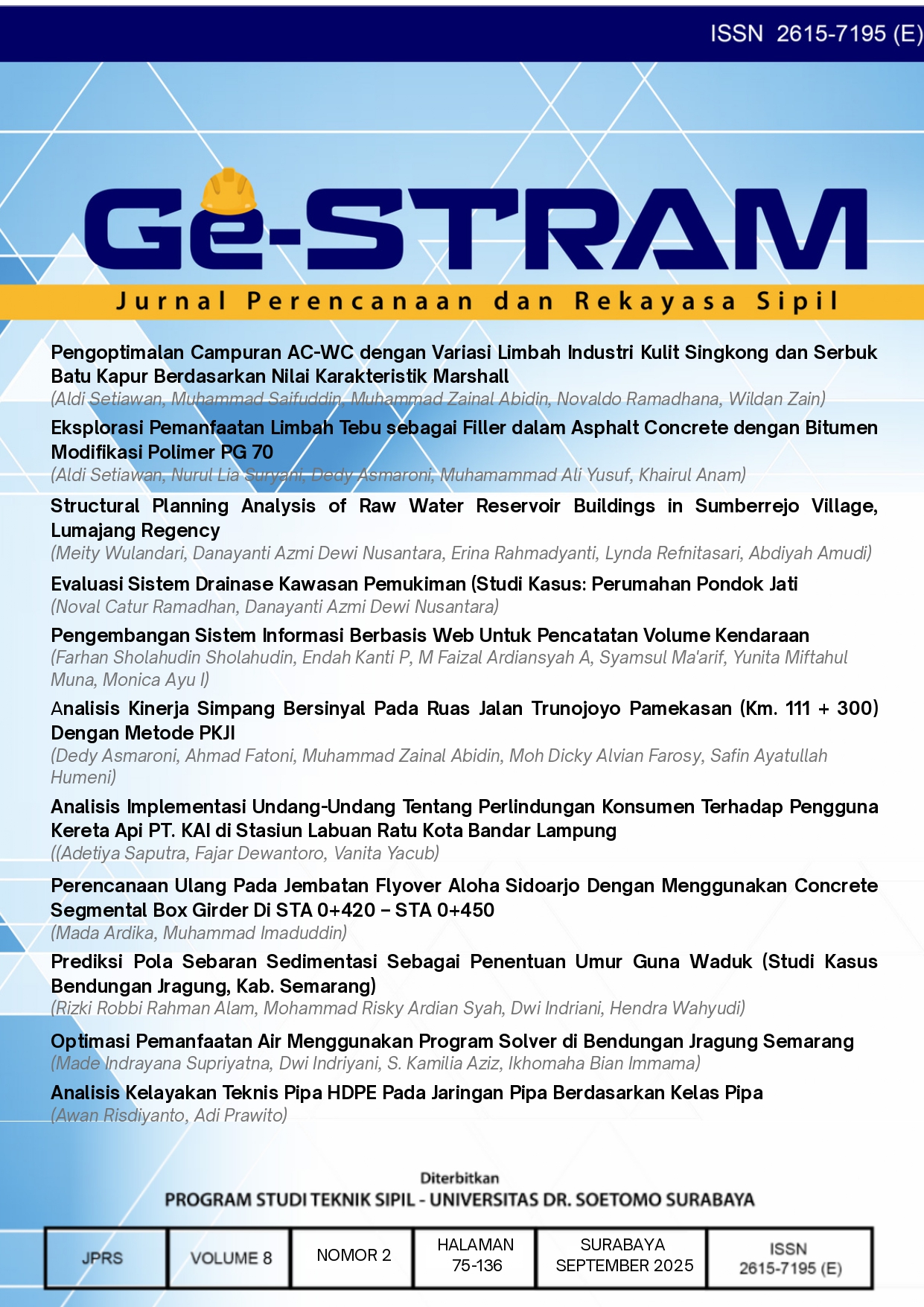
Eksplorasi Pemanfaatan Limbah Tebu sebagai Filler dalam Asphalt Concrete dengan Bitumen Modifikasi Polimer PG 70
DOI:
https://doi.org/10.25139/jprs.v8i2.10051Keywords:
sugarcane waste, PG 70, BitumenAbstract
Sugarcane bagasse is one of the natural wastes that cannot be recycled. Sugarcane bagasse contains chemical compounds with silica (SiO2) content that exceeds that found in Portland cement. This research aims to investigate the effect of using sugarcane waste as a substitute for cement on Marshall characteristics with the use of polymer-modified bitumen PG 70. The sugarcane waste filler used in this study was 1%, 3%, 5%, 7%, and 9%, with variations in asphalt content of 5%, 5.5%, and 6%, resulting in a total of 45 test samples. The research results, with the addition of sugarcane waste filler, met the specifications at a filler content of 1% with 5.5% asphalt content. The test results showed a stability value of 1228 kg, a flow value (deformation) of 3.17 mm, VIM (Void in Mix) of 4.80%, VMA (Void in Aggregate Material) of 15.08%, VFB (Void Filled with Bitumen) of 68.16%, and a Marshall Quotient of 387.71 kg/mm. These values meet the requirements of the 2018 General Specifications of Bina Marga Revision 2.
References
Dedy Asmaroni, Ahmad Fatoni, Alfita Yusriyah. (2022). “Pengaruh Penggunaan Aspal Plastik Recycle dan Aspal Pen 60/70 Pada Campuran Aspal Panas AC-WC (Asphalt Concrete Wearing Course) Menggunakan Agregat Lokal Madura Terhadap Karateristik Marshallâ€. Ge-STRAM J. Perenc. dan Rekayasa Sipil, Vol 6 No 2, September 2023, Hal 66-71, Universitas Dr. Soetomo Surabaya.
Ely M, Mery A. (2022). “Pengaruh Pemanfaatan Abu Ampas Tebu dan Kawat Bendrat Terhadap Kuat Tekan dan Kuat Lentur Beton Ringanâ€. Jurnal Teoretis dan Terapan Bidang Rekayasa Sipil, Vol 9 No 2, Agustus 2022, Hal 199-206. Institut Teknologi Bandung, Bandung.
Kementrian Pekerjaan Umum dan Perumahan Rakyat Direktorat Jenderal Bina Marga. (2018). “Spesifikasi Umum 2018 Untuk Pekerjaan Konstruksi Jalan dan Jembatan (Revisi 2), Direktorat Jenderal Bina Marga, Jakarta.
Pareang, A., Alpius, & Tanan, B. (2024). “Pengaruh Variasi Panjang Serat Tebu Sebagai Bahan Tambah Terhadap Indeks Perendaman Campuran AC-BCâ€. Paulus Civil Engineering Journal, Vol 5, No 1, Maret 2023, Hal 185-193, Program Studi Teknik Sipil Universitas Kristen Indonesia Paulus, Makasar.
Taurina Jemmy Irwanto, Suryani NL, Renaldi S. (2023). “Perbandingan Karakteristik Marshall Aspal Karet (Natural Rubber Modified Asphalt) Dan Aspal Penetrasi 60/70 Pada Campuran Asphalt Concrete - Wearing Course (AC-WC) Menggunakan Aggregat Lokal Maduraâ€. Ge-STRAM J. Perenc. dan Rekayasa Sipil, Vol 6 No 1, Maret 2023, Hal 33-38, Universitas Dr. Soetomo Surabaya.
Yosevina. (2022). “Pengaruh Penggunaan Aspal Modifikasi Polimer Ethyl Vinyl Acetat (EVA) Terhadap Campuran Laston Asphalt Concrete Wearing Course (AC-WC): The Effect Of The Use Of Ethyl Vinyl Acetate (EVA) Modification Polymer On Mixed Asphalt Concrete Wearing Course (AC-WC)â€. Media Ilmiah Teknik Sipil, Vol. 10 No. 2, Juni 2022, Hal 95-104, Universitas Muhammadiyah, Palangkaraya.
Downloads
Published
How to Cite
Issue
Section
License
Authors who publish with this journal agree to the following terms:
- Authors retain copyright and grant the journal right of first publication with the work simultaneously licensed under a Creative Commons Attribution-ShareAlike 4.0 International License that allows others to share the work with an acknowledgement of the work's authorship and initial publication in this journal.
- Authors are able to enter into separate, additional contractual arrangements for the non-exclusive distribution of the journal's published version of the work (e.g., post it to an institutional repository or publish it in a book), with an acknowledgement of its initial publication in this journal.
- Authors are permitted and encouraged to post their work online (e.g., in institutional repositories or on their website) prior to and during the submission process, as it can lead to productive exchanges, as well as earlier and greater citation of published work (See The Effect of Open Access).

This work is licensed under a Creative Commons Attribution-ShareAlike 4.0 International License.