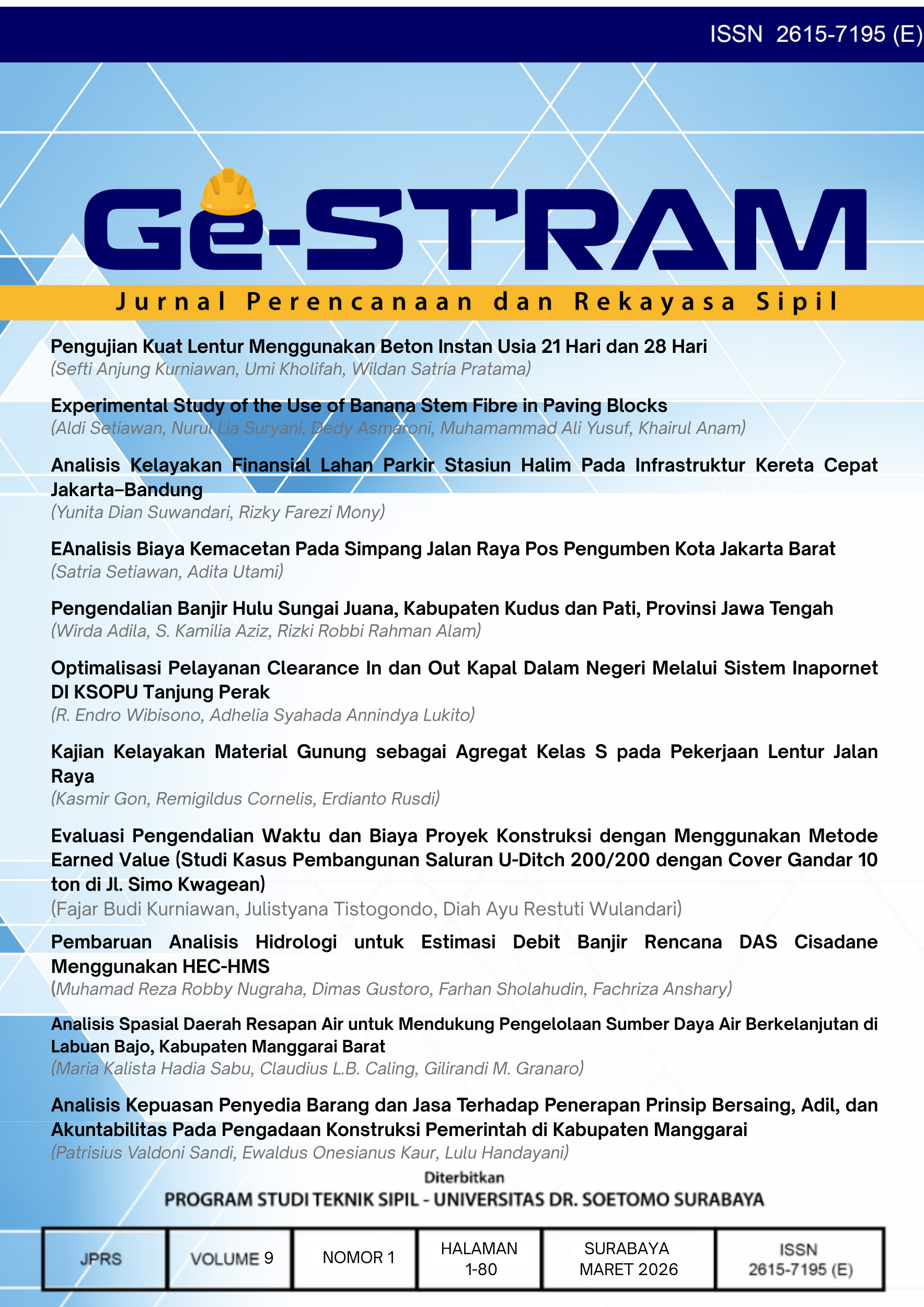
The Evaluation of Construction Project Time and Cost Control Using the Earned Value Method (Case Study of Construction of a 200/200 U-Ditch Channel with 10 ton Axle Cover on Jl. Simo Kwagean)
Evaluation of Construction Project Time and Cost Control Using the Earned Value Method (Case Study of Construction of a 200/200 U-Ditch Channel with 10 ton Axle Cover on Jl. Simo Kwagean)
DOI:
https://doi.org/10.25139/jprs.v9i1.11062Keywords:
Earned Value Management, Time Control, Cost Control, Construction Project, U-DitchAbstract
This study aims to evaluate the time and cost performance of the construction project of U-Ditch 200/200 with a 10-ton axle load cover on Jl. Simo Kwagean, Surabaya, using the Earned Value Management (EVM) method. EVM integrates cost, schedule, and physical progress to measure project efficiency. The data used include the Bill of Quantity (BoQ), project schedule, S-curve, and weekly progress reports. The main indicators analyzed were Planned Value (PV), Earned Value (EV), Actual Cost (AC), Cost Variance (CV), Schedule Variance (SV), Cost Performance Index (CPI), and Schedule Performance Index (SPI).
The analysis up to the 10th week shows that CV was positive (IDR 52,575,882 in week 10), indicating cost efficiency, while SV was positive in 7 out of 10 observation weeks, with the highest acceleration of IDR 233,022,814 in week 9. CPI > 1 (1.055) means actual costs were lower than planned, while SPI > 1 (1.47) indicates the project progressed faster than scheduled. The Estimate at Completion (EAC) projection suggests the final cost will be lower than the original budget, and the estimated project duration will be shorter than the contractual schedule.
These results confirm that EVM is effective as an early warning system for monitoring and controlling project time and cost.
References
Annas, F. M., et al. (2025). Evaluasi Kinerja Biaya dan Waktu Pelaksanaan Menggunakan Metode Earned Value (EVM): Studi Kasus Proyek Pengendalian Banjir Kali Lamong. Universitas Muhammadiyah Surakarta.
Hayati, N. I., & Salim, M. A. (2019). Evaluasi Biaya dan Waktu dengan Metode Earned Value Management pada Proyek Masjid AL-Hijri 2. Universitas Ibn Khaldun Bogor.
Junaidi, A., et al. (2022). Kajian Evaluasi Biaya dan Waktu dalam Penanganan Keterlambatan Proyek Menggunakan EVM (Studi Kasus: Jalan Layang Bandara Ahmad Yani). Politeknik Negeri Semarang.
Kurniawan, A. (2017). Analisis Earned Value Waktu dan Biaya Proyek Konstruksi Jalan: Studi Kasus Pelebaran Jalan Simpang Lago - Sorek I. Universitas Islam Riau.
Kurniawan, M. I. (2021). Evaluasi Pengendalian Waktu dan Biaya Proyek Konstruksi Berdasarkan Metode Earned Value dan Crash Project (Studi Kasus pada Proyek Pembangunan SMP Negeri 1 Surabaya). Universitas Narotama..
Kukuh, R. B., et al. (2023). Analisa Pengendalian Waktu dan Biaya pada Proyek Pembangunan Jalan Menggunakan Earned Value Method. Universitas 17 Agustus 1945 Surabaya.
Laia, S., et al. (2024). Evaluasi Kinerja Waktu dan Biaya Proyek Melalui Pengaplikasian Metode Earned Value: Studi Kasus Pembangunan Jalan Deli Serdang. Universitas Pembinaan Masyarakat Indonesia..
Mahapatni, A. R., et al. (2023). Analisis Kinerja Waktu dan Biaya Proyek Pembangunan Jembatan Pangkung Dalem. Universitas Hindu Indonesia.
Ningsi, R., et al. (2022). Pengendalian Waktu dan Biaya dengan Metode EVM pada Proyek Jalan Ruas Kotu - Laba. Universitas Muhammadiyah Parepare.
Priyono, D. (2015). Analisa Kinerja, Biaya, dan Waktu Pelaksanaan Proyek The Samator Surabaya Menggunakan EVM. Institut Teknologi Sepuluh Nopember..
Downloads
Published
How to Cite
Issue
Section
License
Authors who publish with this journal agree to the following terms:
- Authors retain copyright and grant the journal right of first publication with the work simultaneously licensed under a Creative Commons Attribution-ShareAlike 4.0 International License that allows others to share the work with an acknowledgement of the work's authorship and initial publication in this journal.
- Authors are able to enter into separate, additional contractual arrangements for the non-exclusive distribution of the journal's published version of the work (e.g., post it to an institutional repository or publish it in a book), with an acknowledgement of its initial publication in this journal.
- Authors are permitted and encouraged to post their work online (e.g., in institutional repositories or on their website) prior to and during the submission process, as it can lead to productive exchanges, as well as earlier and greater citation of published work (See The Effect of Open Access).

This work is licensed under a Creative Commons Attribution-ShareAlike 4.0 International License.