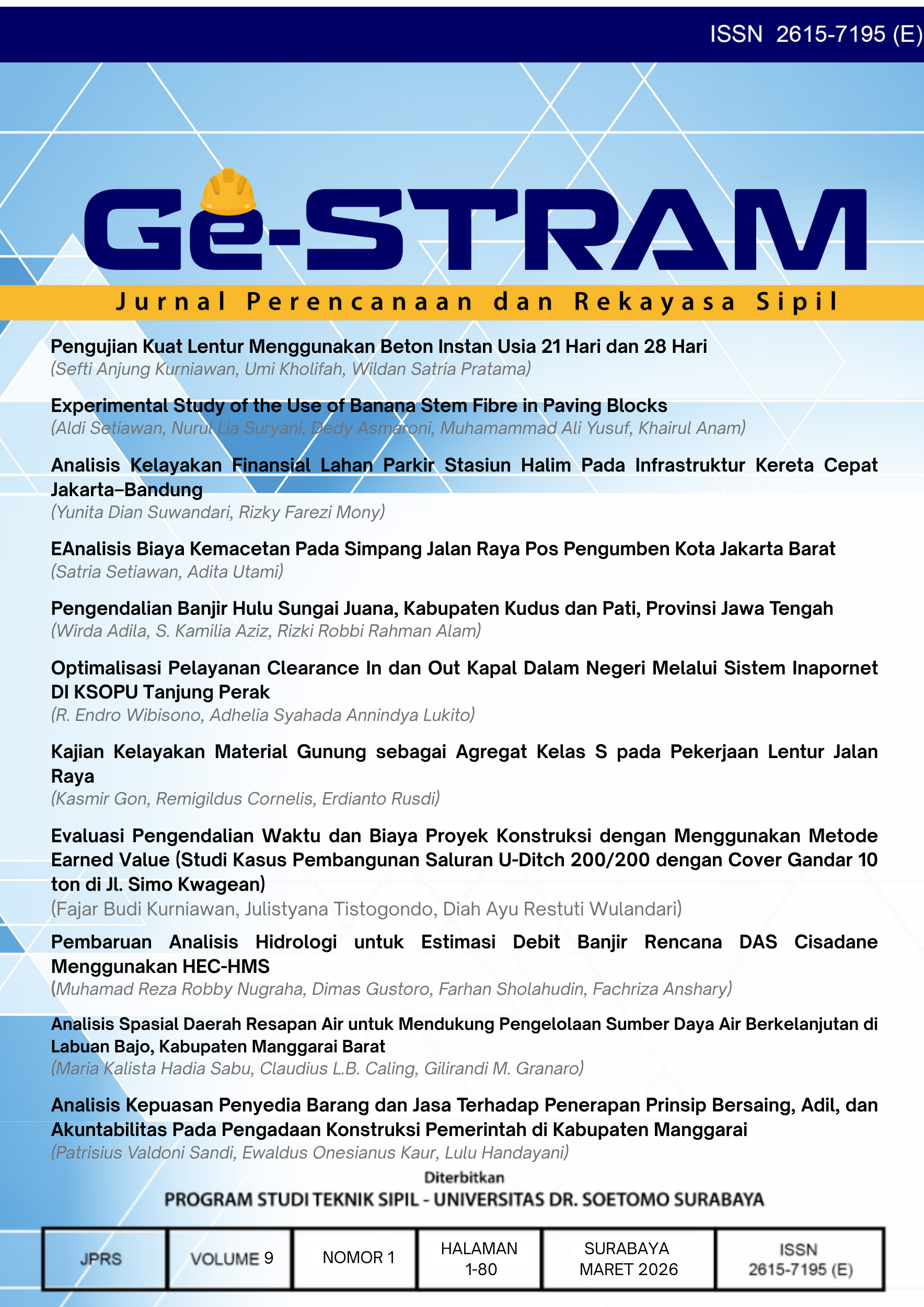
Experimental Study of the Use of Banana Stem Fibre in Paving Blocks
DOI:
https://doi.org/10.25139/jprs.v9i1.9891Keywords:
Banana Stem Fibre, Paving Blocks, Compressive StrengthAbstract
Construction can be categorized into two main types: structural and non-structural. One example of non-structural construction is paving, commonly utilized for road surfaces in rural areas or residential developments. During the planning phase, non-structural elements are frequently regarded merely as dead loads, without considering the potential interactions with structural components. However, it is important to note that paving is also subjected to dynamic loads. As a widely used material, paving is generally more cost-effective compared to rigid or flexible pavements. Paving can reduce the weight of buildings. Over time, paving technology has introduced numerous innovations in material usage, including the incorporation of waste materials such as bagasse ash, rice husk ash, sawdust, and iron filings. However, some studies have not achieved the expected quality of paving. Consequently, further discoveries have been made to optimize the use of available environmental resources. The objective of this research is to determine the compressive strength of paving blocks enhanced with banana stem fiber. The research methodology employed is experimental, conducted in a laboratory setting in accordance with applicable SNI standards. The test results indicated that the average compressive strength values for the paving blocks were 22.67 MPa at 7 days, 23.96 MPa at 14 days, and 25.12 MPa at 28 days.
References
D. Hermanto, Supardi, and E. Purwanto, "The compressive strength of concrete blocks with variations in fibre additives," Matrix of Civil Engineering, Pp. 491-497, Sep. 2014.
J. J. S. Pah, D. Nalle, and R. A. Bella, "Changes in Building Structure Response Due to Non-Structural Components," Journal of Civil Engineering, Vol. 12, No. 2, Pp. 145-158, 2023.
N. Sumbawaty, S. Ahzan, D. Sabda, and B. Prasetya, "Porosity and Compressive Strength Test of Lightweight Brick Made from Gold Processing Waste (Lpe) with Banana Tree Filler (Fpp)," Journal of Research and Assessment of Educational Sciences: E-Saintika | , Vol. 1, No. 2, P. 87, 2018.
A. Rohman and B. Damara, "Effect of Addition of Banana Frond Fibre Waste Variation on Flexural Strength of Concrete," Journal of Civil Talent, Vol. 7, No. 1, P. 102, Feb. 2024, Doi: 10.33087/Talentasipil.V7i1.377.
D. Kurniati, T. Saputro, E. F. Nurhidayatullah, C. D. Saputro, and A. Asyifa, "Compressive Strength of Paving Block by Utilising Acetylene Welding Waste," Journal of Karkasa, Vol. 7, No. 2, 2021.
Downloads
Published
How to Cite
Issue
Section
License
Authors who publish with this journal agree to the following terms:
- Authors retain copyright and grant the journal right of first publication with the work simultaneously licensed under a Creative Commons Attribution-ShareAlike 4.0 International License that allows others to share the work with an acknowledgement of the work's authorship and initial publication in this journal.
- Authors are able to enter into separate, additional contractual arrangements for the non-exclusive distribution of the journal's published version of the work (e.g., post it to an institutional repository or publish it in a book), with an acknowledgement of its initial publication in this journal.
- Authors are permitted and encouraged to post their work online (e.g., in institutional repositories or on their website) prior to and during the submission process, as it can lead to productive exchanges, as well as earlier and greater citation of published work (See The Effect of Open Access).

This work is licensed under a Creative Commons Attribution-ShareAlike 4.0 International License.