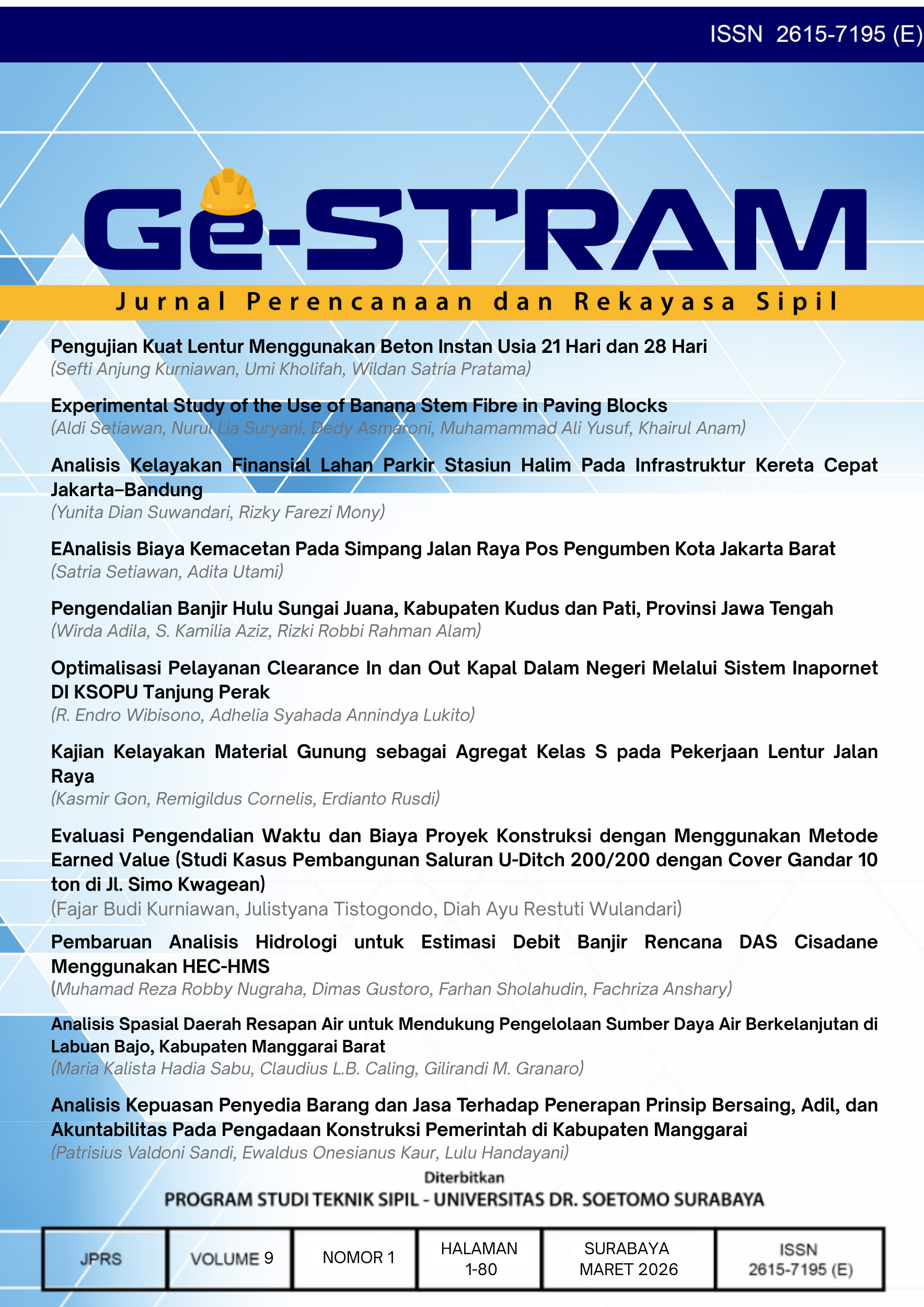
Kajian Kelayakan Material Gunung sebagai Agregat Kelas S pada Pekerjaan Lentur Jalan Raya
DOI:
https://doi.org/10.25139/jprs.v9i1.10956Kata Kunci:
Aggregate S, physical properties, feasibility, laboratory testsAbstrak
This This study aims to determine the physical properties of the Wae Lengkas Quary mountain material based on laboratory tests compared to the provisions of the 2018 General Specifications for Roads and Bridges as Class S Aggregate or road shoulders. Road shoulder preservation or maintenance work is one of the priorities for highway management to maintain or improve the performance of road sections in order to maintain the stability of economic growth in the local community. The use of local materials as Class S Aggregate must meet quality requirements based on laboratory tests. Other aspects that need to be considered are the amount of availability, exploitation methods that prioritize environmental balance, and affordable costs. Laboratory tests of the Quary Wae Lengkas mountain material produced physical properties, namely specific gravity, Gs of 2.63, original water content of 13.20%, liquid limit (LL) average of 32% <35% required, plasticity index (PI) of 7.036% <15% of the 2018 Road and Bridge Specifications requirements. From the plasticity chart, it is known that the local material in question is of the ML type (low plasticity silt). The sieve analysis test shows that the average passing percentage for each sieve is within the upper and lower limits of the 2018 General Specifications for Roads and Bridges. he uniformity coefficient, Cu and gradation coefficient Cc place this material as well graded sand (SW). The sieve analysis test and its plasticity properties produced a well-graded sand with silt (SW-SM) type material. Thus, based on its physical properties, the Wae Lengkas Quarry material in Langke Rembong District, Manggarai Regency, East Nusa Tenggara Province meets the requirements as Class S Aggregate (road shoulder) for flexible road pavement.
Referensi
Abdi, F. N., Alkas, J., & Setiawan, A. (2019). Uji Kelayakan Agregat Muara Wahau, Santan, Senoni, Batu Besaung sebagai Material Subbase. Proseding Seminar Nasional Teknologi V, 148–156.
An-nisa, Z. A., & Utami, A. (2022). Pengaruh Volume Kendaraan Terhadap Tingkat Kerusakan Jalan Pada Perkerasan Kaku Di Kota Tangerang. 05, 47–52.
Arifin, Rani Bastari Alkam, R. (2019). EVALUASI PENGGUNAAN BAHU JALAN PADA PERKERASAN KAKU DI KOTA MAKASSAR. 1(4), 16–27.
Arthono, A., & Permana, V. A. (2022). Perencanaan Perkerasan Lentur Jalan Raya Menggunakan Metode Analisa Komponen SNI 1732-1989-F Ruas Jalan Raya Mulya Sari Kecamatan Pamanukan Sampai Kecamatan Binong Kabupaten Subang Propinsi Jawa Barat. Jurnal Komposit, 6(1), 41. https://doi.org/10.32832/komposit.v6i1.6740
BSN. (2008). SNI 1967:2008 Cara Uji Batas Cair Tanah. Badan Standardisasi Nasional. Jakarta
BSN. (2008). SNI 1964:2008: Cara uji berat jenis tanah. Badan Standardisasi Nasional. Jakarta
BSN. (2008). SNI 1967:2008: Cara uji penentuan batas cair tanah. Jakarta
BSN. (1990). SNI 03-1968:1990: Metode pengujian tentang analisis saringan agregat halus dan kasar. Jakarta
BSN. (2008). SNI 1967:2008 : Cara uji penentuan batas cair tanah. Jakarta
Curren E, J. (1995). Use of Shoulders and Narrow Lanes To Increase Freeway Capacity. In NCHRP Report (Issue 369). https://trid.trb.org/view/427215
Das, B. M. (1995). Soil Mechanics (Principles of Geotechnical Engineering). Jilid 1. Erlangga-Jakarta. https://perpushms.files.wordpress.com/2016/09/mekanika-tanah-jilid-1.pdf
Dzinnur, C. T. I., & Apriyadi, T. (2018). Analisa Kondisi Fisik Jalan dan Volume Lalu Lintas Jalan Raya Leran. Jurnal Konstruksi Sipil, 6(1), 1–17. https://jurnal.yudharta.ac.id/v2/index.php/konstruksi/article/view/3410%0Ahttps://jurnal.yudharta.ac.id/v2/index.php/konstruksi/article/download/3410/2273
Faizul Chasanah. (2015). ANALISIS PENINGKATAN JALAN AKIBAT KERUSAKAN STRUKTURPERKERASAN DI ATAS TANAH EKSPANSIFe Text-4114-5040-10-20160112. Jurnal Teknisia, XX(1), 12–21.
Gaur, P., & Sachdeva, S. N. (2020). Effect of Shoulder and Slow Moving Vehicles on Capacity of a Road. International Journal of Engineering Applied Sciences and Technology, 04(10), 377–380. https://doi.org/10.33564/ijeast.2020.v04i10.068
Gon, K., Lippershey, C., Caling, B., & Rusdi, E. (2024). Evaluasi Kelayakan Material Gunung Terhadap Sifat Fisik dan Mekanis Pada Perkerasan Lentur Jalan Raya di Kabupaten Manggarai Timur. Teknik Sipil, 14(02), 428–441.
Hakzah, A, S., & Yulianti. (2021). Studi Kelayakan Sifat Fisik Agregat Untuk Struktur Perkerasan Jalan (Quarry Gunung Lakera Bum, Gunung Lompongang, Dan Gunung Benderae Kab. Pinrang). Jurnal Karajata Engineering, 1(1), 1–6. http://jurnal.umpar.ac.id/index.php/karajata-▪1
Hardiyatmo, H. C. (2002). Mekanika Tanah 1. Gadjah Mada University Press. Yogyakarta.
Holtz, R. D., & Kovacs, W. D. (1981). An Introduction to Geotechnical Engineering. In Introductory Geotechnical Engineering.
J.Amahoru, A.Pembuain, E. T. H. (2023). Analisis Pengaruh Geometrik Jalan Terhadap Jarak Pandang Pengendara dalam Mencegah Kecelakaan Lalu Lintas (Studi Kasus : Jalan Mangga Dua Kecamatan Nusaniwe Kota Ambon). Accident Analysis and Prevention, 183(2), 153–164.
Kementerian PUPR. (2023). Panduan Kapasitas Jalan Indonesia 2014. Ditjen Bina Marga. Jakarta. https://binamarga.pu.go.id
Kementerian PUPR. (2024). Manual Desain Perkerasan Jalan 2024. Ditjen Bina Marga. Jakarta. https://binamarga.pu.go.id
Kementerian PUPR. (2020). Spesifikasi Umum Bina Marga 2018 Untuk Pekerjaan Konstruksi Jalan dan Jembatan (Revisi 2). Ditjen Bina Marga. Jakarta. https://binamarga.pu.go.id
Lisa, D., Djonnata, D., Rusmiati, F., Agumsari, D., & G, P. G. S. (2023). Implementasi Pemanfaatan Material Lokal Pada Bangunan Di Way Lima Kabupaten Pesawaran. Nemui Nyimah, 3(2). https://doi.org/10.23960/nm.v3i2.97
Shaik, M. E., Abid, H., Irecho, D. N., & Al-Ahmadi, H. M. (2025). The impact of shoulder characteristics on safety of highway in horizontal curves: a systematic literature review. Discover Civil Engineering, 2(1). https://doi.org/10.1007/s44290-025-00225-9
Suaryana, N., & Fransisko, S. (2019). Optimasi Pemanfaatan Material Lokal Untuk Lapis Fondasi Perkerasan Jalan (Utilization Optimization Of Local Materials For Road Pavement Foundation Layers). Jurnal Jalan-Jembatan, 36(1), 9–8.
Taurina Jemmy Irwanto, Suryani, N. L., & Renaldi, S. (2023). Perbandingan Karakteristik Marshall Aspal Karet (Natural Rubber Modified Asphalt) Dan Aspal Penetrasi 60/70 Pada Campuran Asphalt Concrete - Wearing Course (AC-WC) Menggunakan Aggregat Lokal Madura. Ge-STRAM: Jurnal Perencanaan Dan Rekayasa Sipil, 6(1), 33–38. https://doi.org/10.25139/jprs.v6i1.5168
Walizi. (2025). Dampak kebijakan efisiensi anggaran terhadap pencapaian sasaran pembangunan daerah di bappeda Muara Enim. Integrative Perspectives of Social and Science Journal (IPSSJ), 2(1), 1707–1718. https://ipssj.com/index.php/ojs/article/view/251/238
Wibisono, R. E., & Muti, P. (2022). Identifikasi Kerusakan dan Penanganan Perkerasan Lentur Ruas Jalan Peterongan – Kedungbetik Kabupaten Jombang. 05(September), 61–71.
Wibisono, R. E., Yuana, B. W., & Susanti, A. (2021). Analisa Komponen Bina Marga Untuk Perhitungan Tebal Perkerasan Jalan Kepatihan-Warujayeng Kabupaten Nganjuk. 04(September), 53–59.
Unduhan
Diterbitkan
Cara Mengutip
Terbitan
Bagian
Lisensi
Authors who publish with this journal agree to the following terms:
- Authors retain copyright and grant the journal right of first publication with the work simultaneously licensed under a Creative Commons Attribution-ShareAlike 4.0 International License that allows others to share the work with an acknowledgement of the work's authorship and initial publication in this journal.
- Authors are able to enter into separate, additional contractual arrangements for the non-exclusive distribution of the journal's published version of the work (e.g., post it to an institutional repository or publish it in a book), with an acknowledgement of its initial publication in this journal.
- Authors are permitted and encouraged to post their work online (e.g., in institutional repositories or on their website) prior to and during the submission process, as it can lead to productive exchanges, as well as earlier and greater citation of published work (See The Effect of Open Access).

This work is licensed under a Creative Commons Attribution-ShareAlike 4.0 International License.