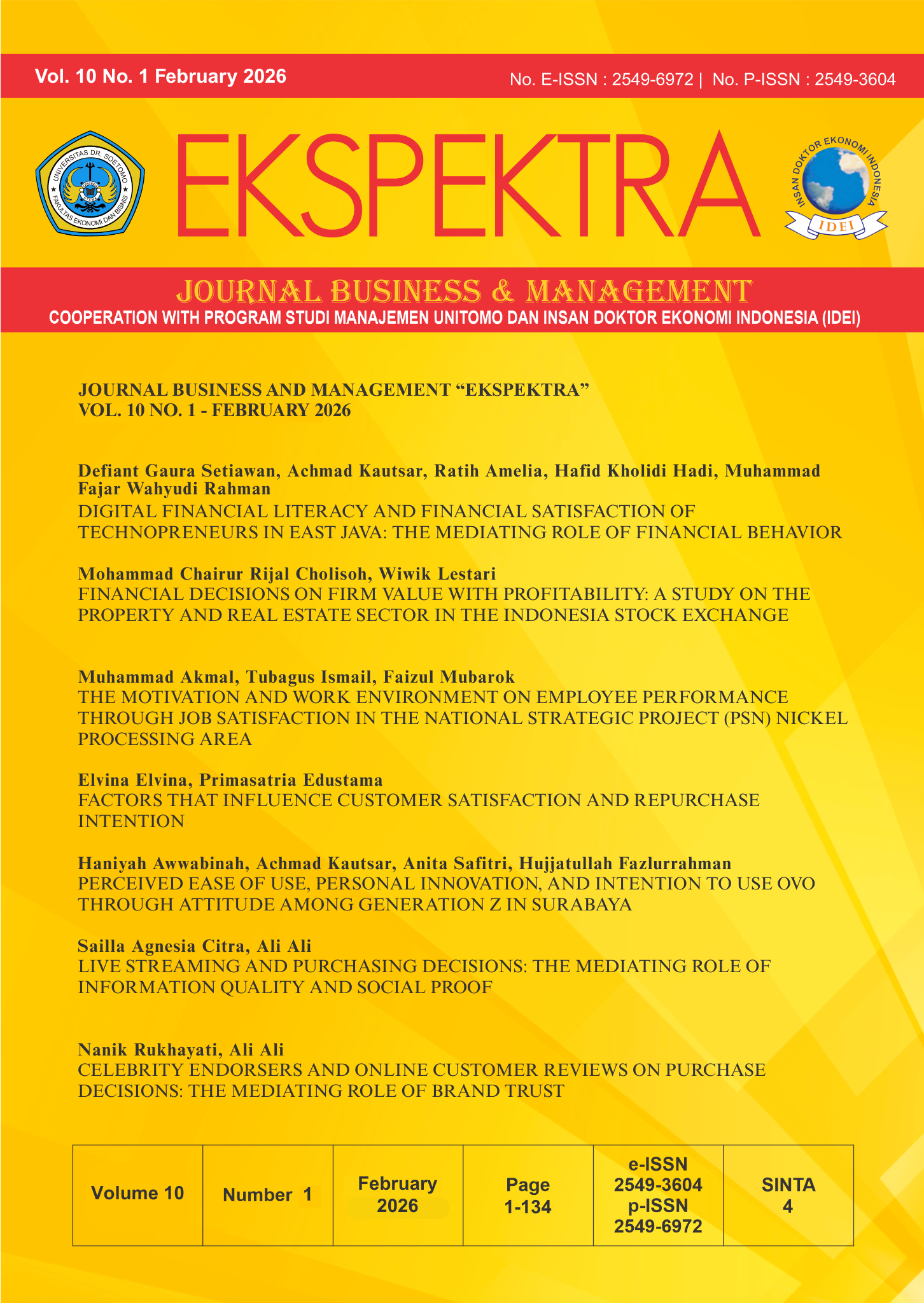
The Motivation and Work Environment on Employee Performance Through Job Satisfaction in The National Strategic Project (PSN) Nickel Processing Area
DOI:
https://doi.org/10.25139/ekt.v10i1.11279Abstract
This study empirically investigates the direct and indirect effects of work motivation, work environment, and job satisfaction on employee performance. The sample consists of 141 personnel assigned to Customs Offices within the National Strategic Project Nickel Processing Area, specifically at Makassar, Kendari, Morowali, and Ternate. Data collection involved direct observation and surveys using structured questionnaires. Partial Least Squares (PLS) analysis was conducted with SMART PLS Software version 4.1.14. The findings indicate that work motivation and the work environment both significantly influence job satisfaction. However, neither work motivation nor the work environment exerts a significant effect on employee performance. In contrast, job satisfaction has a significant positive effect on employee performance. Regarding mediation, job satisfaction does not mediate the relationship between motivation and performance, but it does mediate the relationship between the work environment and performance. These results suggest that organizations should focus on improving physical comfort, fostering social relationships, and enhancing managerial support within the work environment to increase job satisfaction and, consequently, employee performance. Additionally, organizations are advised to systematically review and strengthen reward systems, incentives, and feedback mechanisms to more effectively translate motivation into measurable performance outcomes.
Downloads
Published
Issue
Section
License

Ekspektra : Jurnal Bisnis dan Manajemenis licensed under a Creative Commons Attribution-ShareAlike 4.0 International License.