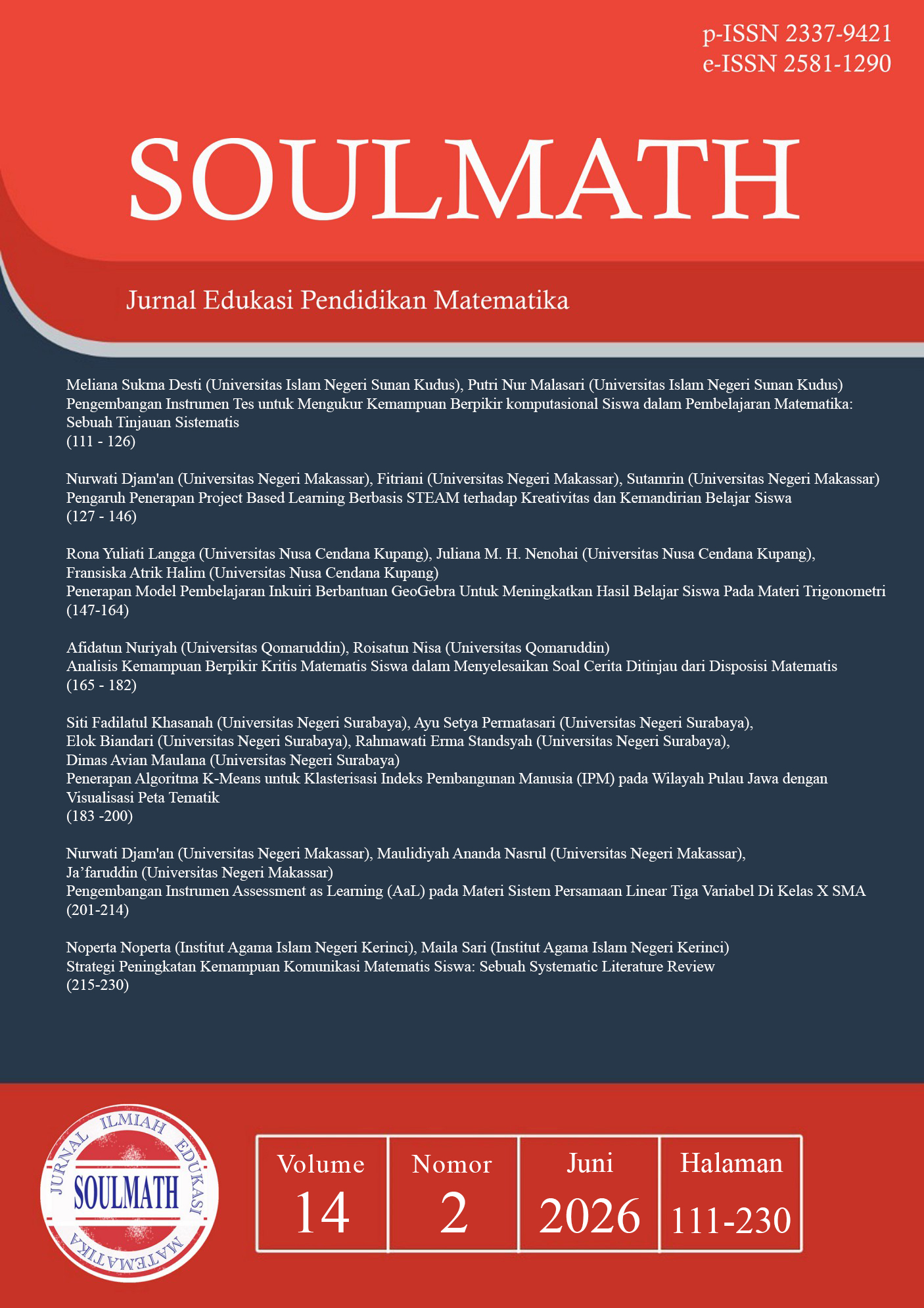
Pengembangan Instrumen Tes untuk Mengukur Kemampuan Berpikir komputasional Siswa dalam Pembelajaran Matematika: Sebuah Tinjauan Sistematis
DOI:
https://doi.org/10.25139/smj.v14i2.11440Abstract
Abstract
The integration of computational thinking (CT) into mathematics is highly strategic due to the cognitive overlap between the two fields. However, the validity and reliability of its measurement instruments remain major challenges. This study aims to map the development of CT test instruments in mathematics through a Systematic Literature Review (SLR) of 8 empirical articles (2021-2025). The novelty of this research lies in the critical analysis of psychometric quality and the characteristics of domain-specific mathematics instruments. The results indicate a dominance of development at the elementary school level (50%). Critical findings reveal significant variations in reliability, where low coefficients (0.27 and 0.33) indicate the limitations of classical statistics in measuring multidimensional CT. The conclusion emphasizes the urgency of shifting to modern psychometric analysis (Rasch/IRT) and expanding instrument development to higher education levels to ensure the continuity of student cognitive measurement from basic to advanced levels.
Keywords: Computational Thinking, Test Instrument, Mathematics Learning, Systematic Literature Review, Assessment.
Abstrak
Integrasi berpikir komputasional (CT) dalam matematika sangat strategis karena adanya tumpang tindih kognitif antara dua bidang. Namun, validitas dan reliabilitas instrumen pengukuran masih menjadi tantangan utama. Penelitian ini bertujuan memetakan pengembangan instrumen tes CT dalam matematika melalui metode Systematic Literature Review (SLR) terhadap 8 artikel empiris (2021-2025). Kebaruan penelitian ini terletak pada analisis kritis kualitas psikometrik dan karakteristik instrumen spesifik domain matematika. Hasil menunjukkan dominasi pengembangan pada jenjang SD (50%). Temuan kritis mengungkap variasi reliabilitas signifikan, di mana koefisien rendah (0,27 dan 0,33) mengindikasikan keterbatasan statistik klasik dalam mengukur CT yang multidimensi. Simpulan menekankan urgensi pergeseran ke analisis psikometrik modern (Rasch/IRT) serta perluasan pengembangan instrumen pada jenjang pendidikan tinggi guna menjamin kesinambungan pengukuran kognitif siswa dari level dasar hingga tinggi.
Kata Kunci: Berpikir komputasional, Instrumen Tes, Pembelajaran Matematika, Systematic Literature Review, Asesmen.
Downloads
References
E. Raziana, H. Wibawanto, U. I. Indonesia, U. S. Maret, and C. Author, “Pedagogical Innovation of Game-Based Learning for 21st Century Skills in Vocational Education : A Systematic Literature Review,” ijolii Indones. J. Learn. Instr. Innov., vol. 3, no. 1, pp. 19–30, 2025, doi: https://journal.uns.ac.id/ijolii Pedagogical.
A. H. Alifah and S. Widodo, “Membuka Kemampuan Computational thinking Sebagai 21 Century Skills Disiplin STEM,” Fakt. J. Ilm. Kependidikan, vol. 12, no. 1, pp. 100–108, 2024, doi: https://doi.org/10.30998/fjik.v11i1.21962.
J. M. Wing, “Computational thinking,” Commun. ACM, vol. 49, no. 3, pp. 33–35, 2006.
C. C. Selby and J. Woollard, “Computational thinking : The Developing Definition,” 2013..
D. Kaya, A. Ö. Yaşar, İ. Çetin, and T. Kutluca, “The Relationship Between the 21st-Century Skills and Computational thinking Skills of Prospective Mathematics and Science Teachers,” J. Pedagog. Res., vol. 9, no. 1, pp. 73–95, 2025, doi: https://doi.org/10.33902/JPR.202531498.
D. Weintrop et al., “Defining Computational thinking for Mathematics and Science Classrooms,” J. Sci. Educ. Technol., vol. 25, no. 1, pp. 127–147, 2016, doi: 10.1007/s10956-015-9581-5.
E. Nurlaelah, A. Pebrianti, M. Taqiyuddin, J. A. Dahlan, and D. Usdiyana, “Improving Mathematical Proof Based on Computational thinking Components for Prospective Teachers in Abstract Algebra Courses,” Infin. J. Math. Educ., vol. 14, no. 1, pp. 85–108, 2025, doi: https://doi.org/10.22460/infinity.v14i1.p85-108.
E. Irawan, R. Rosjanuardi, and S. Prabawanto, “Research Trends of Computational Thinking in Mathematics Learning : A Bibliometric Analysis from 2009 to 2023,” EURASIA J. Math. Sci. Technol. Educ., vol. 20, no. 3, 2024, doi: https://doi.org/10.29333/ejmste/14343
M. P. Listiowati, T. Astuti, and B. Subali, “Effectiveness of Coding in Enhancing Computational Thinking among Elementary School Students : A Literature Review 2020 – 2025 Coding teaching has been introduced since the elementary school ( SD ) level , as conveyed by the Vice President of RI , Gibran,” Edunesia J. Ilm. Pendidik., vol. 6, no. 3, pp. 1766–1784, 2025, doi: https://doi.org/10.51276/edu.v6i3.1299.
J. Bilbao et al., “Analytical Methods and Tools for Evaluating the Development of Computational Thinking Abilities,” Int. J. Educ. Inf. Technol., vol. 19, 2025, doi: 10.46300/9109.2025.19.6.
Ö. Korkmaz and X. Bai, “Adapting Computational Thinking Scale ( CTS ) for Chinese High School Students and Their Thinking Scale Skills Level,” Particip. Educ. Res., vol. 6, no. 1, pp. 10–26, 2019, doi: http://dx.doi.org/10.17275/per.19.2.6.1.
A. Liberati et al., “The PRISMA Statement for Reporting Systematic Reviews and Meta-Analyses of Studies That Evaluate Health Care Interventions : Explanation and Elaboration,” PLoS Med, vol. 6, no. 7, 2009, doi: 10.1371/journal.pmed.1000100.
B. Kitchenham and S. Charters, “Guidelines for performing systematic literature reviews in software engineering,” 2007.
L. Inasari, D. Lidinillah, and A. Prehanto, “Pengembangan Instrumen Tes Computational Thinking Siswa Sekolah Dasar melalui Analisis RASCH Model,” COLLASE (Creative Learn. Students Elem. Educ., vol. 6, no. 1, pp. 102–110, 2023, doi: https://doi.org/10.22460/collase.v1i1.16188.
Z. Zafrullah, S. Hamdi, A. Wahyuni, R. Safitri, R. N. Gunawan, and Y. Istiawanto, “Development of Numerical Literacy Question Instrument based on Computational Thinking for Mathematics Learning,” AL-ISHLAH J. Pendidik., vol. 16, no. 4, pp. 4489–4502, 2024, doi: 10.35445/alishlah.v16i4.5985..
R. N. Haniah and M. Waluyo, “Development of Computational Mathematic Thinking Test Instruments Based On Computerized Based Test,” Mathline J. Mat. dan Pendidik. Mat., vol. 9, no. 3, pp. 675–690, 2024, doi: 10.31943/mathline.v9i3.648.
K. Maksum, N. Afifah, M. Ardiyaningrum, and S. Sukati, “Pengembangan Instrumen Tes Keterampilan Berpikir Komputasi pada Pelajaran Matematika Sekolah Dasar (SD)/Madrasah Ibtida’iyah (MI),” Model. J. Progr. Stud. PGMI, vol. 09, no. 01, pp. 39–53, 2022, [Online]. Available: http://jurnal.stitnualhikmah.ac.id/index.php/modeling/article/view/1038%0Ahttps://www.jurnal.stitnualhikmah.ac.id/index.php/modeling/article/download/1038/708.
A. Novianto, I. L. Il Maknun, N. Y. N. Aliyah, and A. N. Khalifah, “Pengembangan Instrumen Penilaian Computational Thinking pada Pembelajaran Matematika SD,” Kalam Cendekia J. Ilm. Kependidikan, vol. 13, no. 1, 2025, doi: 10.20961/jkc.v13i1.93072.
Munawarah, S. Z. Thalhah, A. D. Angriani, F. Nur, and A. Kusumayanti, “Development of Instrument Test Computational Thinking Skills IJHS/JHS Based RME Approach,” Math. Teaching-Research J., vol. 13, no. 4, pp. 202–220, 2021.
J. Dobgenski, M. E. B. Brito Prado, and A. da F. Garcia Silva, “Development and Validation of Learning Objects Aimed at Mathematical Instructions Based On Computational Thinking,” Int. Electron. J. Math. Educ., vol. 20, no. 2, p. em0812, 2025, doi: 10.29333/iejme/15816.
Y. P. Harti, A. Agustin, L. Sari, and Mukarom, “Model Evaluasi Adaptif Berbasis Computational Thinking untuk Meningkatkan Kompetensi Pedagogik Calon Guru di Era Digital (Studi Kasus Pada Mahasiswa PPG),” Econ. Educ. J., vol. 7, no. 2, pp. 426–442, 2025, doi: 10.33503/education.v7i2.1847.
Shuchi Grover and Roy Pea, “Berpikir komputasional in K–12: A Review of the State of the Field,” Educ. Res., vol. 42, no. 1, pp. 38–43, Jan. 2013, doi: 10.3102/0013189X12463051.
X. Tang, Y. Yin, Q. Lin, R. Hadad, and X. Zhai, “Computers & Education Assessing Computational Thinking : A systematic review of empirical studies,” Comput. Educ., vol. 148, no. December 2019, p. 103798, 2020, doi: 10.1016/j.compedu.2019.103798.
Y. Li, S. Xu, and J. Liu, “Development and Validation of Computational Thinking Assessment of Chinese Elementary School Students,” Pacific Rim Psychol., vol. 15, no. 22, 2021, doi: 10.1177/18344909211010240..
J. Sung, “Assessing young Korean children ’ s Computational Thinking : A validation study of two measurements,” Educ. Inf. Technol., vol. 27, pp. 12969–12997, 2022, doi: 10.1007/s10639-022-11137-x.
S. Bocconi, A. Chioccariello, G. Dettori, A. Ferrari, K. Engelhardt, and Y. Punie, Developing Computational Thinking in Compulsory Education. Luxembourg: Publications Office of the European Union, 2016. doi: 10.2791/792158.
Y. M. Hidayati, B. A. Sukowati, and W. Hastuti, “Kemampuan Berpikir Komputasi pada Pembelajaran Geometri Berbasis Geogebra Ditinjau dari Gaya Kognitif,” Histogram J. Pendidik. Mat., vol. 9, no. 1, pp. 74–89, 2025, doi: http://journal.stkip-andi-matappa.ac.id/index.php/histogram/index.
Downloads
Published
How to Cite
Issue
Section
License

Jurnal Ilmiah Soulmath by http://ejournal.unitomo.ac.id/index.php/mipa is licensed under a Creative Commons Attribution 4.0 International License.Â