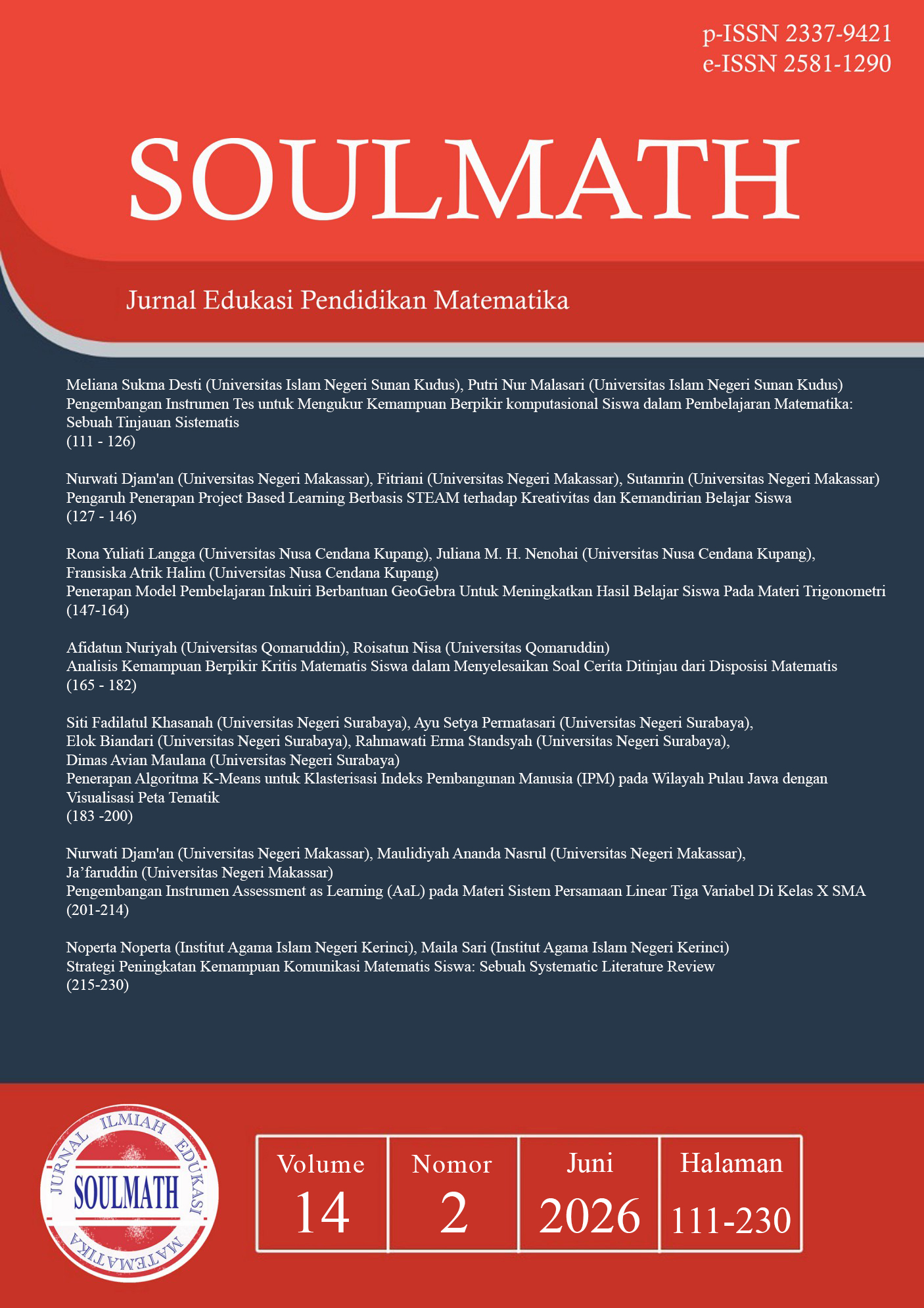
Pengaruh Penerapan Project Based Learning Berbasis STEAM terhadap Kreativitas dan Kemandirian Belajar Siswa
DOI:
https://doi.org/10.25139/smj.v14i2.11573Abstract
Abstract
This study examines the improvement of students’ creativity and learning independence in mathematics through the implementation of a STEAM-based Project-Based Learning (PjBL) model. The study employed a pre-experimental one-group pretest–posttest design involving 26 seventh-grade students of Class VII.A at SMP Negeri 21 Makassar. The research instruments included a creativity test, a learning independence questionnaire, and an observation sheet for learning implementation. Data were analyzed using descriptive statistics and inferential analysis, including normality testing, One-Group Pretest–Posttest, and proportion test. The results showed an increase in both students’ creativity and learning independence after the implementation of the PjBL–STEAM model. Descriptive analysis indicated that the average scores of creativity and learning independence increased from the pretest to the posttest, with classical mastery achieved in both variables. The normalized gain scores were 0.73 for creativity and 0.76 for learning independence, which are categorized as high. Observations also indicated that the implementation of learning activities was carried out effectively. Inferential statistical analysis revealed significant differences between students’ pretest and posttest scores, indicating improvements in both creativity and learning independence after the intervention. Overall, the findings suggest that the implementation of the STEAM-based PjBL model can support the enhancement of students’ creativity and learning independence in mathematics learning.
Keywords: Learning Independence; Creativity; Mathematics; Project Based Learning; STEAM.
Abstrak
Penelitian ini bertujuan untuk mengkaji peningkatan kreativitas dan kemandirian belajar siswa dalam pembelajaran matematika melalui penerapan model Project-Based Learning (PjBL) berbasis STEAM. Penelitian ini menggunakan desain pre-eksperimental one-group pretest–posttest yang melibatkan 26 siswa kelas VII.A SMP Negeri 21 Makassar. Instrumen penelitian yang digunakan meliputi tes kreativitas, angket kemandirian belajar, serta lembar observasi keterlaksanaan pembelajaran. Data dianalisis menggunakan statistik deskriptif dan inferensial yang meliputi uji normalitas, One-Group Pretest–Posttest, dan uji proporsi. Hasil penelitian menunjukkan adanya peningkatan kreativitas dan kemandirian belajar siswa setelah penerapan model PjBL–STEAM. Analisis deskriptif menunjukkan bahwa rata-rata skor kreativitas dan kemandirian belajar meningkat dari pretest ke posttest, serta ketuntasan klasikal pada kedua variabel telah tercapai. Nilai gain ternormalisasi (N-gain) sebesar 0,73 untuk kreativitas dan 0,76 untuk kemandirian belajar termasuk dalam kategori tinggi. Hasil observasi juga menunjukkan bahwa keterlaksanaan aktivitas pembelajaran berlangsung dengan baik. Analisis statistik inferensial menunjukkan adanya perbedaan yang signifikan antara skor pretest dan posttest siswa, yang mengindikasikan adanya peningkatan kreativitas dan kemandirian belajar setelah perlakuan. Secara keseluruhan, temuan penelitian ini menunjukkan bahwa penerapan model Project-Based Learning berbasis STEAM dapat mendukung peningkatan kreativitas dan kemandirian belajar siswa dalam pembelajaran matematika.
Kata Kunci: Kemandirian Belajar; Kreativitas; Matematika; Project Based Learning; STEAM.
Downloads
References
Trilling B, Fadel C. 21st century skills: learning for life in our times. San Francisco (CA): Jossey-Bass; 2009.
Organisation for Economic Co-operation and Development (OECD). The future of education and skills: Education 2030. Paris: OECD Publishing; 2018.
Trilling, B., & Fadel, C. (2009). 21st century skills: Learning for life in our times. Jossey-Bass.
Leikin R, Pitta-Pantazi D. Creativity and mathematics education: the state of the art. ZDM Math Educ. 2013;45(2):159–166.https://doi.org/10.1007/s11858-012-0459-1.
Djam’an N, Asrawati N, Sappaile BI, Sidjara S. Development of a model of creative thinking based on mathematical literacy. World Trans Eng Technol Educ. 2023;21(4):273–279.
Guilford, J. P. (1950). Creativity. American Psychologist, 5(9), 444–454. https://doi.org/10.1037/h0063487.
Runco, M. A., & Acar, S. (2012). Divergent thinking as an indicator of creative potential. Creativity Research Journal, 24(1), 66–75. https://doi.org/10.1080/10400419.2012.652929.
Hendriana H, Rohaeti EE, Sumarmo U. Hard skills dan soft skills matematik siswa. Bandung: Refika Aditama; 2017.
Djam’an N, Nasir NA, Sahid. The impact of the Think-Pair-Share (TPS) cooperative learning model on students’ engagement and mathematics achievement in powers and roots topics. Daya Matematis: J Inov Pendidik Mat. 2025;13(2):105–114. https://ojs.unm.ac.id/JDM/article/view/71975.
Djam’an N. Examining the implementation of environmental education in the STEAM approach for sustainability. Discover Educ. 2025;4:410. https://doi.org/10.1007/s44217-025-00837-4.
Perignat E, Katz-Buonincontro J. STEAM in practice and research: an integrative literature review. Thinking Skills Creat. 2019;31:31–43.
https://doi.org/10.1016/j.tsc.2018.10.002.
Schunk DH, Greene JA, editors. Handbook of self-regulation of learning and performance. 2nd ed. New York (NY): Routledge; 2018.
https://doi.org/10.4324/9781315697048.
Zimmerman BJ. Becoming a self-regulated learner: an overview. Theory Into Practice. 2002;41(2):64–70. https://doi.org/10.1207/s15430421tip4102_2.
Bell S. Project-based learning for the 21st century: skills for the future. Clearing House. 2010;83(2):39–43.https://doi.org/10.1080/00098650903505415.
Djam’an N, Bernard, Sahid. Developing students’ creativity in building city mathematics through project-based learning. J Phys Conf Ser. 2021;1899(1):012147. https://iopscience.iop.org/article/10.1088/1742-6596/1899/1/012147.
Setiawan, W., Juniati, D., & Khabibah, S. (2024). Studi literatur: Berpikir kreatif dalam pemecahan masalah matematika. Jurnal Ilmiah Soulmath: Jurnal Edukasi Pendidikan Matematika, 12(1), 43–54. https://doi.org/10.25139/smj.v12i1.7548.
Munandar, & Utami. (1992). Mengembangkan Bakat dan Kreativitas Anak Sekolah. Jakarta: Gramedia Widiasarana.
Marsidi, M. (2025). The integration of the RBL-STEM learning model and graph theory in solving transportation and logistics optimization problems to enhance students’ computational thinking skills. Jurnal Ilmiah Soulmath: Jurnal Edukasi Pendidikan Matematika, 13(1), 49–66. https://doi.org/10.25139/smj.v13i1.10025.
Djam’an N, Amaliah N, Arwadi F. Pengaruh penerapan model project based learning dengan pendekatan STEM terhadap peningkatan kemampuan berpikir kreatif matematis siswa pada materi bangun ruang sisi lengkung di SMP. Proximal: J Penelit Mat dan Pendidik Mat. 2025;8(4):1009–1020. https://doi.org/10.30605/proximal.v8i4.6716.
Melele V, Ramaboka ME. The design thinking approach to students’ STEAM projects. Procedia CIRP. 2020;91:230–236. https://doi.org/10.1016/j.procir.2020.03.100.
Djam’an N, Talib A, Wahdania A, Arfah A. Development of student activity sheets based on educational principles for sustainable development in mathematics learning. In: Aswi A, et al., editors. Proceedings of the International Conference on Sciences, Technology and Education (ICSTE 2024). Advances in Social Science, Education and Humanities Research. Vol 898. Amsterdam: Atlantis Press; 2024. p. 335–341. doi: 10.2991/978-2-38476-335-1_7.
Downloads
Published
How to Cite
Issue
Section
License

Jurnal Ilmiah Soulmath by http://ejournal.unitomo.ac.id/index.php/mipa is licensed under a Creative Commons Attribution 4.0 International License.Â