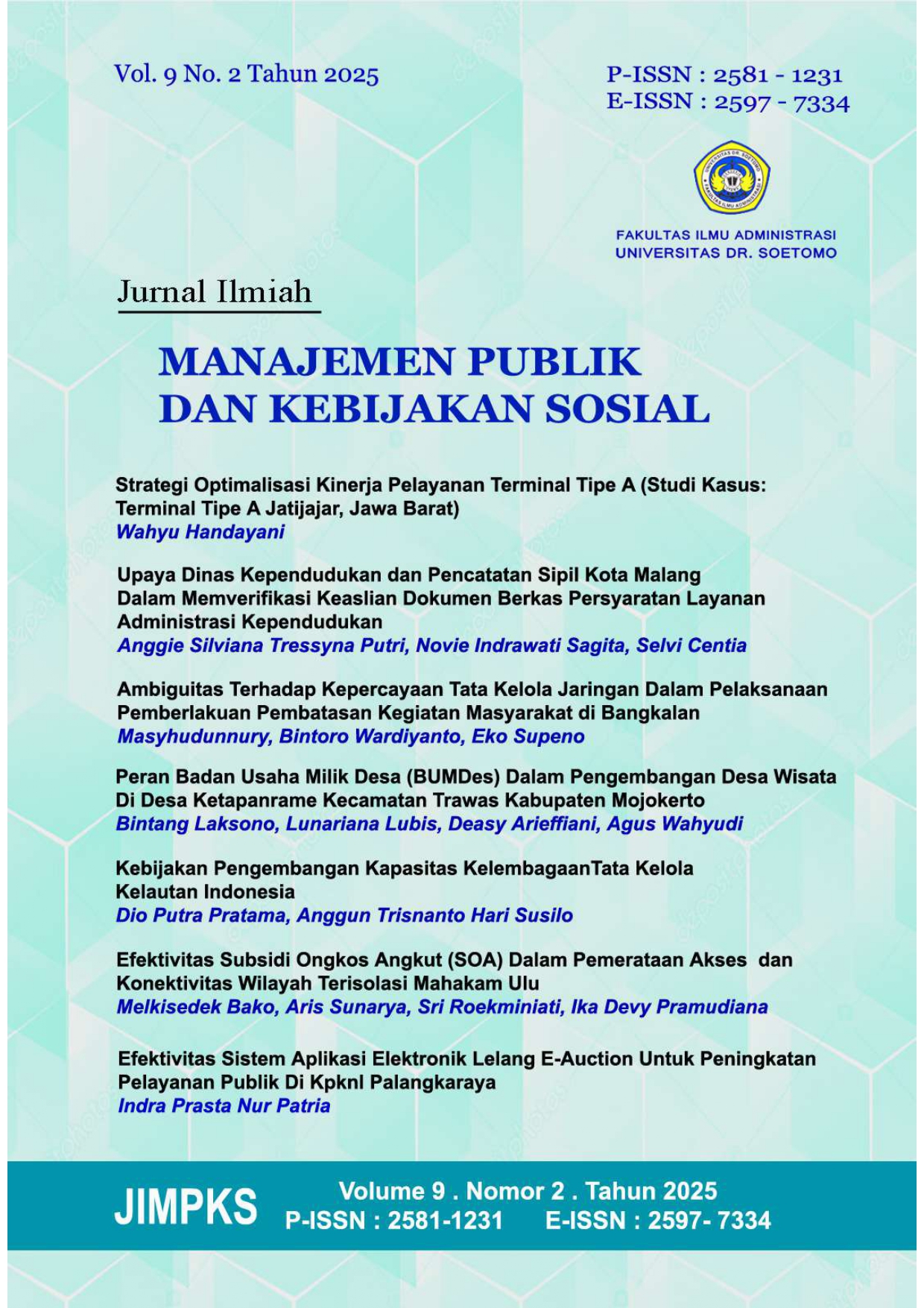
Ambiguitas Terhadap Kepercayaan Tata Kelola Jaringan Dalam Pelaksanaan Pemberlakuan Pembatasan Kegiatan Masyarakat di Bangkalan
DOI:
https://doi.org/10.25139/jmnegara.v9i2.10890Keywords:
Governance Networks, Trust Ambiguity, PPKM, Patron-Client, Social CapitalAbstract
This research purposes to identify the governance network structure, explain the impact of trust ambiguity on policy implementation, and integrate patron-client theory and religious social capital into the governance network concept. A qualitative case study approach was used, combining in-depth interviews with 11 informants (officials, kyai, community members), analysis of 37 policy documents (ministerial instructions, regent's decrees, Covid-19 task force reports), and field observations. The findings indicate an asymmetric governance network structure: the government holds legal legitimacy, while kyai control religious-based social capital. Collaborative governance was successful during the Micro PPKM (February–June 2021) through a jurisdiction-based strategic model, as evidenced by the decline in Covid-19 cases. However, the Emergency PPKM (July 2021) sparked mass resistance due to clashes between policy norms and the Bhuppa 'Bhebbu' Guruh Ratoh hierarchy, where mosque closures conflicted with religious values. The ambiguity of trust manifested itself in higher compliance with kyai (Islamic clerics) directives compared to government regulations, particularly during Eid al-Adha 2021. Its novelty lies in the integration of patron-client theory and religious social capital into governance network analysis, highlighting how dual authority and local wisdom shape policy effectiveness. Theoretically, this enriches the governance network literature by emphasizing cultural governance in hierarchical-religious societies. Policy recommendations include harmonizing health protocols with religious needs and establishing mediation forums based on local norms.
References
Anisa Pratiwi, Ari Setiawan, YRH (2021). The Influence of the Emergency PPKM Policy from July 3-20, 2021, on the Formation of Public Opinion. Dialectics of Communication: Journal of Communication and Regional Development Studies , 9 (2), 34–61. https://doi.org/10.33592/dk.v9i2.1568 .
Coleman, J. S. (1988). Social Capital in the Creation of Human Capital Author. The American Journal of Sociology , 94 (Supplement), S95–S120. https://faculty.washington.edu/matsueda/courses/587/readings/Coleman 1988.pdf.
Furqan, H., Sinaga, TF, & Nugraha, JR (2021). Community Participation in the Implementation of Emergency PPKM in Garut Regency. Journal of Government and Public Security (JP and KP) , 3 (2), 80–88. https://doi.org/10.33701/jpkp.v3i2.2025 .
Galluccio, C. (2018). Trust in the Market: Institutions versus Social Capital. Open Journal of Political Science , 08 (02), 95–107. https://doi.org/10.4236/ojps.2018.82008 .
Graaf, ND De. (2014). Modernization and Postmodernization: Cultural, Economic and Political Change in 43 Societies by Ronald Inglehart Review by: Nan Dirk De Graaf. The British Journal of Sociology , 49 (4), 674–675.
Hanifah, L., & Kholifah, SK (2020). Empowering Women in Facing the Impact of the Covid-19 Pandemic Through Family Financial Management Training in Langkap Village, Burneh District, Bangkalan Regency. Abdidas Journal , 1 (6), 777–783. https://doi.org/10.31004/abdidas.v1i6.173 .
Hefni, M. (2013). Bhuppa'-Bhâbhu'-Ghuru-Rato (A Constructivist-Structuralist Study of the Hierarchy of Obedience in Madurese Culture). KARSA: Journal of Social and Islamic Culture , XXI ( 1). https://media.neliti.com/media/publications/145581-ID-bhuppa-bhabhu-ghuru-rato-studi-konstrukt.pdf .
Huxham, C., & Vangen, S. (1996a). Working together: Key themes in the management of. International Journal of Public Sector Management , 9 (7), 5–17.
Ikmal, NM, & Noor, M. (2021). Indonesian Government Policy in Handling Covid-19. Central Java Provincial Research and Development Journal , 19 (2), 155–167. https://doi.org/10.36762/jurnaljateng.v19i2.910 .
Ishaq Abdussalam. (2015). Reproduction of Kyai and Blater Power in Bangkalan Regency. DIMENSION - Scientific Journal of Trunojoyo University, Madura , 8 (1), 32. https://doi.org/https://doi.org/10.21107/djs.v8i1.3723 .
Julia Dian Christiani Adi Santoso, Joewen Sarliency Manafe, Dayu Triana Rahmawati, Sheila Maryam Gautama, & Azimatul Karimah. (2023). Training for Mental Health Volunteers of People Living with Schizophrenia in the COVID-19 Pandemic in Bangkalan City. Surabaya Journal of Psychiatry , 12 (2), 140–148. https://doi.org/10.20473/jps.v12i2.42008 .
Khairiyah, A. (2022). The Policy of Enforcing Restrictions on Community Activities (PPKM) Viewed from the Perspective of International Law and Legal Politics in Controlling the Spread of Covid-19 in Indonesia. Jurnal Hukum Lex Generalis , 3 (1), 1–16. https://doi.org/10.56370/jhlg.v3i1.172 .
Laksana, MW (2021). The Emergency PPKM Crisis in Java: How Governors Communicate It Through Instagram. Ministrate: Journal of Bureaucracy and Regional Government , 3 (3), 27–38. https://doi.org/10.15575/jbpd.v3i3.14586 ..
Downloads
Published
How to Cite
Issue
Section
License
Authors who publish with JIMPKS: Jurnal Ilmiah Manajemen Publik dan Kebijakan Sosial agree to the following terms:
-
Authors retain copyright and grant the journal right of first publication with the work simultaneously licensed under a Creative Commons Attribution License (CC BY-SA 4.0) that allows others to share the work with an acknowledgment of the work's authorship and initial publication in this journal.
-
Authors are able to enter into separate, additional contractual arrangements for the non-exclusive distribution of the journal's published version of the work (e.g., post it to an institutional repository or publish it in a book), with an acknowledgment of its initial publication in this journal.
-
Authors are permitted and encouraged to post their work online (e.g., in institutional repositories or on their website) prior to and during the submission process, as it can lead to productive exchanges, as well as earlier and greater citation of published work.